
-
Guildford Jazz Club, Guildford

(c’82-08) The Guildford Jazz Club was held at The Stoke Hotel, Guildford and subsequently monikered Jazz at the Stoke for it’s first 5 years. The monthly gigs and club were run by husband and wife duo Colin and Heather Tipton, and it is believed that Bill Bruford met Django Bates and Iain Ballamy at the Guildford Jazz Club, going on to form Earthworks.
In October ’84 the club’s house band consisted of Martin Drew, John Critchinson, Dick Morrisey, Jim Mullen, and Ron Mathewson. They were joined by Iain Ballamy on 14 and 28 October ’84; and held their own on 24 October. On 24 April ’85 the Clark Tracey CT3+2 performed at The Stoke Hotel. The following year, British jazz saxophonist Art Theman, who’d featured in Channel 4’s documentary ‘Hoarded Dreams’ the year before, was supported by The Waite/Wickens Trio on 24 February ’86. A month later, on 28 March, the club held a Good Friday special featuring Meantime, previously known as Morrisey / Mullen; this was followed by the Cliff Burchell Simkins Quartet on the 25 April ’86.
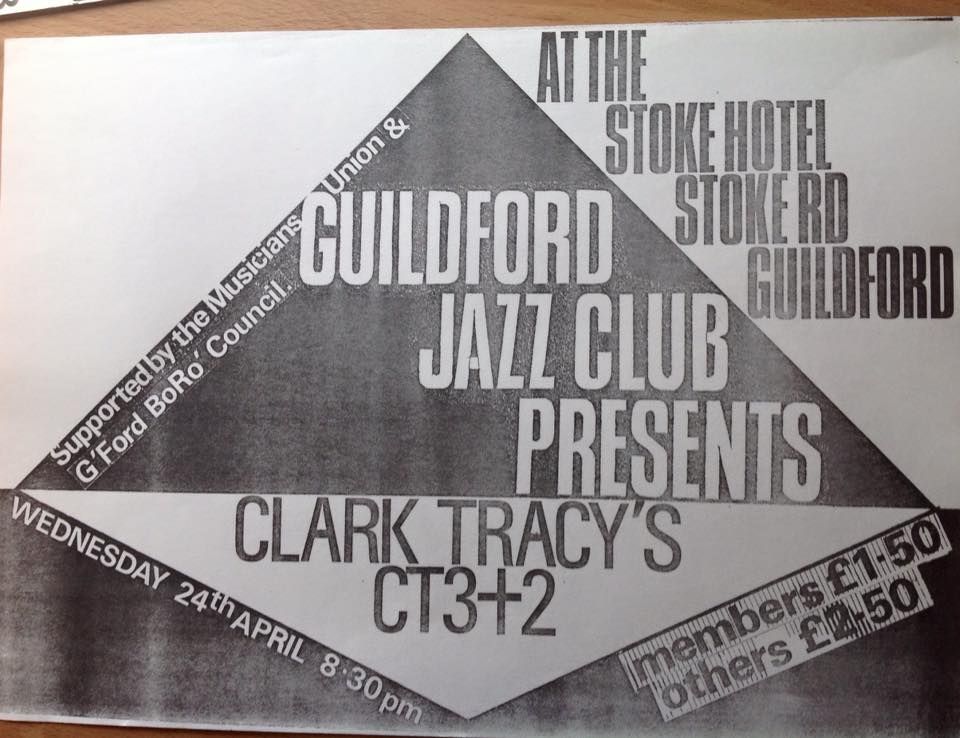
24 April 1985: Clark Tracey’s CT3 + 2. Source: Heather Tipton’s post in Guildford Town Past & Present After about 5 years at the Stoke Hole, it moved to the bar at Guildford Civic Hall. On 10 February ’88, New York based singer Joe Lee Wilson was accompanied a Touch of the Blues, formed by Terry Seabrook (piano), Ron Parry (drums), Adrian Kendon (bass), Geoff Hearns (tenor sax), and Stevie Smith (harmonica). The following month, after not visiting the club for over two years, Guildford’s Iain Ballamy was joined on stage by the Geoff Rideout/Mark Ballamy Quartet. The Siger Band entertained club members on 14 April ’88, and The Jim Mullen Quartet followed suit on 4 May. In 1 June that year Julian and Steve Argüelles, both members of Loose Tubes at the time, formed The Julian Argüelles Quartet with Steve Watts and a pianist for a show in Guildford Civic Hall’s bar room. The club kicked off The Guildford Festival in ’88 with a performance by The Ronnie Scott Quartet on 13 July, followed two days later by ex-The Animals’ Alan Price Band on 15 July.

The Tina May Quartet palyed the Guildford Jazz Club on 3 April 1997. Source: Heather Tipton’s post in Guildford Town Past & Present The club moved to The Electric Theatre and starting using the Jazz at The Electric moniker. The Tina May Quartet played on 3 April 1997 and on 20 March 2001 the Clark Tracey Sextet – CT6 no less – dropped in. Here, at The Electric Theatre, it continued to programme live jazz gigs until 2008.
The Jazz Club was resurrected by Marianne Windham in 2012 with monthly jazz nights at The Freeholders pub in nearby Farncombe. When the pub changed hands in the Spring of 2014 the club moved to the Pavilion of the Guildford Rugby Club. Since 2012, Windham has also put on a monthly Jazz Cafe night at The Electric Theatre. Since its re-inception, Guildford Jazz has welcomed over 1700 musicians and 32,000 music lovers to a total of nearly 450 events.
Colin Tipton, who succumb to decades-long battle with MS in late November 2012, was a lecturer of political sociology at the University of Surrey. Heather Tipton is a former associate lecturer in Sociology at the University of Surrey, was a Labour Councillor for Stoke Ward for 13 years and a local artist. Windham is a professional jazz bassist.
Gallery:
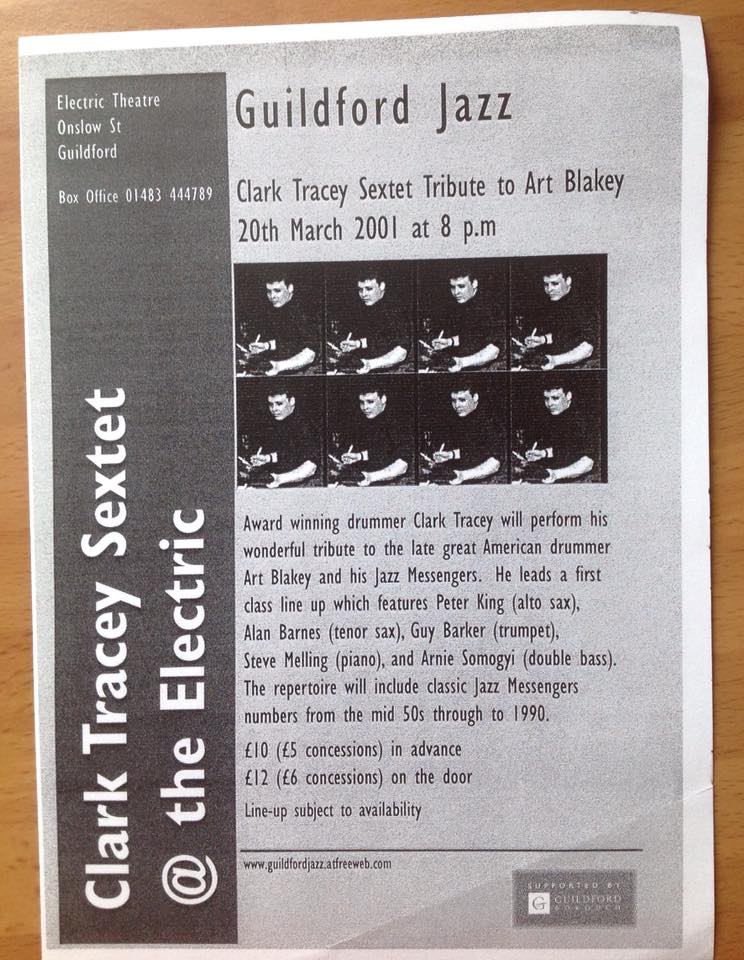
20 March 2001 and the Clark Tracey Sextet played Guildford Jazz Club. Source: Heather Tipton’s post in Guildford Town Past & Present 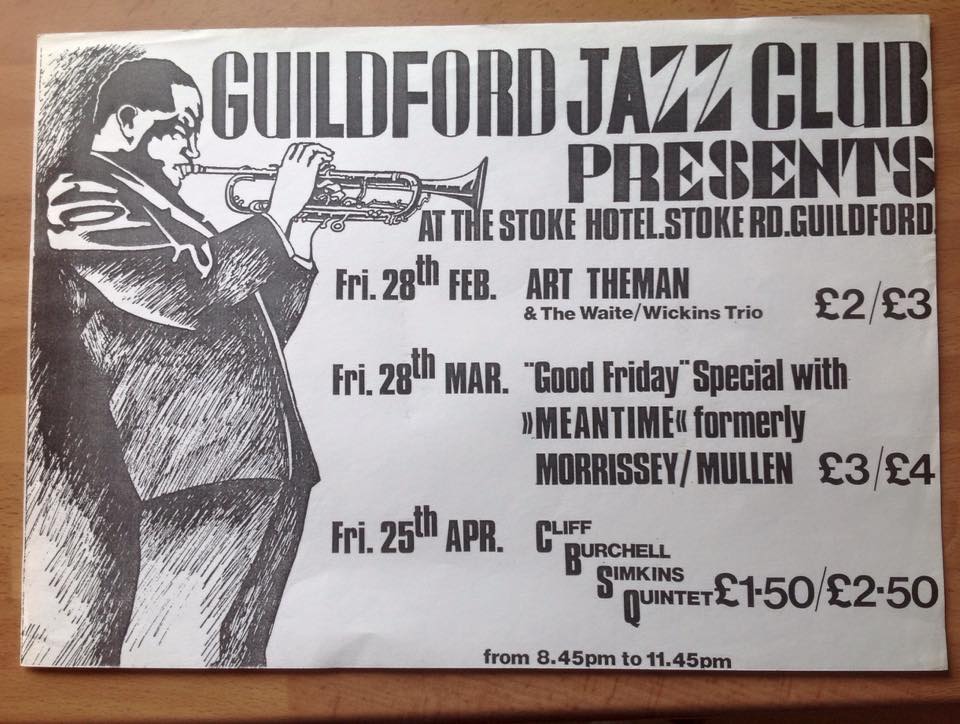
Source: Heather Tipton’s post in Guildford Town Past & Present 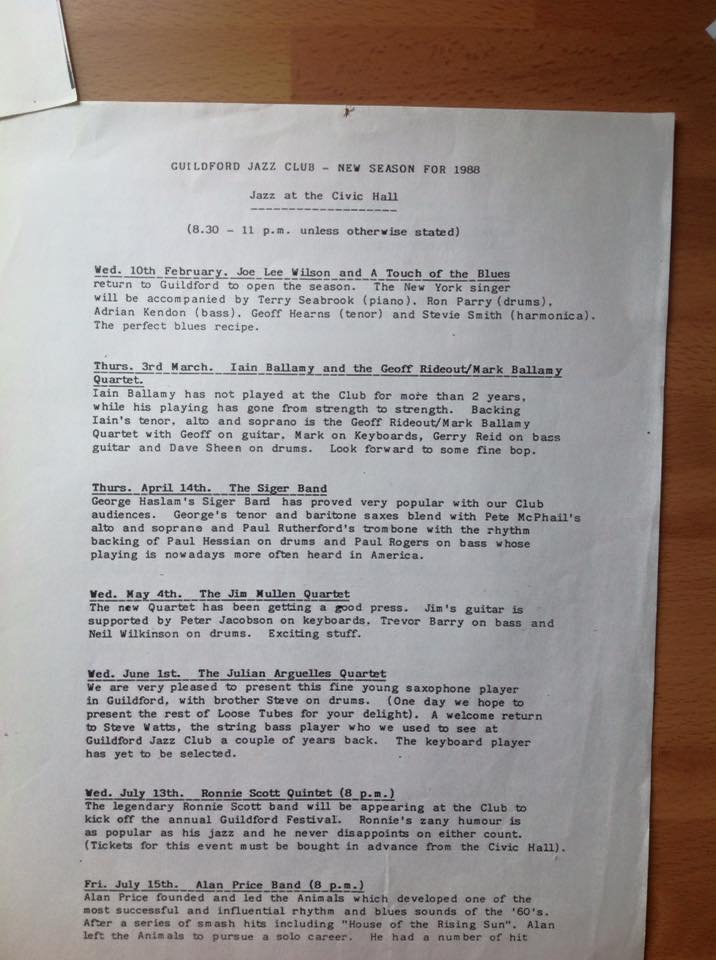
February to July 1988’s Jazz at the Civic Hall season. Source: Heather Tipton’s post in Guildford Town Past & Present 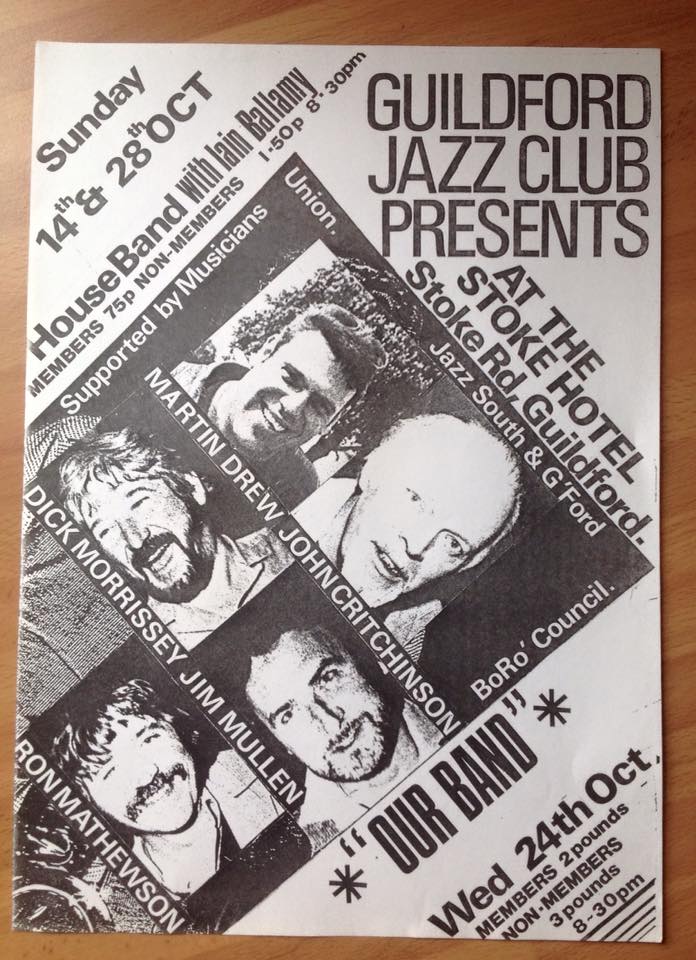
Source: Heather Tipton’s post in Guildford Town Past & Present Adrian Kendon, Alan Price, Alan Price Band, Art Theman, Bill Bruford, Channel 4, Civic hall, Clark Tracey CT3+2, Clark Tracey Sextet, Cliff Burchell Simkins Quartet, Colin Tipton, Dick Morrisey, Django Bates, Earthworks, Farncombe, Geoff Hearns, Geoff Rideout/Mark Ballamy Quartet, Guildford, Guildford Jazz, Guildford Jazz Club, Guildford Rugby Club, Heather Tipton, Iain Ballamy, Jazz at The Electric, Jazz at the Stoke, Jazz Cafe, Jim Mullen, Joe Lee Wilson, John Critchinson, Julian Argüelles, Loose Tubes, Marianne Windham, Martin Drew, Meantime, Morrisey / Mullen, Ron Mathewson, Ron Parry, Steve Argüelles, Steve Watts, Stevie Smith, Stoke Hole, Terry Seabrook, The Animals, The Electric Theatre, The Freeholders, The Guildford Festival, The Jim Mullen Quartet, The Julian Argüelles Quartet, The Ronnie Scott Quartet, The Siger Band, The Stoke Hotel, The Tina May Quartet, The Waite/Wickens Trio, Touch of the Blues -
Disruptive Patterns

(c’78-’81) Andy McInnes (vocals), Simon Raymonde (bass), Simon Godfrey (drums), Paul Cummins (guitar), and Adam Peters (keyboards).
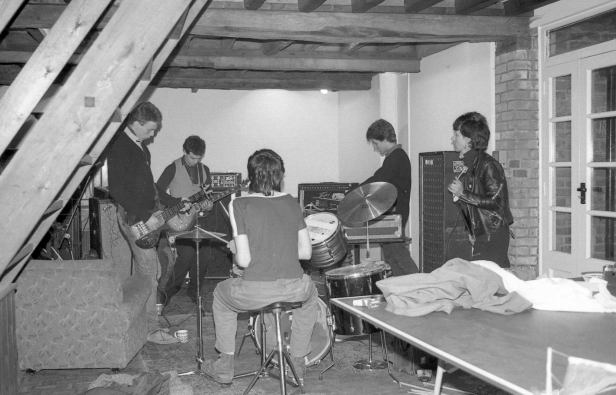
Disruptive Patterns rehearsing at The Manor. Picture courtesy of Fred Pipes The band was initiated by Peters with Cummins and then Raymonde. Their first gig was at a Prior’s Field, the all-girls school in Godalming playing Sex Pistols covers. McInnes joined and Godfrey became the drummer. The band would often rehearse at The Manor, Tuesley Lane, Godalming; the home of Peter’s then girlfriend, Janet Astor – she now lives at Goodwood House and is the current Duchess of Richmond.

21 July 1980: Disruptive Patterns supported by Consenting Adults played The Wooden Bridge, Guildford. This new wave group are recalled for a song with the chorus refrain of “pleasure never hurt anyone”, which may have also been the name of the song. They gigged locally at venues such as The Wooden Bridge, Guildford; appearing there on 21 July ’80 supported by Consenting Adults. Late 1980 saw the band perform a demonstration gig at The Garden for record companies, at which an A&R man showed interest. There were also rumours of a German tour in early ’81.
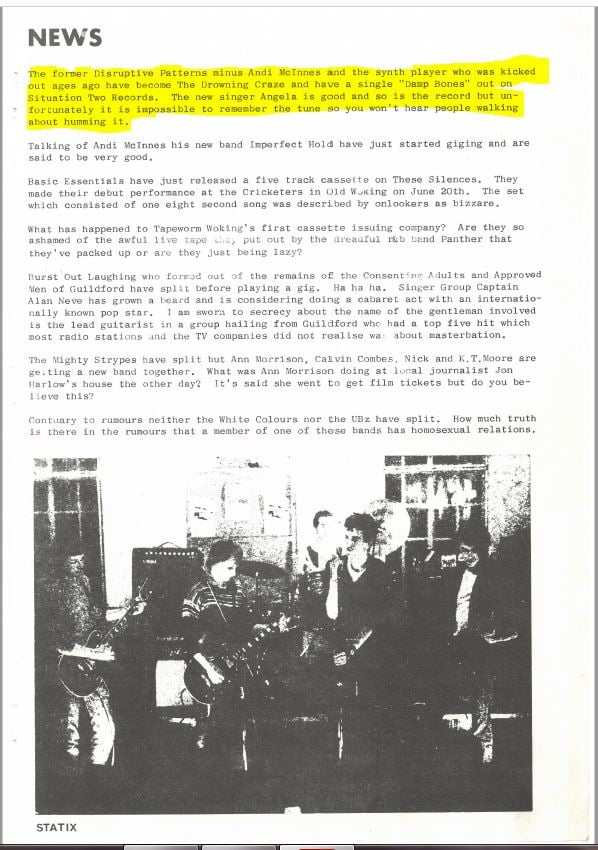
In late ’81 McInnes was replaced by American Angela Jaeger (vocals) who was brought in to front the group, which also changed its name to Drowning Craze. Both changes possibly instigated by indie label Situation Two with whom the group had signed a record deal.
Raymonde went on to become a Cocteau Twin and now owns / runs the Bella Union label. McInnes went on to join Imperfect Hold and Peters joined Displayed.
Tracks:
Gallery:

Short piece from the Bitch Bitch fanzine on reformation of Disruptive Patterns as Drowning Craze. Picture courtesy of John Hudson 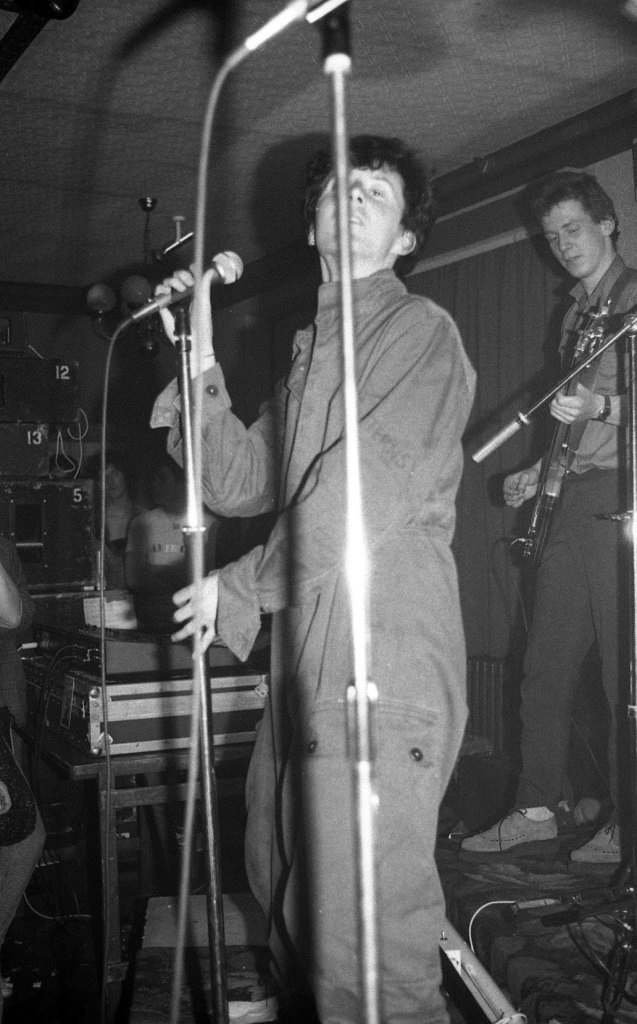
Disruptive Patterns c’80 at The Wooden Bridge, Guildford. Picture courtesy of Fred Pipes 
Disruptive Patterns c’80 at The Wooden Bridge, Guildford. Picture courtesy of Fred Pipes 
Disruptive Patterns c’80 at The Wooden Bridge, Guildford. Picture courtesy of Fred Pipes 
Disruptive Patterns c’80 at The Wooden Bridge, Guildford. Picture courtesy of Fred Pipes 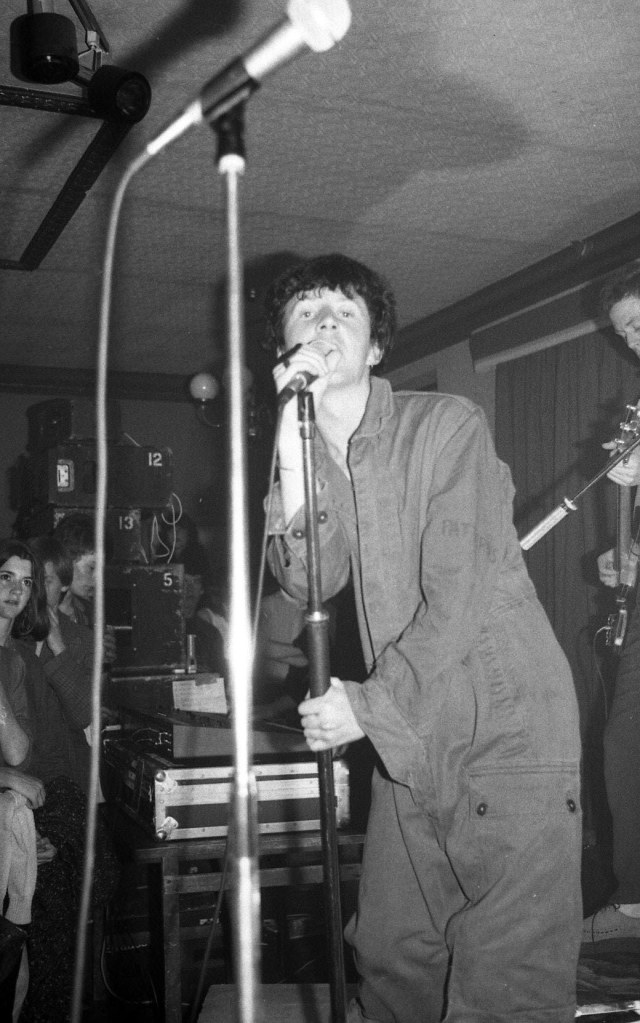
Disruptive Patterns c’80 at The Wooden Bridge, Guildford. Picture courtesy of Fred Pipes 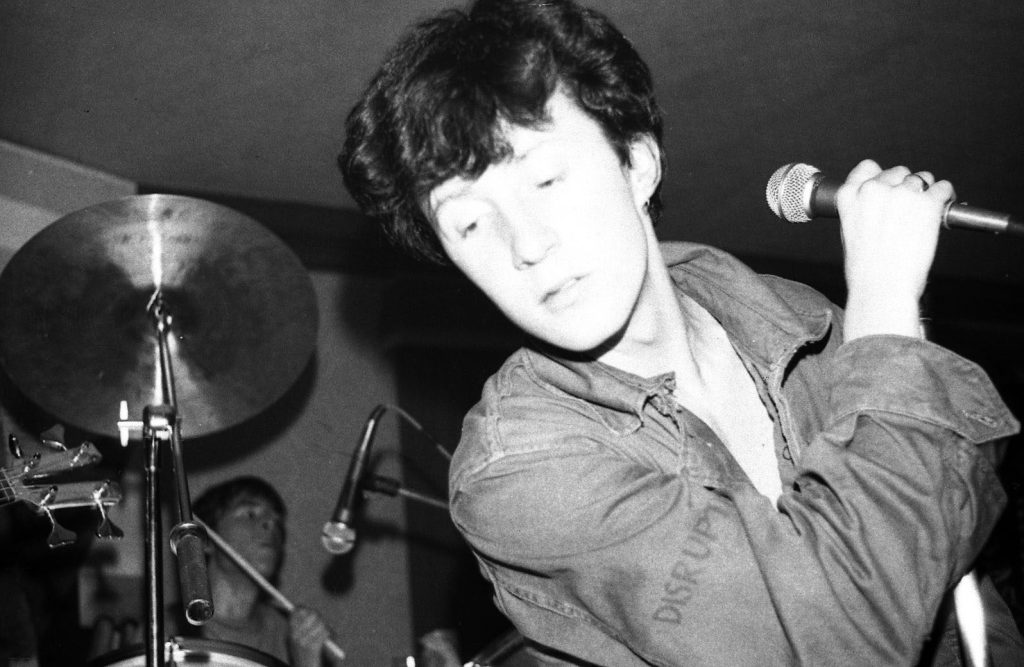
Disruptive Patterns c’80 at The Wooden Bridge, Guildford. Picture courtesy of Fred Pipes 
Disruptive Patterns rehearsing at The Manor. Picture courtesy of Fred Pipes 
Disruptive Patterns rehearsing at The Manor. Picture courtesy of Fred Pipes 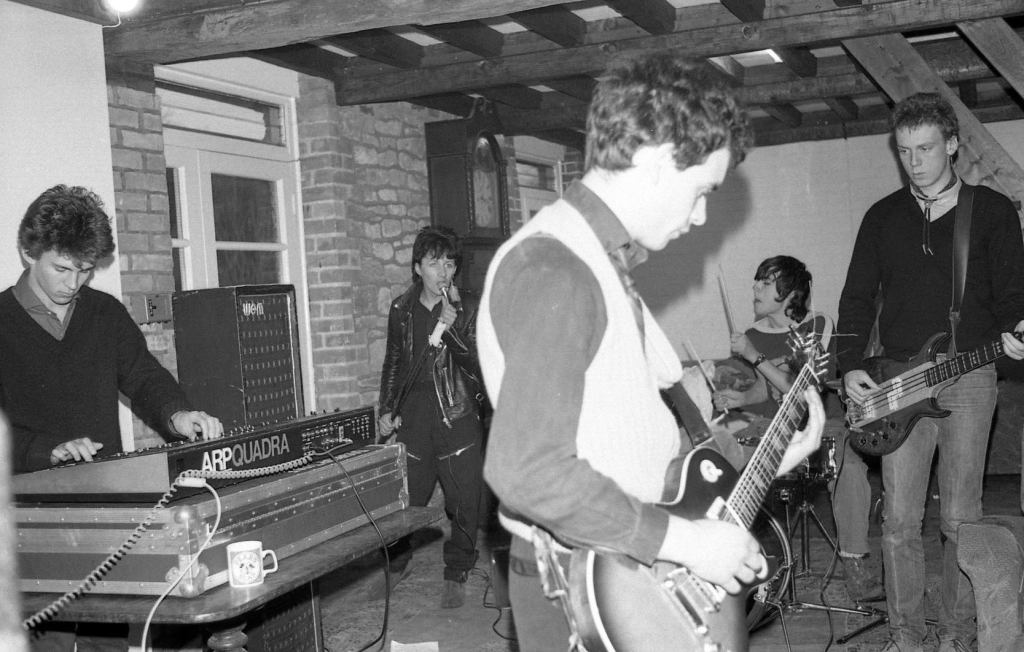
Disruptive Patterns rehearsing at The Manor. Picture courtesy of Fred Pipes 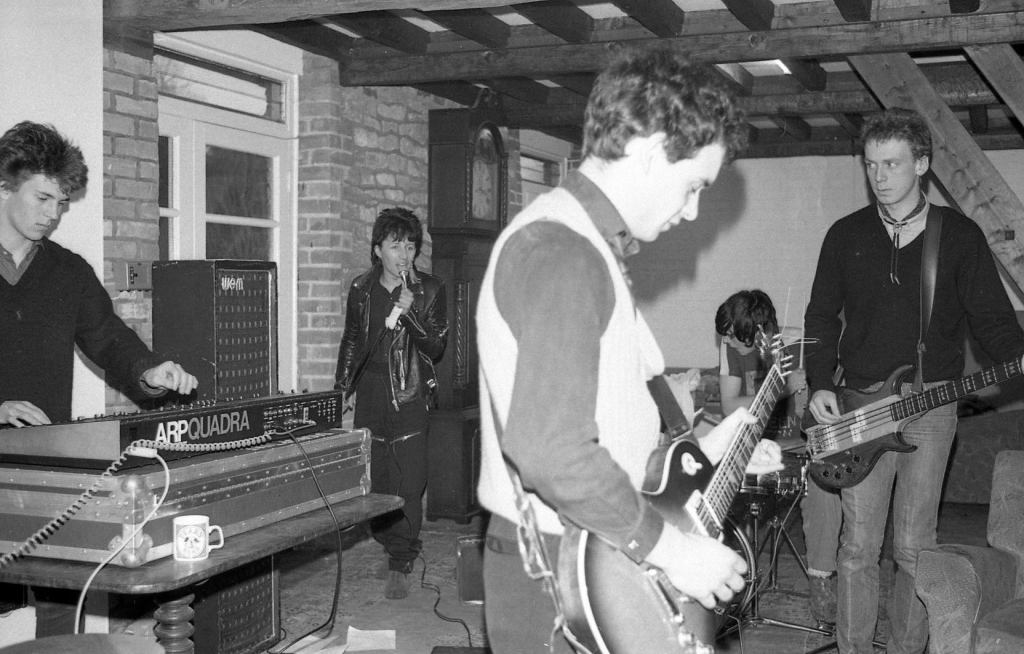
Disruptive Patterns rehearsing at The Manor. Picture courtesy of Fred Pipes 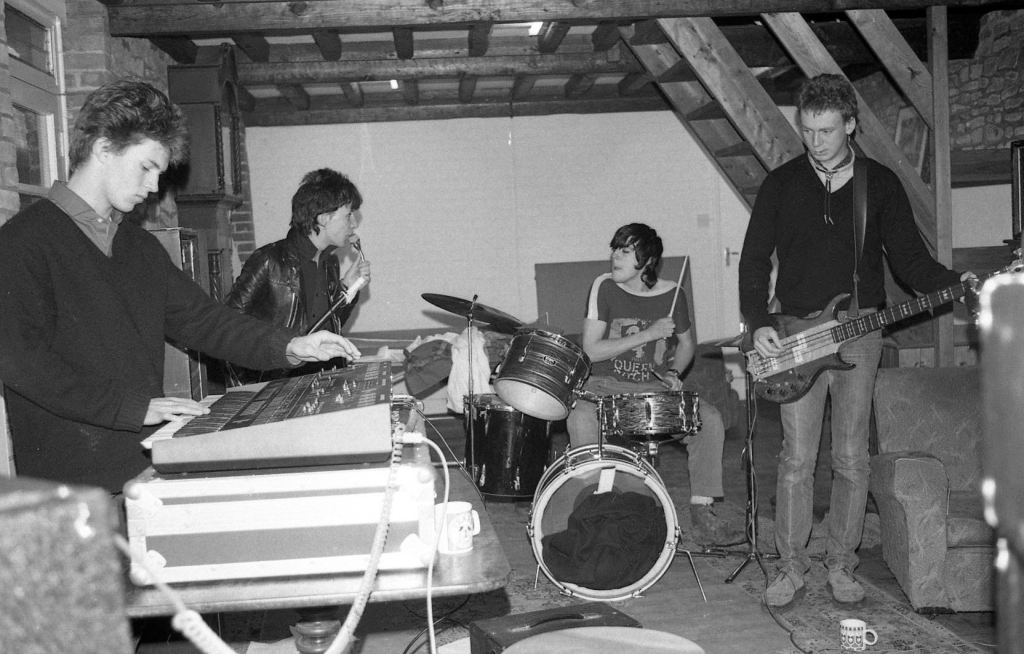
Disruptive Patterns rehearsing at The Manor. Picture courtesy of Fred Pipes 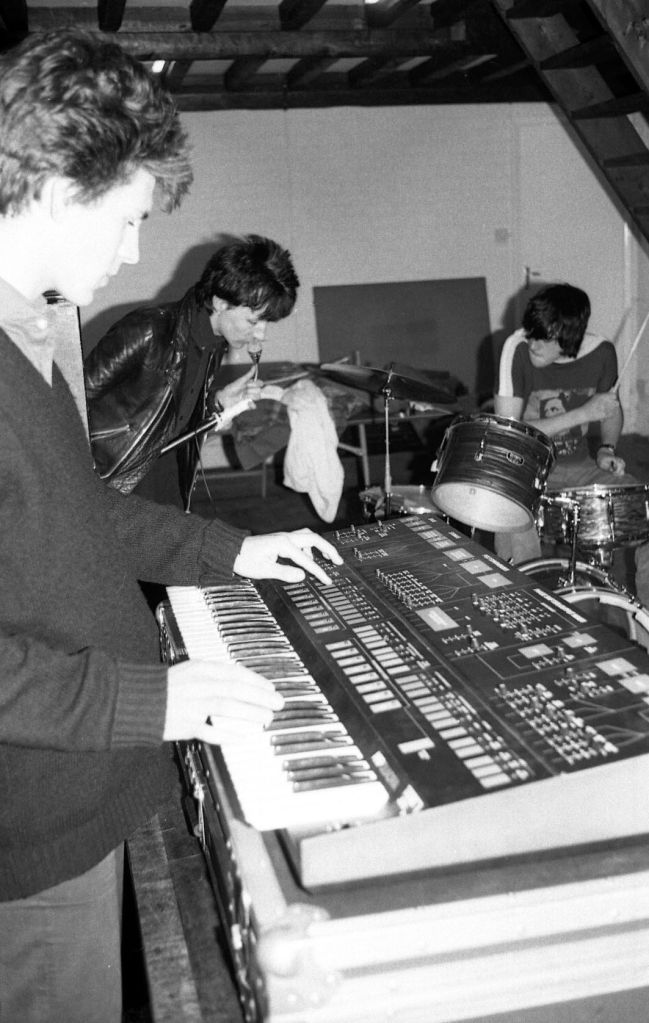
Disruptive Patterns rehearsing at The Manor. Picture courtesy of Fred Pipes 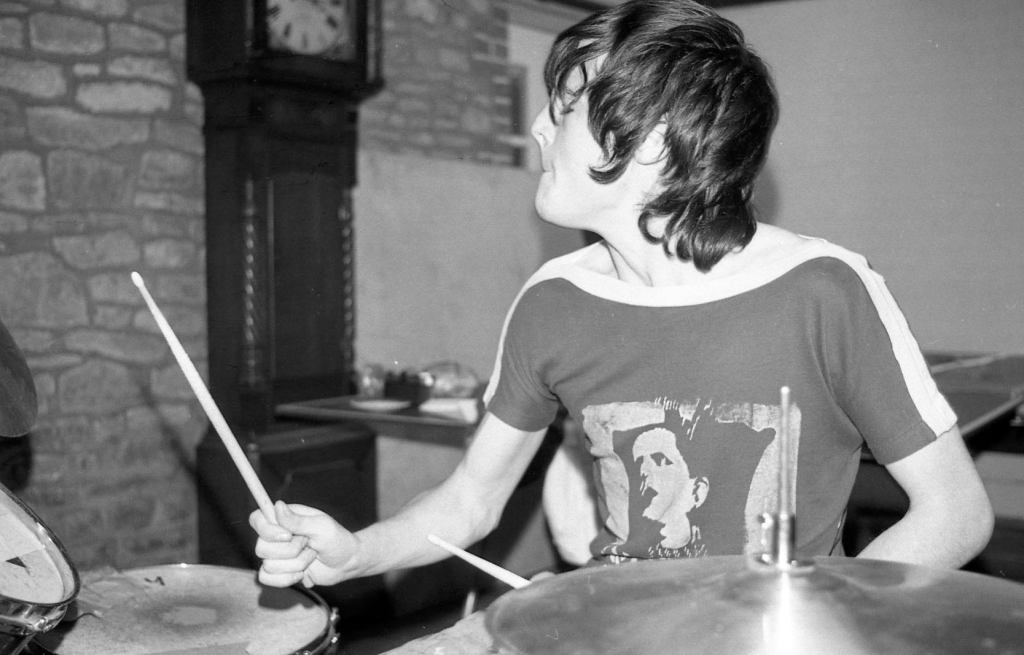
Disruptive Patterns rehearsing at The Manor. Picture courtesy of Fred Pipes 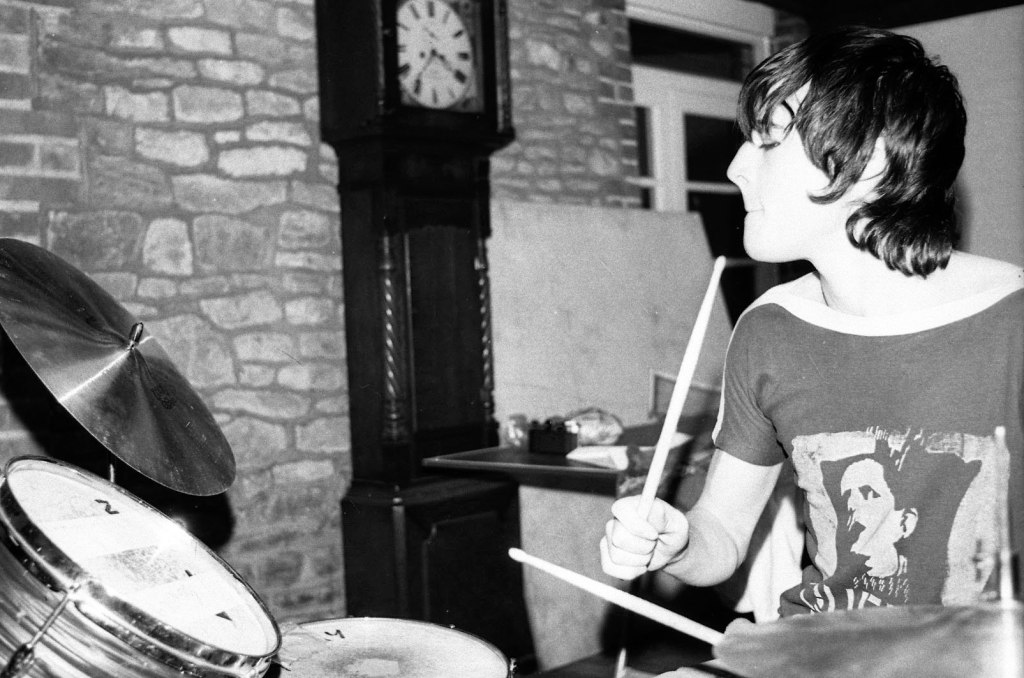
Disruptive Patterns rehearsing at The Manor. Picture courtesy of Fred Pipes 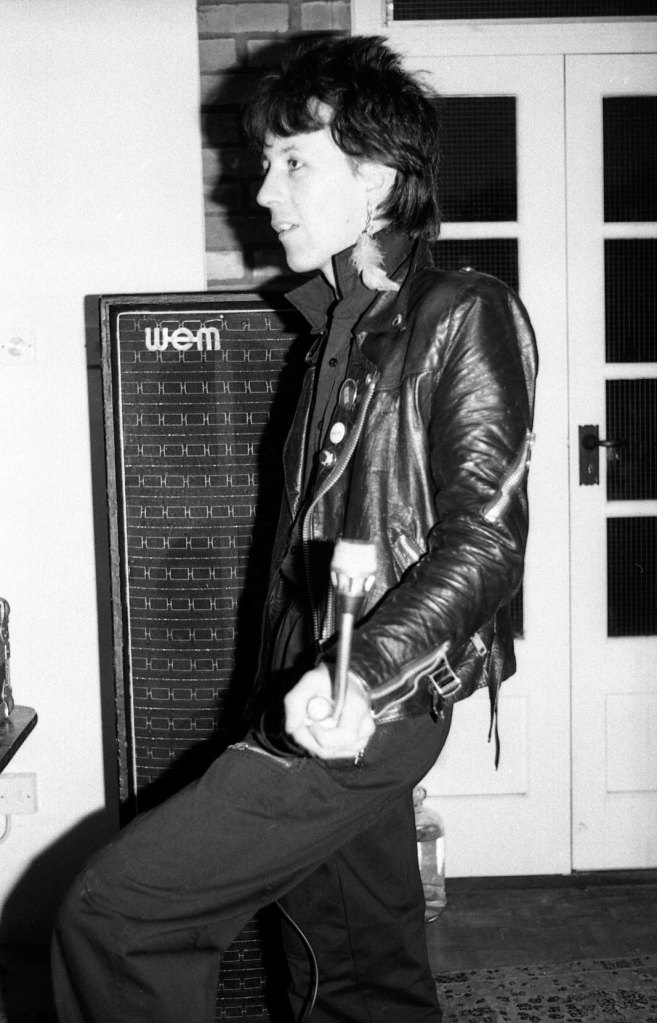
Disruptive Patterns rehearsing at The Manor. Picture courtesy of Fred Pipes 
Disruptive Patterns rehearsing at The Manor. Picture courtesy of Fred Pipes 
Disruptive Patterns rehearsing at The Manor. Picture courtesy of Fred Pipes 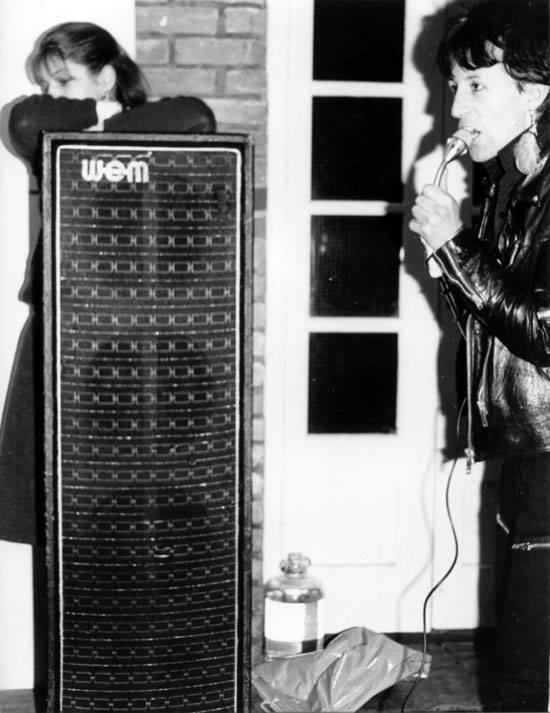
Disruptive Patterns rehearsing at The Manor. Picture courtesy of Fred Pipes 
Disruptive Patterns rehearsing at The Manor. Picture courtesy of Fred Pipes 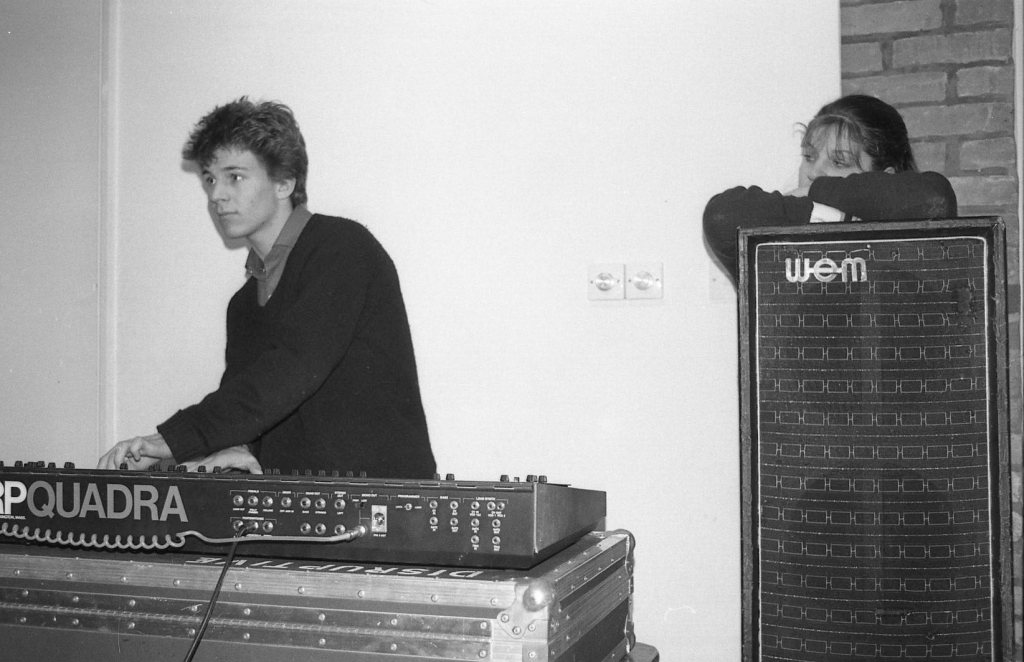
Disruptive Patterns rehearsing at The Manor. Picture courtesy of Fred Pipes 
Disruptive Patterns rehearsing at The Manor. Picture courtesy of Fred Pipes 
Disruptive Patterns rehearsing at The Manor. Picture courtesy of Fred Pipes 
Disruptive Patterns rehearsing at The Manor. Picture courtesy of Fred Pipes 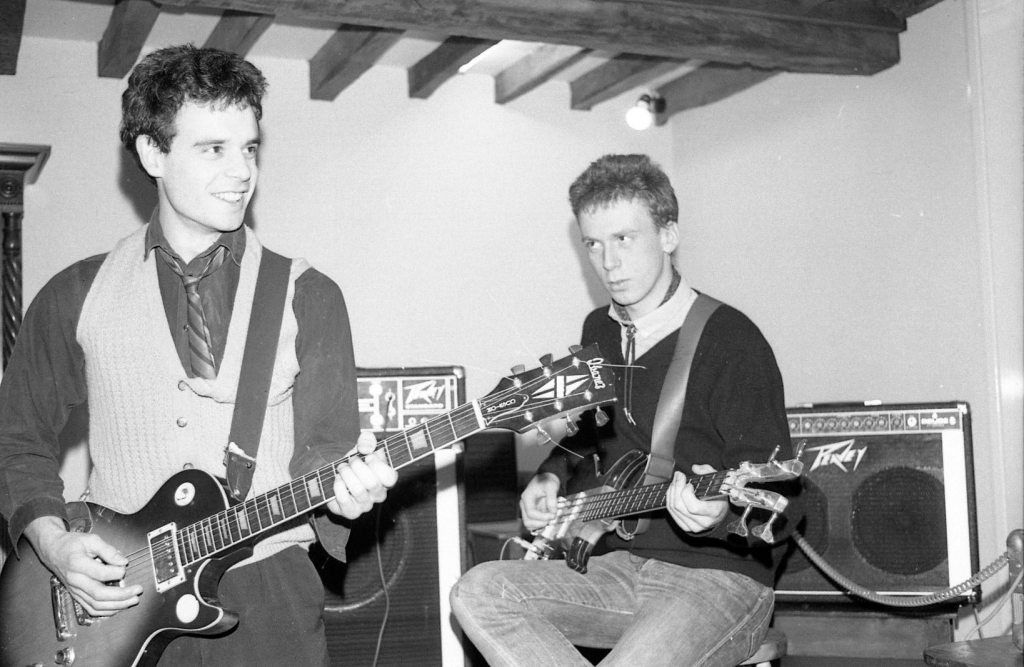
Disruptive Patterns rehearsing at The Manor. Picture courtesy of Fred Pipes 
Disruptive Patterns rehearsing at The Manor. Picture courtesy of Fred Pipes 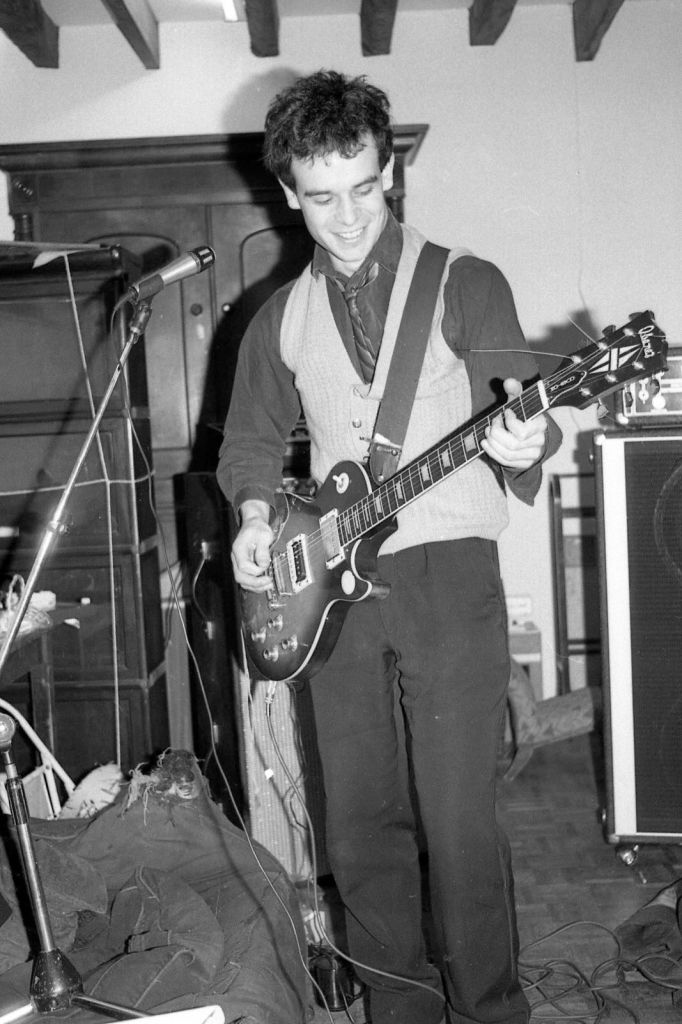
Disruptive Patterns rehearsing at The Manor. Picture courtesy of Fred Pipes Adam Peters, Andy IcInnes, Angela Jaeger, Bella Union, Cocteau Twins, Consenting Adults, Displayed, Disruptive Patterns, Drowning Craze, Duchess of Richmond, Godalming, Goodwood House, Guildford, Imperfect Hold, Janet Astor, Paul Cummins, Prior’s Field, Simon Godfrey, Simon Raymonde, Situation Two, The Garden, The Maner, Wooden Bridge -
The Stormsville Shakers

(c’61-’67) Phillip Goodhand-Tait (keyboards / vocal), Paul Demers (drums), Ivor Shackleton (guitar), and Michael Francis ‘Kirk’ Riddle (bass)
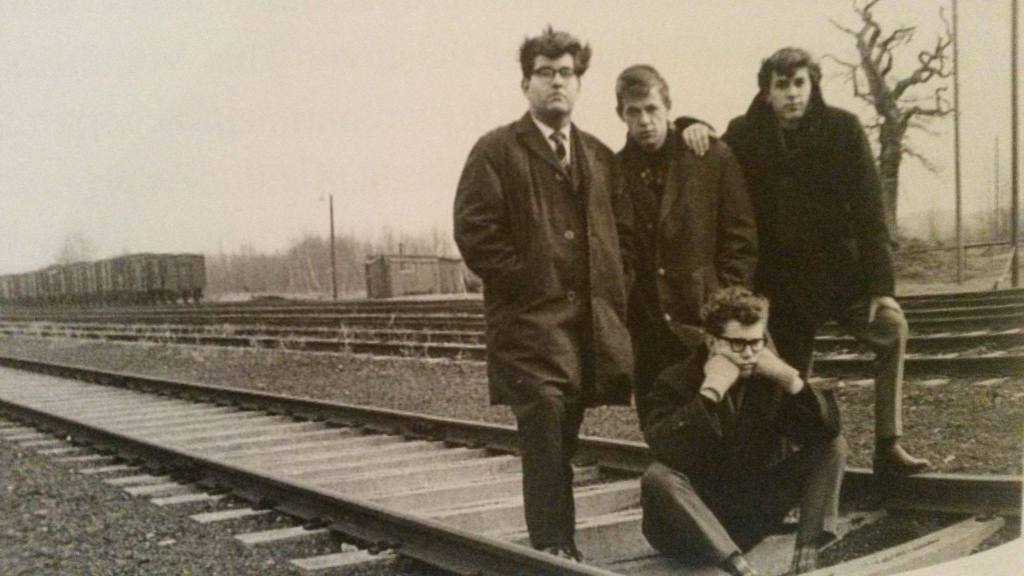
Philip Goodhand-Tait and The Stormsville Shakers. Year and location unknown. Phillip Goodhand-Tait – who used to live on Bushy Hill Estate, Guildford and went to Pewley then George Abbot schools – joined forces with Demers, and Goldalming Grammar students Shackleton, and Riddle to form Phil Tone & The Midnighters. The band rehearsed at the Youth Club, Merrow, held at Merrow Village Hall, Guildford and played their first gig at the Town Hall, Eastleigh, Hampshire on the 2 September ’61.
Riddle was the band’s driver to these early gigs, getting them to venues like the Village Hall, Effingham; Youth Clubs in Farncombe, Merrow, and Charlotteville; the Congo Youth Club that was held on North Street, Guildford; the Odeon, Guildford; and Friary Brewery, Guildford.
In Dec ’62 the band, now going by The Stormsville Shakers or Phillip Goodhand-Tate and the Stormsville Shakers monikers, signed with the Michael G. Burton Agency to be represented by Mike Gee. The band graced the NAAFI Club, Aldershot on an almost weekly basis in ’63 and were hired by Brian Howard to appear on 21 September ’63, as Phill and the Stormsville Shaker at Peace Memorial Hall, Ashtead, supported by the Echolettes. They were at the Village Hall, Churt on 7 December ’63 and only advertised a few days later on 22 December ’63 the band performed at the Holy Trinity Hall, Guildford in aid of Oxfam. On 25 January and 8 May ’64 the group returned to the Village Hall in Churt and then went on to win The Surrey Rock Competition on 25 May ’63, held at Shalford Park. They also won the 1st heat of the All England Beat Competition, held at the Plaza Ballroom, Guildford on 24 Sept that year. The prize was a recording session at Decca, publicity in the Surrey Advertiser and the titles of “Surrey’s Top Group”. Towards the end of ’63 they were starting to get gigs further afield in Ipswich, London (inc. the Flamingo Club) and The Jazz Cellar, Kingston-Upon-Thames. Meanwhile they were still busy on the local circuit supporting the likes of The Yardbirds, John Mayall, Alexis Korner and The Rolling Stones at The Wooden Bridge, Guildford. On 4 November ’63, Phil and The Stormsville Shakers headline opening night of the Rock & Twist Dances at the Civic Hall, Guildford, with The Original Dominos, The Condors and The Age Beaters in support.

Early January ’64 the band expanded with the addition of Steve Howard (tenor sax). The next month Dick Forcey (drums) replaced Demers. A few days later they had there first official recording session in West Hampstead. A couple of days after that there was a recording audition for Decca followed, within a few weeks, by a Recording Test in Studio 1. Brian Howard booked the band again, this time as support to Alexis Korner’s Blues Incorporated on 7 March ’64 at Epsom Baths Hall, Epsom. On 4 July ’64 they supported the Paramounts at the Civic Hall, Guildford and John Lee Hooker at the Ricky Tick Club, Windsor on 11 July. It was around this time that Patrick Martin of The Late approached Riddle and asked how he achieved the ‘really punchy sound’, with Riddle crediting “La Bella Flatwound” strings. Mid-July they became a 6-piece with the addition of Peter ‘Greg’ MacGregor (tenor sax).
It was around this time The Surrey Advertiser titled them the “Go ahead Generation – Number one group” and they became a regular feature at Ricky Tick, Guildford and Windsor. On 10 August they enter a studio again, this time Central Sounds, Denmark St, returning on the 18 August. Shortly after the first recording session Mick Douglas (guitar) ‘temporarily’ picks up the axe for Shackleton. In early September, duties change again when MacGregor leaves to be replaced Geoff Cooke (tenor sax). The band are now playing nationally including Stringfellows’ The Mojo Club, Sheffield; The Place, Stoke on Trent; ; Crawdaddy at The Star, Croydon; California Ballroom, Dunstable; Blue Moon Club, Hayes; and the Whisky A Go Go, Newcastle. On the 1 October ’64 the combined Farnborough Tech & RAE Rag Ball was held at R.A.E.’s Assembly Hall, Farnborough and featured The Art Woods, Reading based The Moquettes, and Phillip Goodhand-Tate and the Stormsville Shakers. Two weeks later they were at the Locarno Ballroom, Swindon supporting Wayne Fontana and The Mindbenders on 15 October. On 13 December the band were the headliner at Ilkley D.J. Club at the Troutbeck Hotel, Ilkley, supported by Thimble Riggers, and in mid-December ’64 there was a 4-day tour of Scotland followed by a recording session at the Marquee Studios with Georgio Gomelski on the 23 December, with a gig at the Flamingo Club with Zoot Money straight after. To close out ’64 and hail in ’65 they played Ricky Tick, Windsor supporting Georgie Fame and The Blue Flames. A portion of Fame’s performance was introduced by Brian Matthew with June Imrat and broadcast live from Clewer Mead as part of BBC Radio’s “New Year Revels”, which also featured Mark Wynter.

15 October 1964: Wayne Fontana and the Mindbenders with The Stormsville Shakers at Locarno, Swindon While signed to The Rik Gunnell Agency the band pretty much gigged every other day through ’64 and the schedule didn’t change entering ’65, which included touring with The Larry Williams Show. More recording in the first week of January ’65 at IBC Studios, London, but why waste a trip to town; getting booked to play the Marquee Club that night and running down to Reading the day after to join The Animals at the Olympia on the 7 January. Around mid-February ’65, David Sherrington (tenor sax) and Tony Hurley (tenor sax) join as Cooke and Howard leave. In March The Stormsville Shakers are recording again, this time at Regent Sound Studios, London. They were back on local turf on 31 March ’65 performing for The Guildford School of Art Students Union at the Village Hall, Merrow with The SmokeStakks in support.

31 March ’65: Poster, designed by William Neal, for gig at Merrow Village Hall. Finally, on the 5 and 6 April ’65, they enter the studios to record an LP with Larry Williams at Decca Recording Studios and Marquee Studios, London respectively. The bands time with The Larry Williams Show and these recording sessions led to their appearance on the snappily title “The Larry Williams Show Featuring Johnny ‘Guitar’ Watson With The Stormsville Shakers” LP, the cover of which carries an image taken at The Plaza, Guildford. On 19 April ’65, The Stormsville Shakers were supporting Downliner’s Sect at the Rendezvous Club at Oddfellows Hall, Portsmouth, shortly before the club stopped operating. THe band arrived at The Scotch of St.James, Mayfair at 7:30pm on 7 May ’65, performing three 35 minute long spots across the night and finished at 2:00am. They were subsequently booked to appear at the venue on both the 14 and 15 May. Jammed between their constant gigs come more recording sessions: 18 May at Regent Sound Studios, London they lay down “Long Live Love” and “I’ll Do The Best I Can” with Chris Andrews; 23 June at Regent Sound Studio, London for “Do What You Wanna Do” and “There You Go”; 4 August and 13 September recording at Rayrick Studios, London; 15, 27 and 30 September and 1 October at Advision Studios, that included recording “It’s A Lie”; and 23 December at R.G. Jones Studio, Morden, to record “Number One” and “There You Go”. In late ’65 Ian Jelfs (guitar) replaces Shackleton. As a result Shackleton misses out on the bands first international gigs on the 18 and 19 December at La Locomotive, Paris before returning to The Wooden Bridge, Guildford for a Christmas Eve gig.
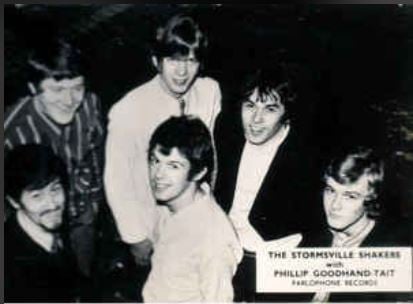
A Stormville Shakers promo card. Picture courtesy of Ben’s Collectors Records The band returned to R.G. Jones Studio in January ’66 to finish “There You Go” and “Number One” and again on the 4 February for “I’ll Do The Best I Can” and “Gonna Put Some Hurt On You”, again on the 14, and once more on 17 February when they worked on “Gonna Put Some Hurt On You” again, but this time with The Marionettes vocal group and Gus Galbraith on trumpet. They were still playing, almost every other day, and sometimes twice a day, everywhere from pubs, clubs, colleges/polytechnics and wedding receptions up and down the country. On 29 January ’66, The Stormsville Shakers appeared with Lee Dorsey at the Flamingo Club, Wardour Street in the evening staying on to re-appear supporting Geno Washington and the Ram Jam Band at the Allnighter Club at midnight. Then on 20 February they began a tour of France starting off in Paris with a gig at the Weekend Club (which was recorded), two at the Sims Club, and the Locomotive Club on the first day alone. Over the next five days they played eight gigs at the Palladium, Poparama, Television, Top Ten, New Palladium and a private party. The crazy schedule didn’t stop when they moved onto Nantes, with four performances on the 26 February and another on the 27 February. Back to Paris and another private party on 1 March and eleven more club gigs over the next five days at Top Ten, La Plantation, Whisky A Go Go, Potel Etoile, Le Club, Weekend, Locomotive and Les Chateaux. Mid tour they return to London for recording sessions at Rayrick Studios laying down “The Bear” and Advision Studios, London for more work on “Gonna Put Some Hurt On You”, then it’s back off to Paris for the rest of March and all of April, with a quick trip to Marseilles’ Club L’Omnibus on 26 and 27 March. On 1 April they take on a month long residency at Paris’ Palladium, playing every night of the month through 1 May.
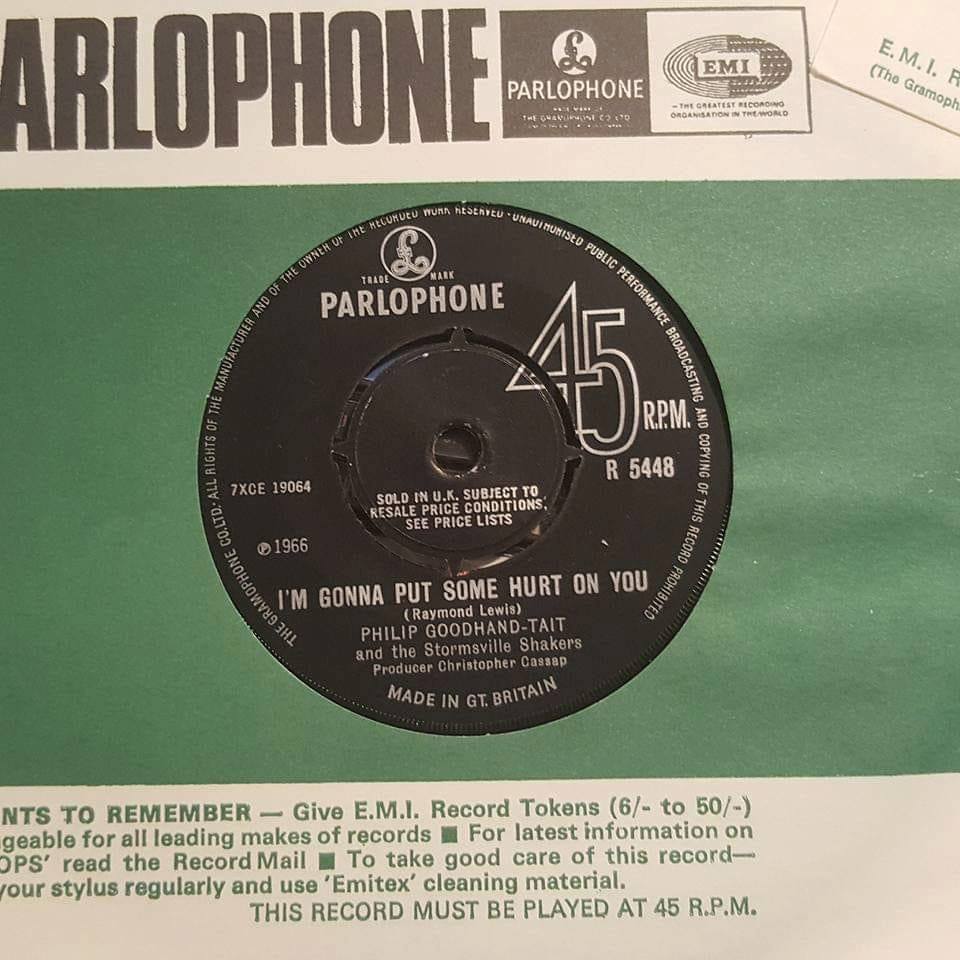
Released in 1966, “Gonna Put Some Hurst On You”. Picture courtesy of Ben’s Collectors Records On 6 May ’66 “Gonna Put Some Hurt On You” backed with “It’s A Lie” is released on Parlophone Records [R5448]. As their single hits the charts in early May ’66 they are back gigging in the UK. Mid-May saw Goodhand-Tate signing a publishing contract with Dick James Music and the band engaged Tony Brainsby as Publicist; Mel Collins (sax) also joined the band. The single enters the Melody Maker Pop 50 chart by 21 May and they close out the month with The Who at Morecambe, Winter Gardens. By 4 June the single has reached No.40 in the Melody Maker Pop 50 chart and the almost daily gigging continues. In June, news breaks of Sherrington having an incident with a British Rail policeman. On 15 July they find time to hit the studio – R.G. Jones Studio again – and record “No Problem”, “What More Do You Want”, and “Where Were You”. “No Problem” is assigned to Dick James Music on 1 August and the band work on the track at R.G. Jones Studio the next day. Towards the end of August ’66 “No Problem”, produced by Chris Cassup, who also managed the band in the early to mid-sixties, backed by “What More Do You Want” is released on Parlophone Records [R5498].
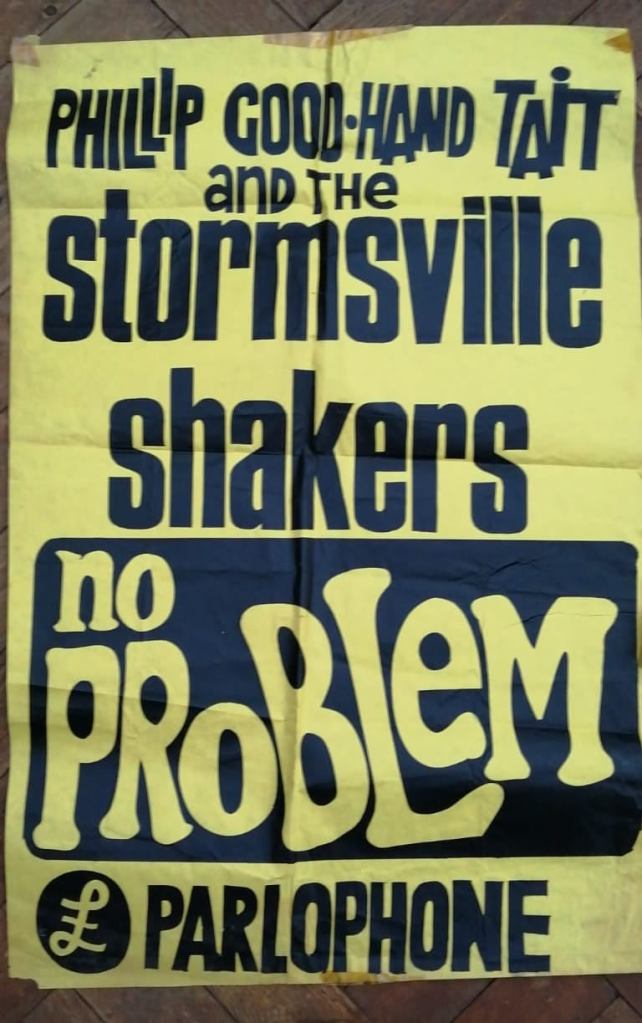
Poster promoting 1966’s “No Problem” by Phillip Good-Hand Tait and the Stormville Shakers. Picture courtesy of Ben’s Collectors Records A meeting with producer Roy Pitt in September results in a number of recording sessions at Maximum Sound Studios on: 11 and 12 October “You Can’t Take Love” is initially laid down; on the 19 October, with The Carols as backing, they work on the track some more; and then on 2 and 9 November ’66 they wrap it up. In the middle was another one week tour of France. On 2 December, Parlophone Records released “You Can’t Take Love” backed by “J.C. Greaseburger” [R5547]; and “I’m Gonna Put Some Hurt On You” appeared on a compilation by Columbia [SX6062].
Early ’67 and the gigging schedule continues at it’s usual rapid rate, including two week long trips to Belfast in March and April. There’s a break in the gigging on 30 January to record “The Society For The Protection Of Love” at R.G. Jones Studio. The 13 February ’67 sees the band at the Marquee, London supporting The Herd, a role they repeated at the venue a month later on 13 March. The 30 March is used recording “One And One Is Two” and “There You Go” at CTS Studio; 4 April back at R.G. Jones Studio, 18 April at IBC Studios, London, 17 May at City of London Recording Studios recording “Sink Or Swim” and “Gone Are The Songs Of Yesterday”.
Then in April ’67 rumors started of a name change. In ’67 we know that Doreen Pettifer, of Godalming, was the official secretary of The Stormsville Shakers Fan Club and Chris Cassap from Guildford was their manager. On 28 July ’67, The Stormsville Shakers closed out the month with a gig in Ostend, Belgium on then took a break before hitting Switzerland mid-August en-route to Italy to play the Piper Club, Rome on the 15 August, then the Piper Club, Viareggio on the 21 August. They finished out August back in Rome recording a scene playing “You Got Me Humming” for the Italian movie titled “Main City”. On 1 September ’67 the band changed their name to Circus.
In June 2003: Phillip Goodhand-Tait and the Stormsville Shakers, The Switch, The Phantom Four and Razzle Dazzle got together and played a final gig at the Civic Hall, Guildford. 2015 saw the release of “One And One Is Two – The Stormville Shakers and Circus with Phillip Goodhand-Tait, Complete Recordings 1965 – 1967” [RETRO967] which carries 27 tracks including the five Parlophone singles. This was also the year that John Reed and Paul Robinson of Cherry Red Records worked with 23 Ears to compile the CD that accompanied the June 2015 issue of MOJO Magazine titled ‘My Generation – 15 Tracks of ’60s Beat-Filled Teenage MOD Angst‘ that included The Stormsville Shakers ‘Number One’ as the fifth track.
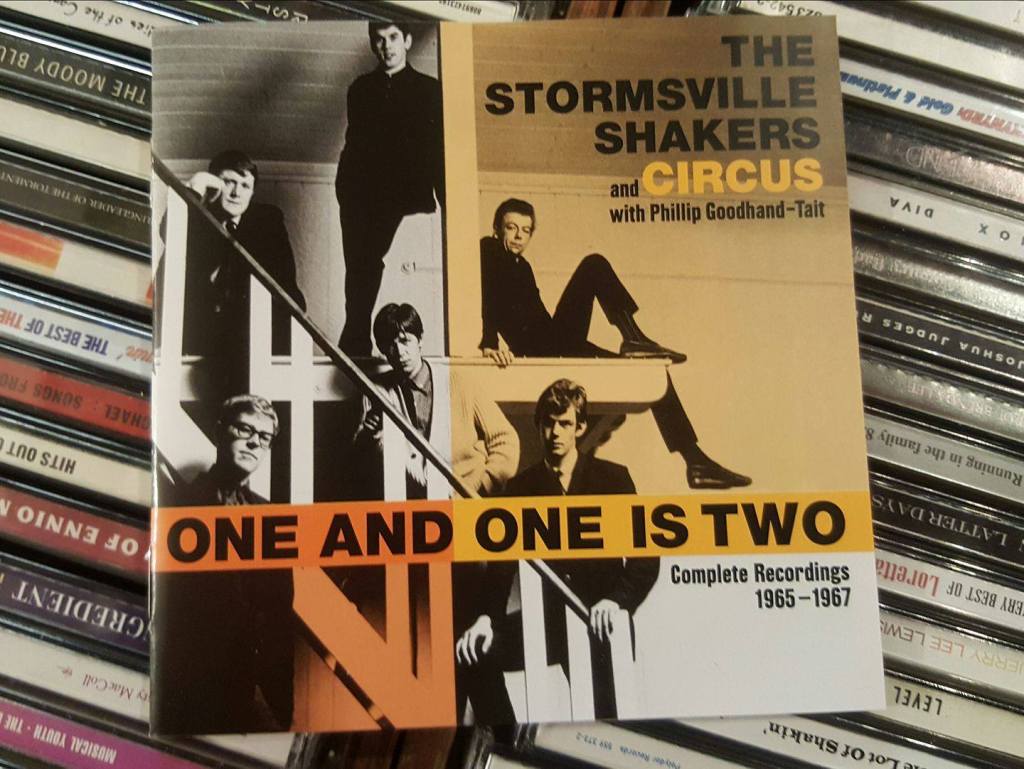
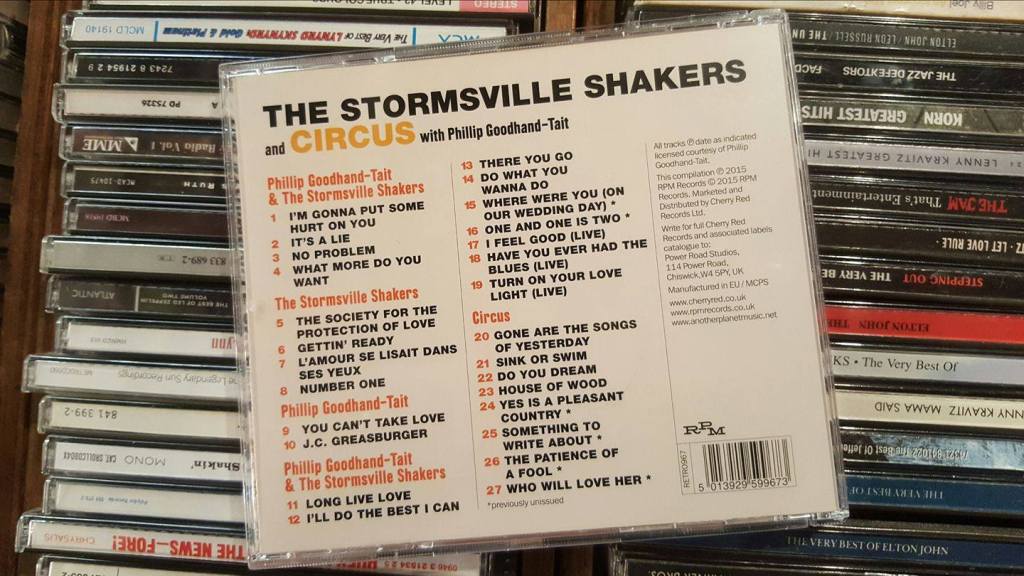
The 2015 released “One And One Is Two – The Stormville Shakers and Circus with Phillip Goodhand-Tait. Picture courtesy of Ben’s Collectors Records Other members not yet slotted into the timeline are Graham “Cupcake” Cooper (guitar) who went on to play in Strange Brew and Jackie Lynton’s Happy Days Band, and Chris Brayne (drums) who would later join Backhurst, Manhole, and Cryin’ Out Loud. Copper would be later found performing solo under the Graham “Cupcake” Cooper moniker, and some recall Eric Clapton joining him and other local musicians onstage at The Royal, Guildford for a charity gig in the early ’80s with Bruce Foxton of The Jam in the audience. Chris Cassup, who is listed as the producer on the “No Problem” single and was the band’s manager opened the Unit Three burger bistro in Jeffries Passage, Guildford around 1974, opposite the Horse and Groom. Cassup was working the night that the bomb went off, he was unhurt. He went on to run a guest house on the coast and died around 2006. Riddle, who lately played in the Staubanzee skiffle band, sadly passed away November 2017. Dick Forcey was last heard of in Australia. Sax player Sherrington passed in early March 2022 with sax all set up just 6 feet away.
Gallery:
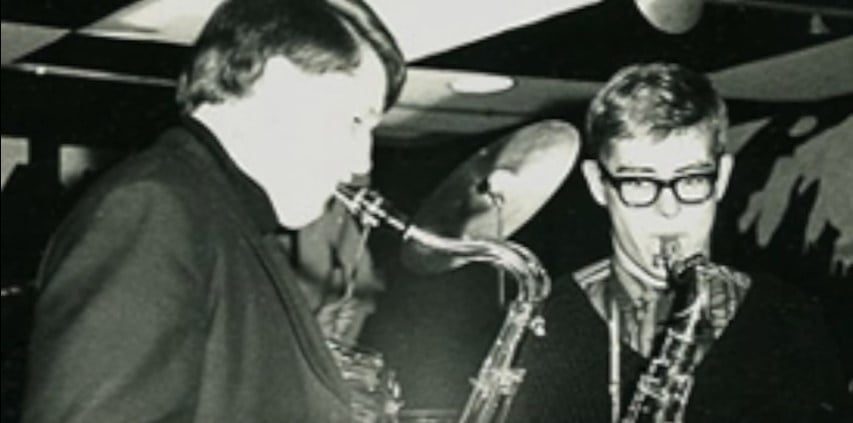
The Stormsville Shakers ‘horn section’ 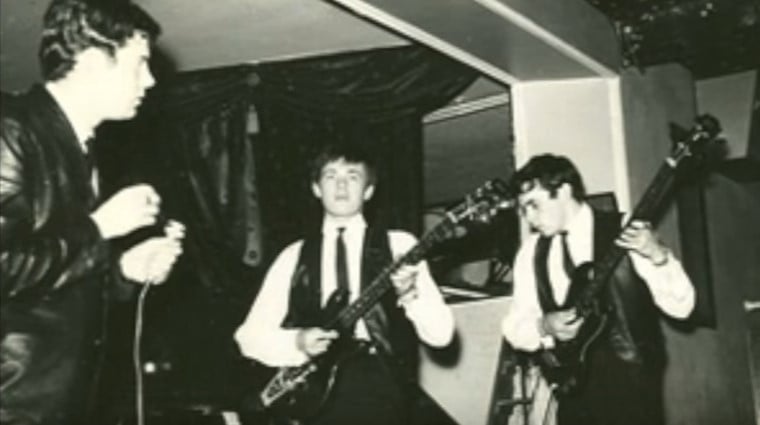
The Stormsville Shakers 
Ivor Shackleton and Kirk Riddle of The Stormville Shakers at the Plaza, Guildford. Picture courtesy of Pat Conroy 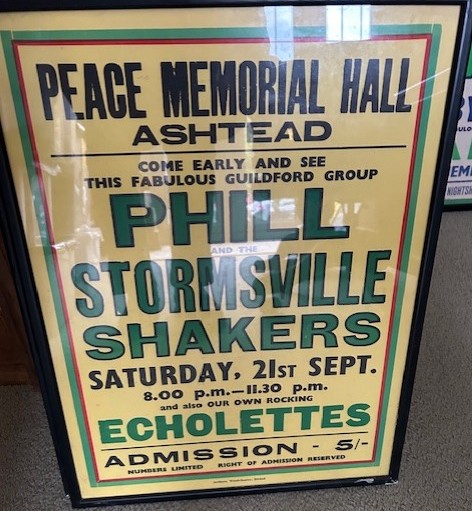
21 September 1963: Phill and the Stormsville Shaker with Echolettes. Image courtesy of Brian Howard 
7 March 1964: Alexis Korner’s Blues Incorporated with Phill and the Stormsville Shaker. Image courtesy of Brian Howard 
1 October 1964: The combined Farnborough Tech & RAE Rag Ball at RAE’s Assembly Hall eatured The Art Woods, The Moquettes, and Phillip Goodhand-Tate and the Stormsville Shakers. 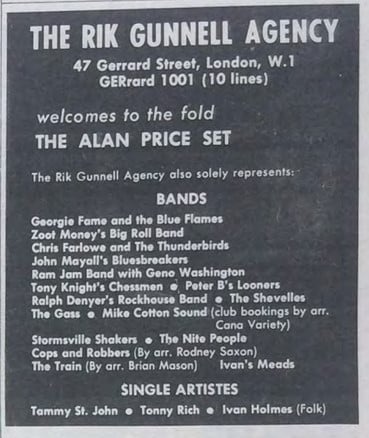
Rik Gunnell Agency advert from Melody Maker (29 Jan 1966) listing The Stormsville Shakers as one of their ‘exclusive’ bands. 
29 January 1966: The Stormsville Shakers appeared with Lee Dorsey at the Flamingo Club, staying on to re-appear supporting Geno Washington and the Ram Jam Band at the Allnighter Club. Advert from Melody Maker 29 Jan 1966 issue. 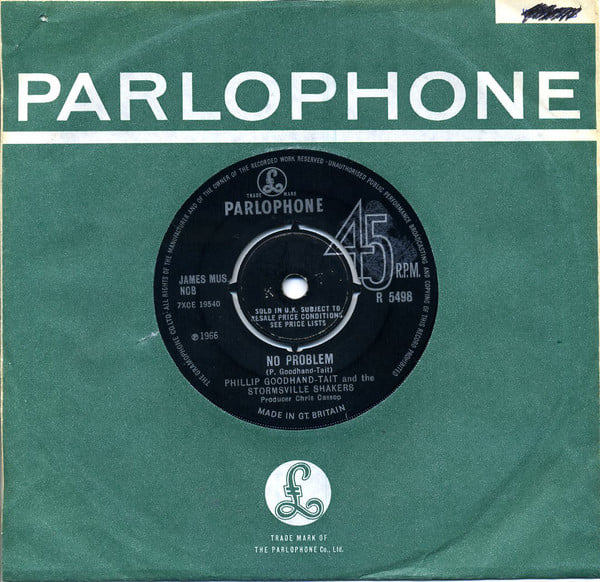
Towards the end of August ’66 “No Problem” is released on Parlophone Records [R5498] 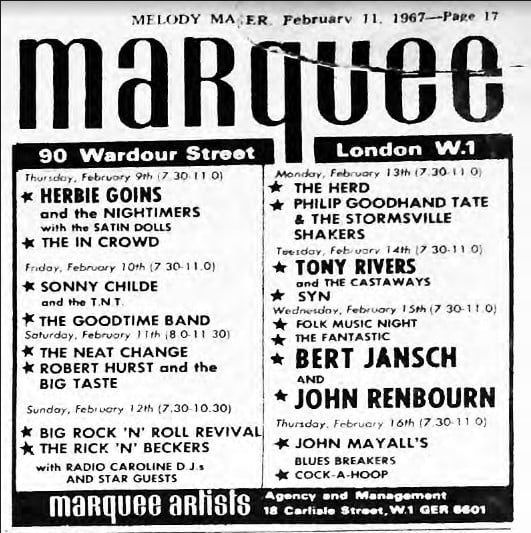
13 February 1967: Philip Goodhand-Tate and The Stormsville Shakers supported The Herd at the Marquee, London (Advert from Melody Maker 11 Feb 1967) 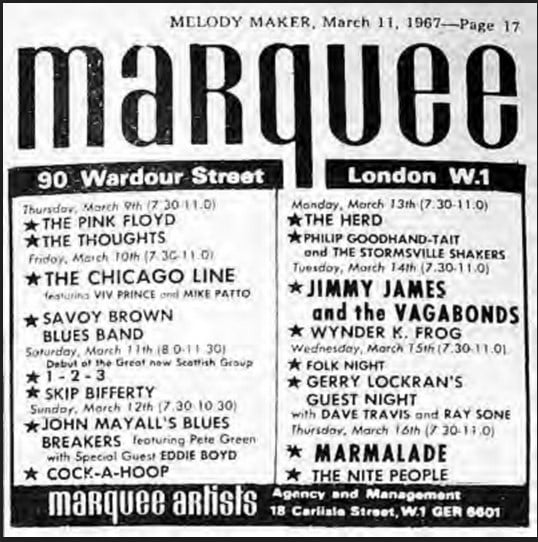

8 June 2003: Poster for “Let The Good Times Roll” featuring Phillip Goodhand-Tait with The Stormville Shakers, The Switch, The Phantom 4, and Razzle Dazzle played the Civic Hall, Guildford. Picture courtesy of Ben’s Collectors Records 
Record Mirror, 2 January 1965: The Stormville Shakers, along with Georgie Fame and The Blue Flames, played the Ricky Tick, Windsor New Year’s Eve Party. 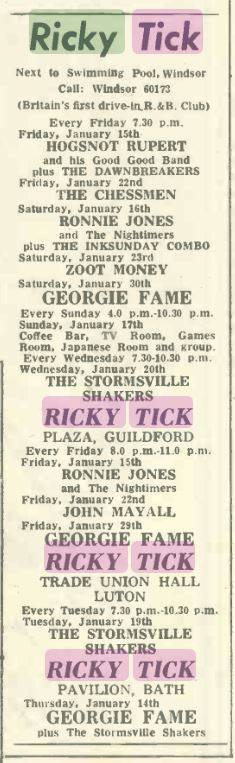
Record Mirror, 16 January 1965: The Stormville Shakers played the Rick Tick, Windsor on 20 January. 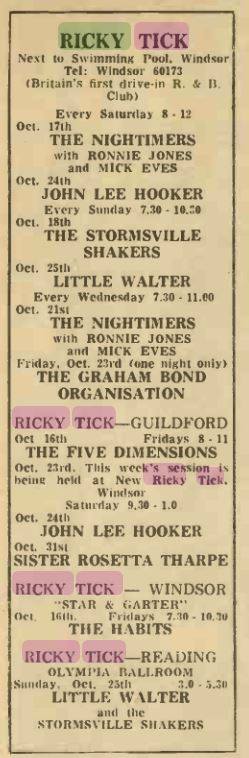
Record Mirror, 17 October 1964: The Stormville Shakers are at Rick Tick, Windsor on 18 October. 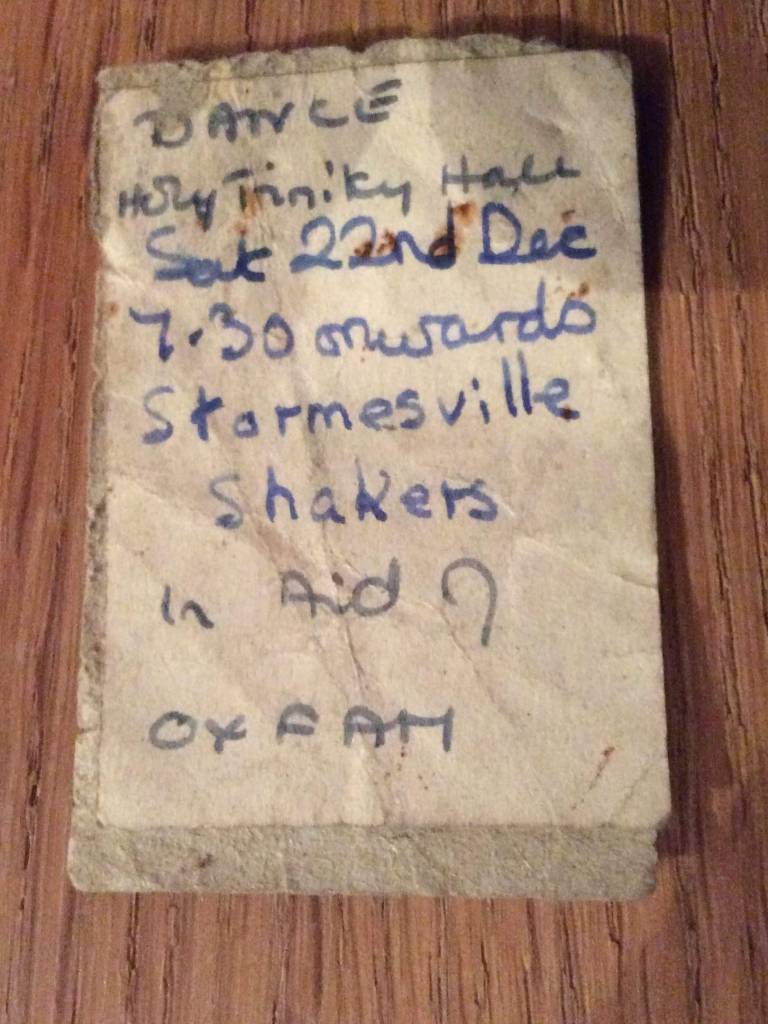
22 December 1962 – This handwritten ticket got you in to see the band at Holy Trinity Hall, Guildford. Ticket from the collection of Mary Fereday, picture courtesy of Ben’s Collectors Records 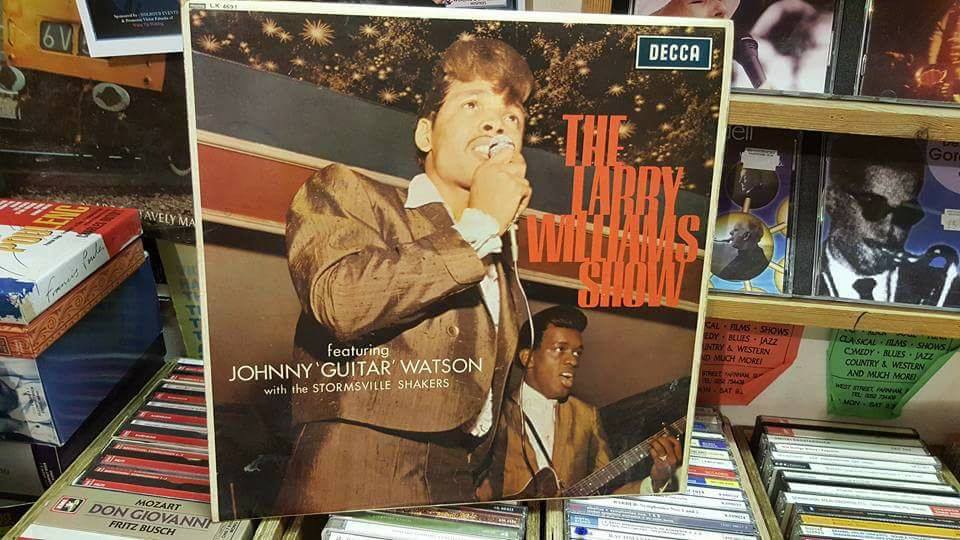
In 1965 The Larry Williams Show featuring Johnny ‘Guitar’ Watson with The Stormsville Shakers LP was released. The cover picture was taken at the Ricky-Tick Club at The Plaza Ballroom, Guildford. Picture courtesy of Ben’s Collectors Records 
August ’66 release “No Problem” backed by “What More Do You Want”. Picture courtesy of Ben’s Collectors Records 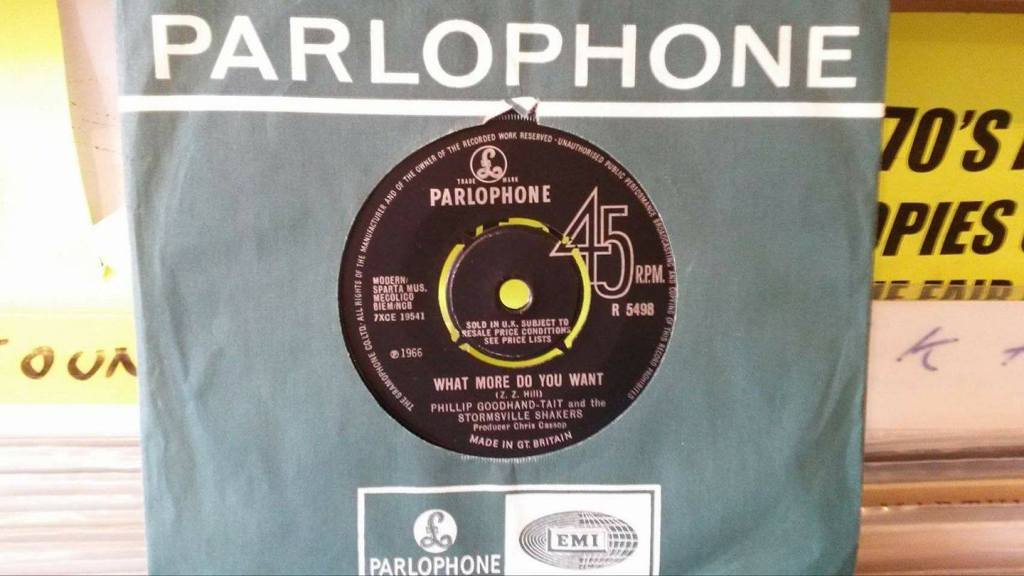
August ’66 release “No Problem” backed by “What More Do You Want”. Picture courtesy of Ben’s Collectors Records 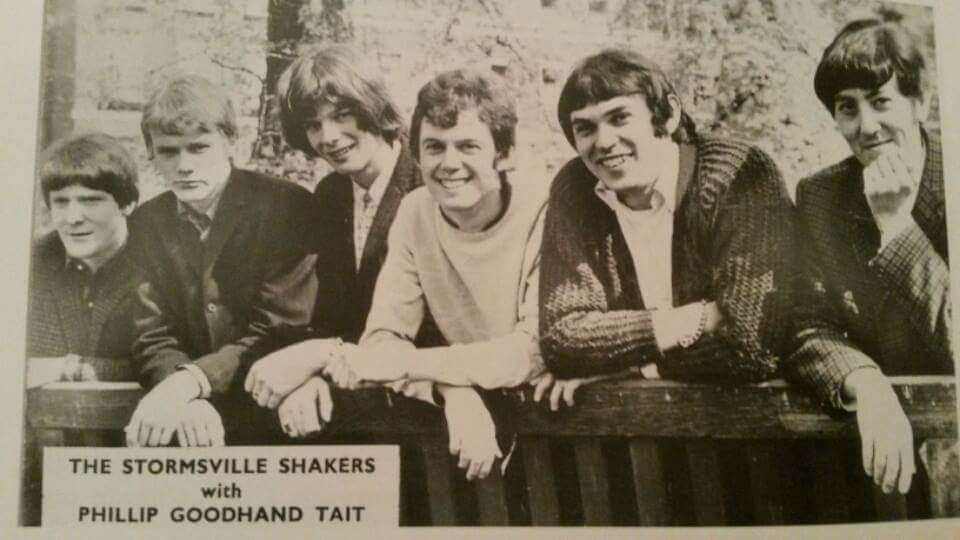
The Stormville Shakers with Phillip Goodhand-Tait. Picture courtesy of Ben’s Collectors Records 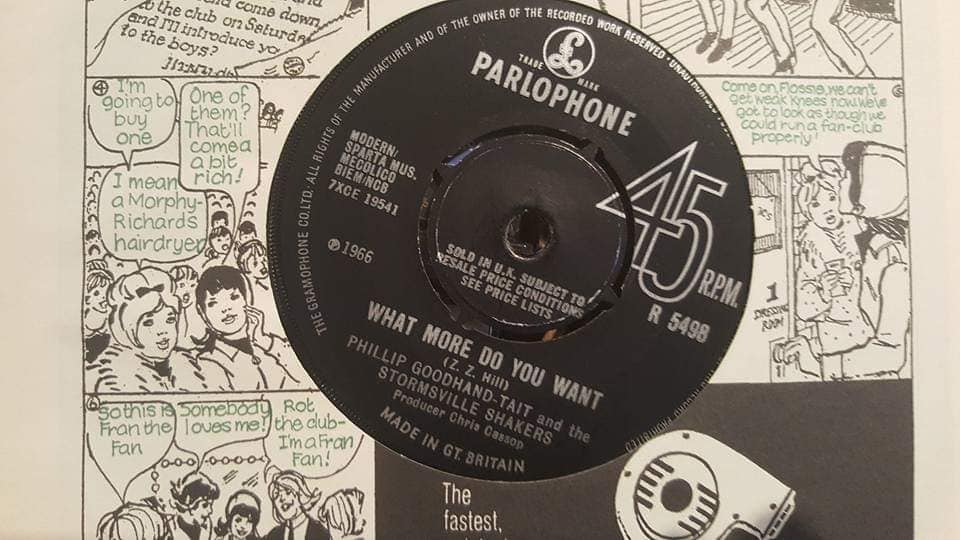
Stormsville Shakers “What More Do You Want”. Picture courtesy of Ben’s Collectors Records 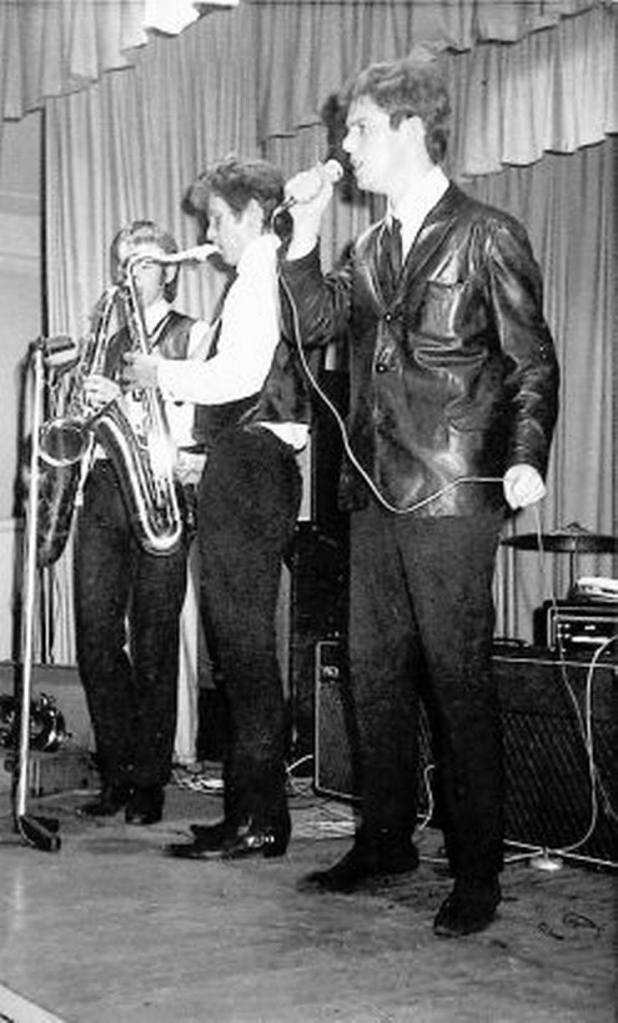
Stormville Shakers in 1960’s 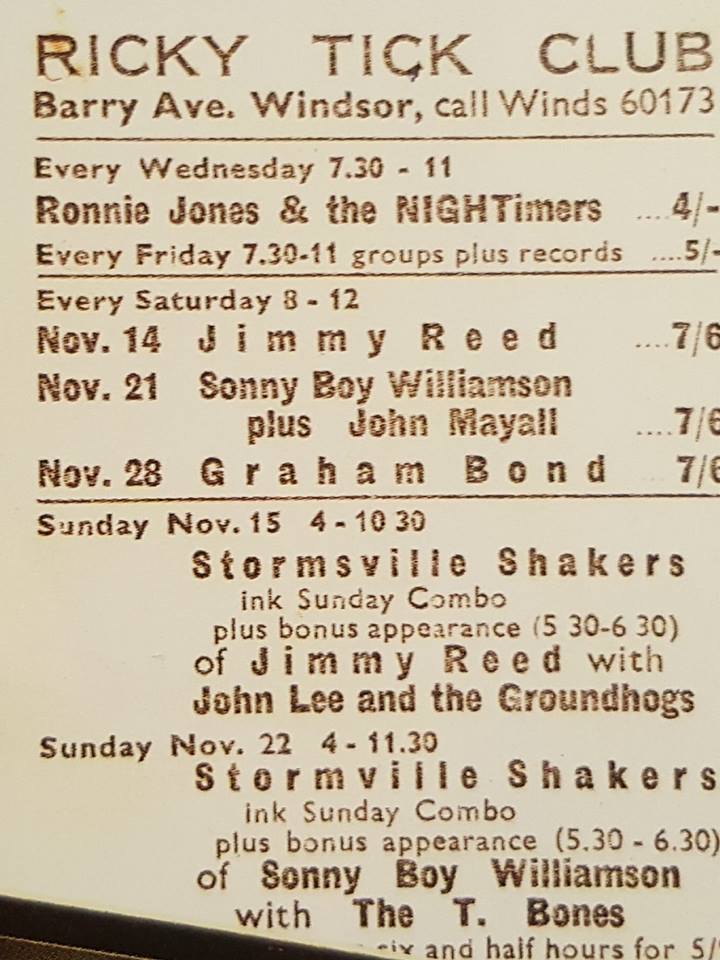
15 & 22 November 1964: Stormsville Shakers at the Ricky Tick, Windsor. Picture courtesy of Ben’s Collectors Records 
19 April 1965: Stormsville Shakers supporting Downliner’s Sect at the Rendezvous Club at Oddfellows Hall, Portsmouth. Picture courtesy of Ben’s Collectors Records 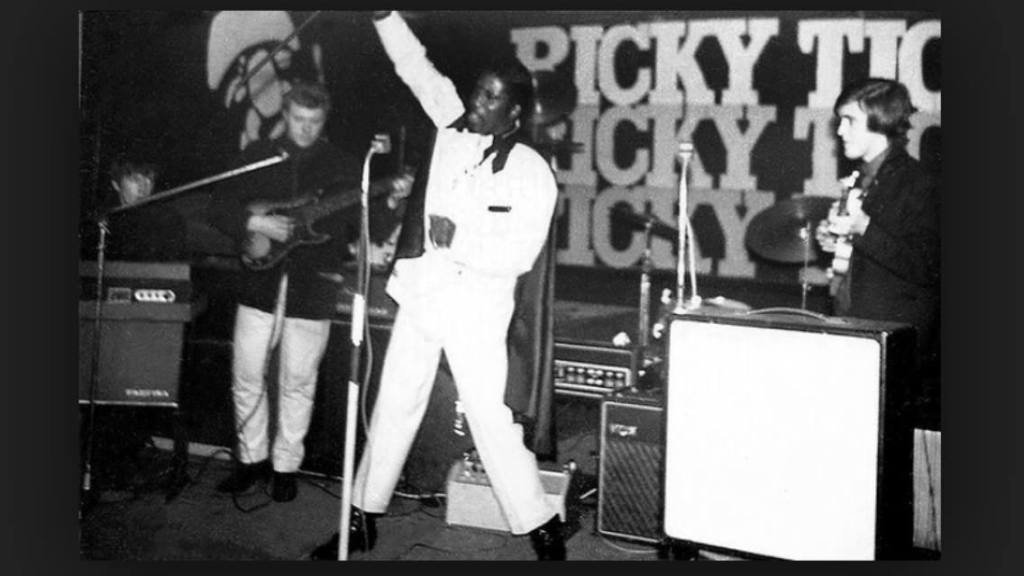
The Stormville Shakers backing Screamin’ Jay Hawkins at a Ricky Tick on 10 Feb 1965. Source: rickytick com 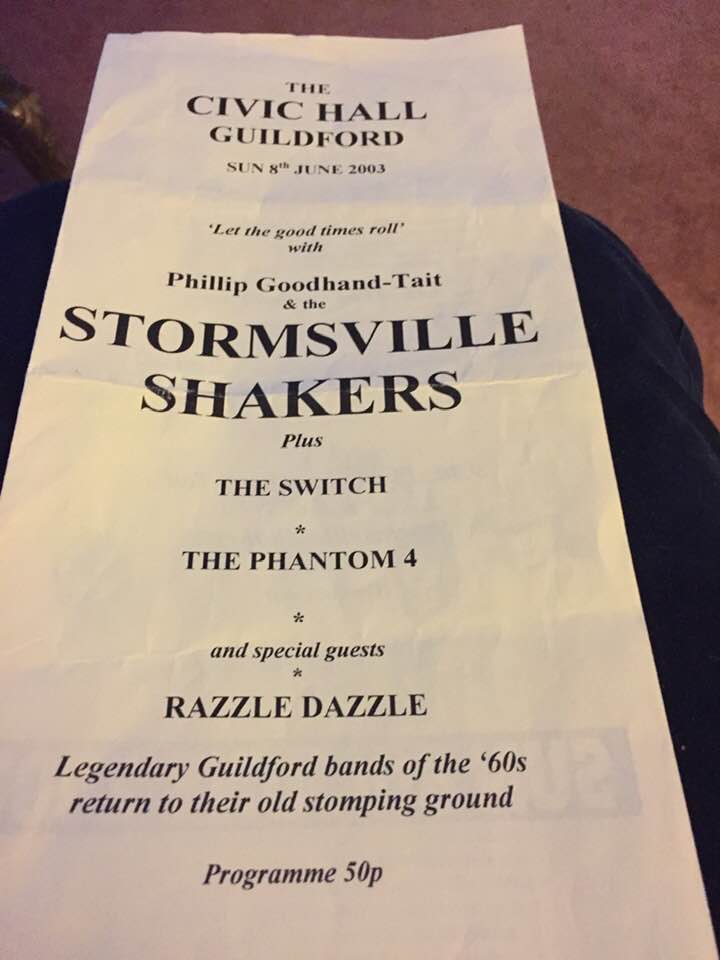
8 June 2003: Page 1 of the programme for the ”60’s Return” gig at the Civic Hall, Guildford featuring Phillip Goodhand-Tait and the Stormsville Shakers. Source Tina Lambley via Guildford Town Past & Present 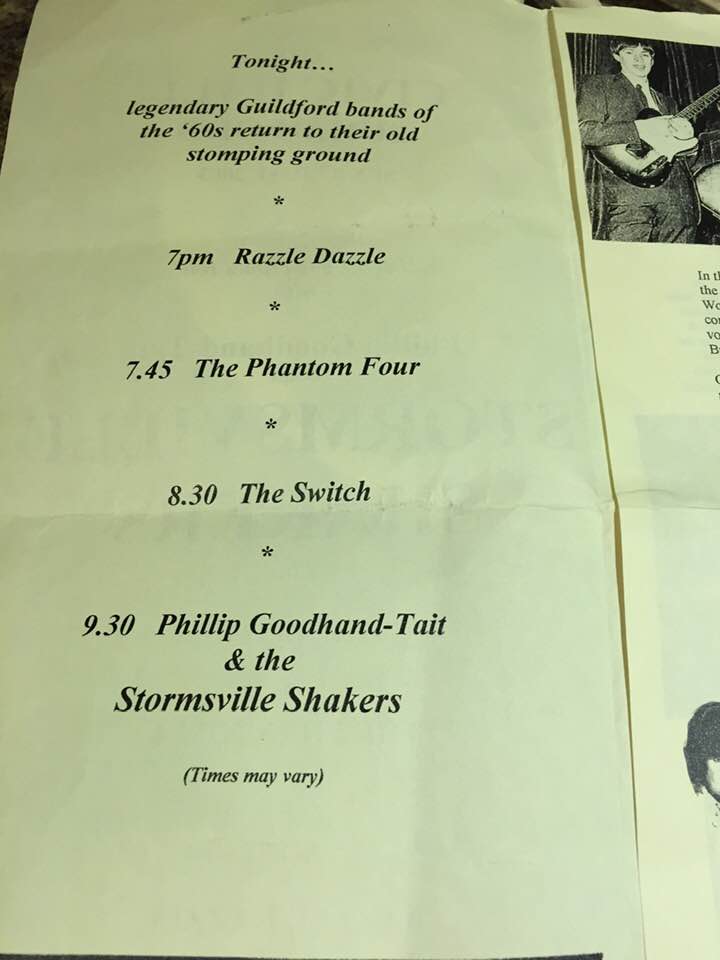
8 June 2003: Page 2 of the programme for the ”60’s Return” gig at the Civic Hall, Guildford featuring Phillip Goodhand-Tait and the Stormsville Shakers. Source Tina Lambley via Guildford Town Past & Present 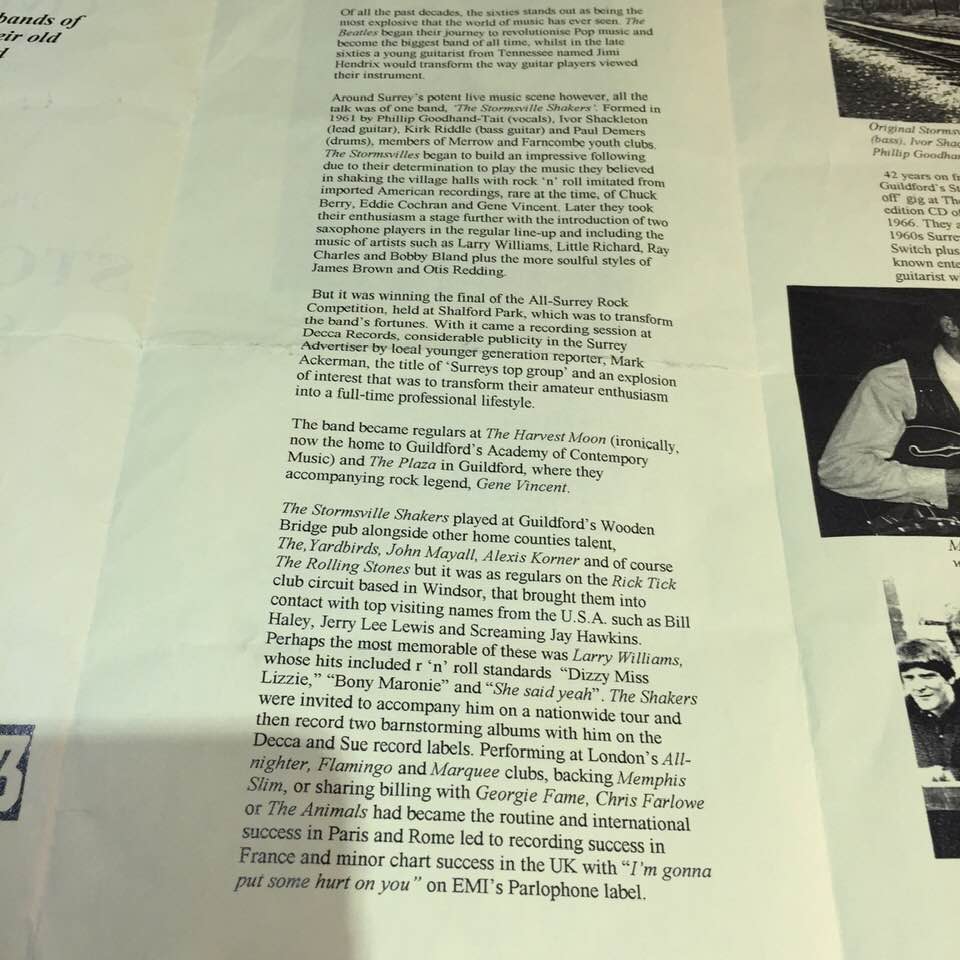
8 June 2003: Page 3 of the programme for the ”60’s Return” gig at the Civic Hall, Guildford featuring Phillip Goodhand-Tait and the Stormsville Shakers. Source Tina Lambley via Guildford Town Past & Present 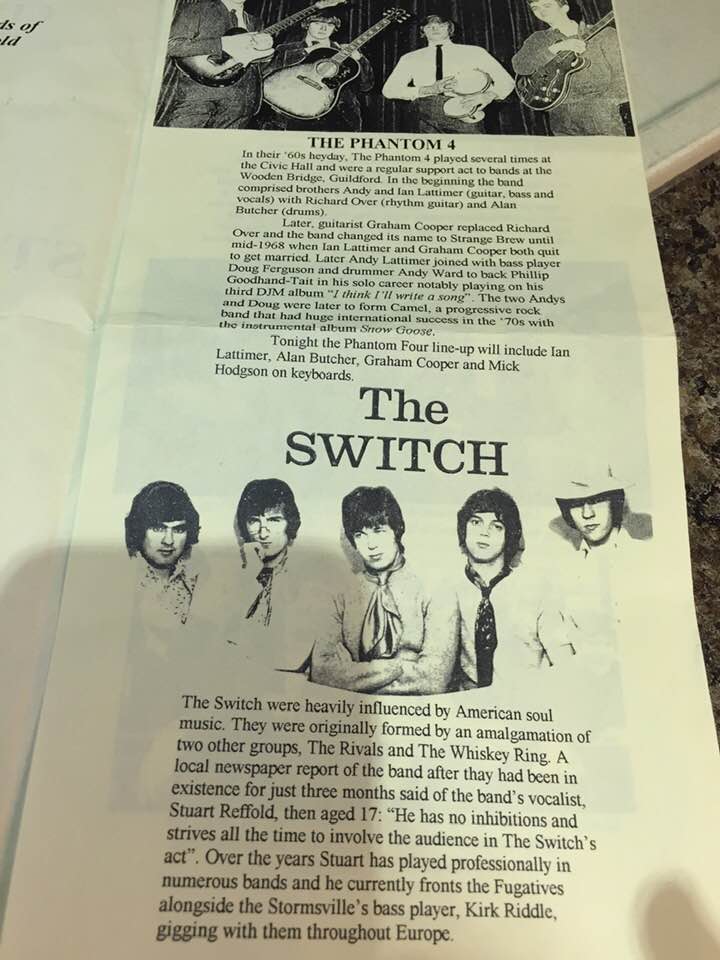
8 June 2003: Page 4 of the programme for the ”60’s Return” gig at the Civic Hall, Guildford featuring Phillip Goodhand-Tait and the Stormsville Shakers. Source Tina Lambley via Guildford Town Past & Present 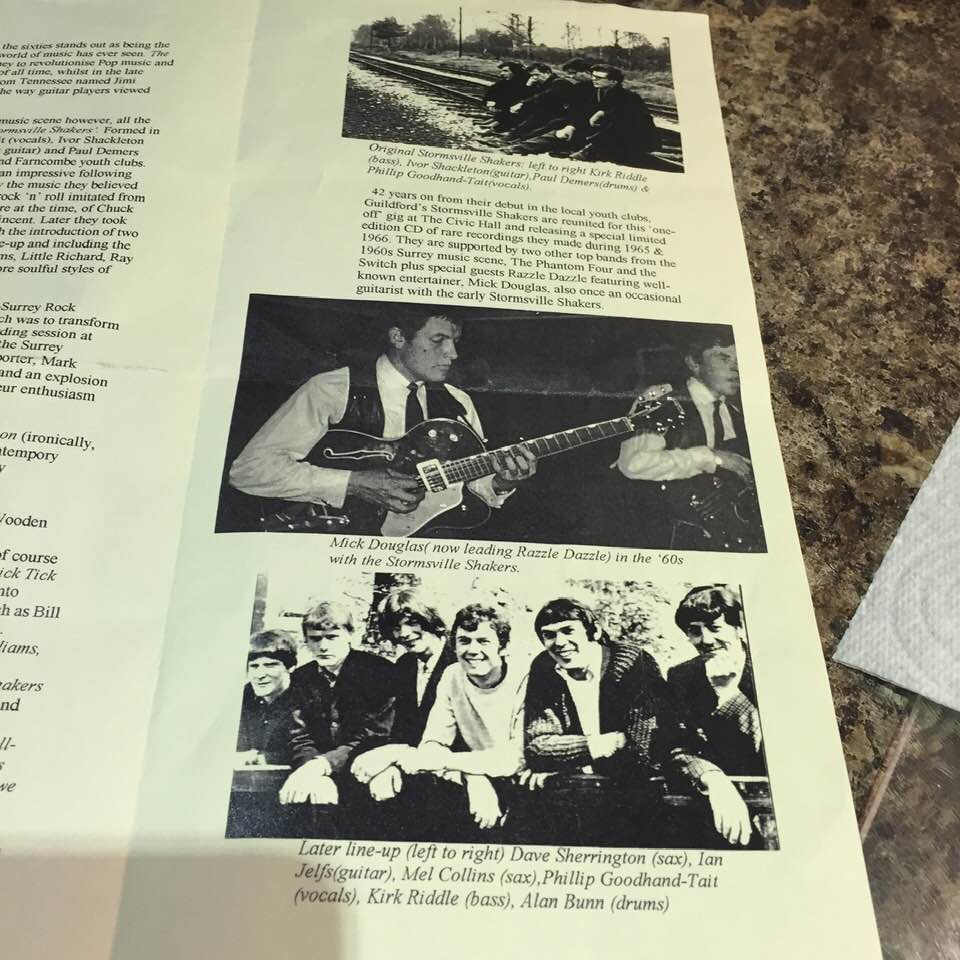
8 June 2003: Page 5 of the programme for the ”60’s Return” gig at the Civic Hall, Guildford featuring Phillip Goodhand-Tait and the Stormsville Shakers. Source Tina Lambley via Guildford Town Past & Present 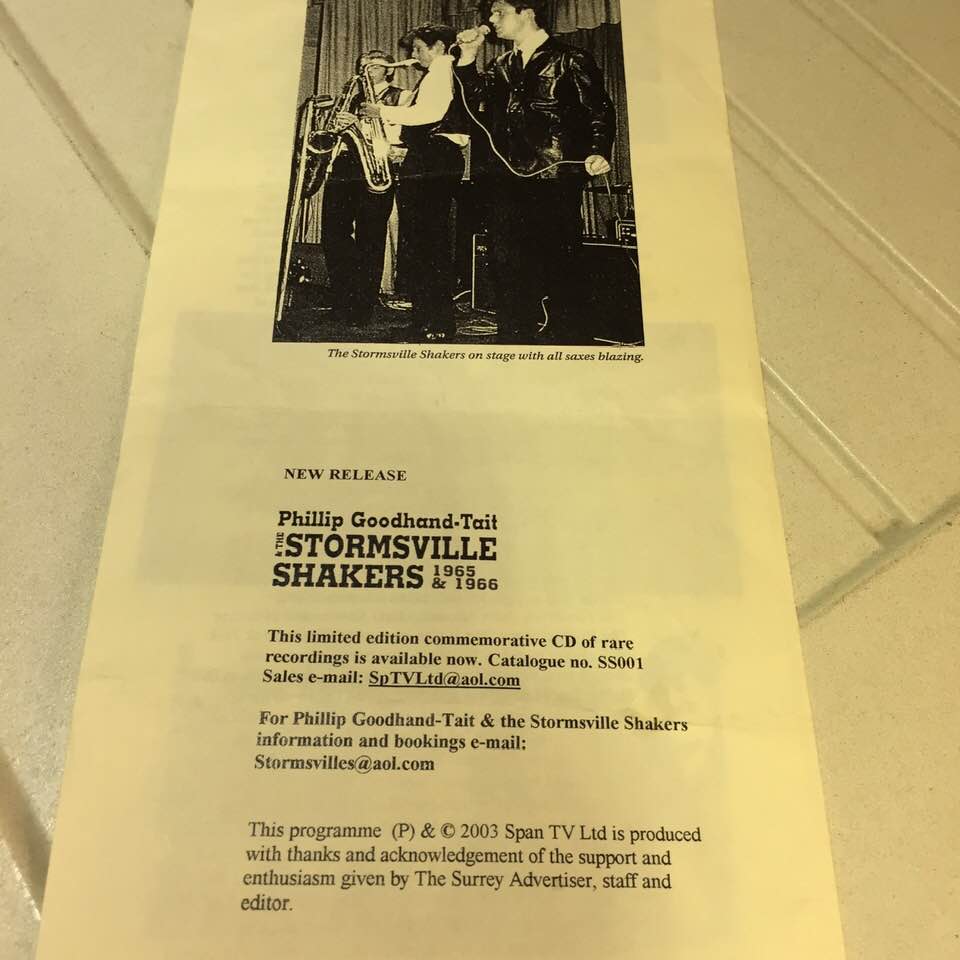
8 June 2003: Page 6 of the programme for the ”60’s Return” gig at the Civic Hall, Guildford featuring Phillip Goodhand-Tait and the Stormsville Shakers. Source Tina Lambley via Guildford Town Past & Present 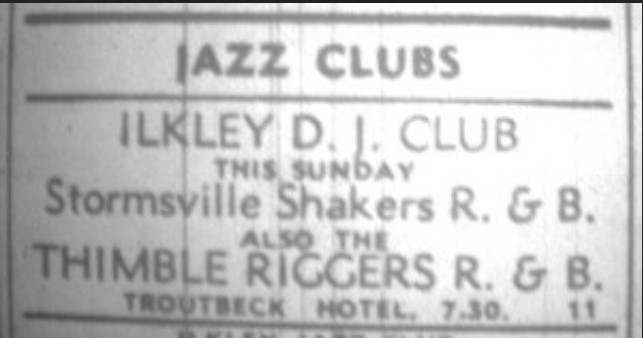
13 December 1964: Ilkley D.J. Club, Troutbeck Hotel, Ilkley. Source: www.bradfortimeline.co.uk 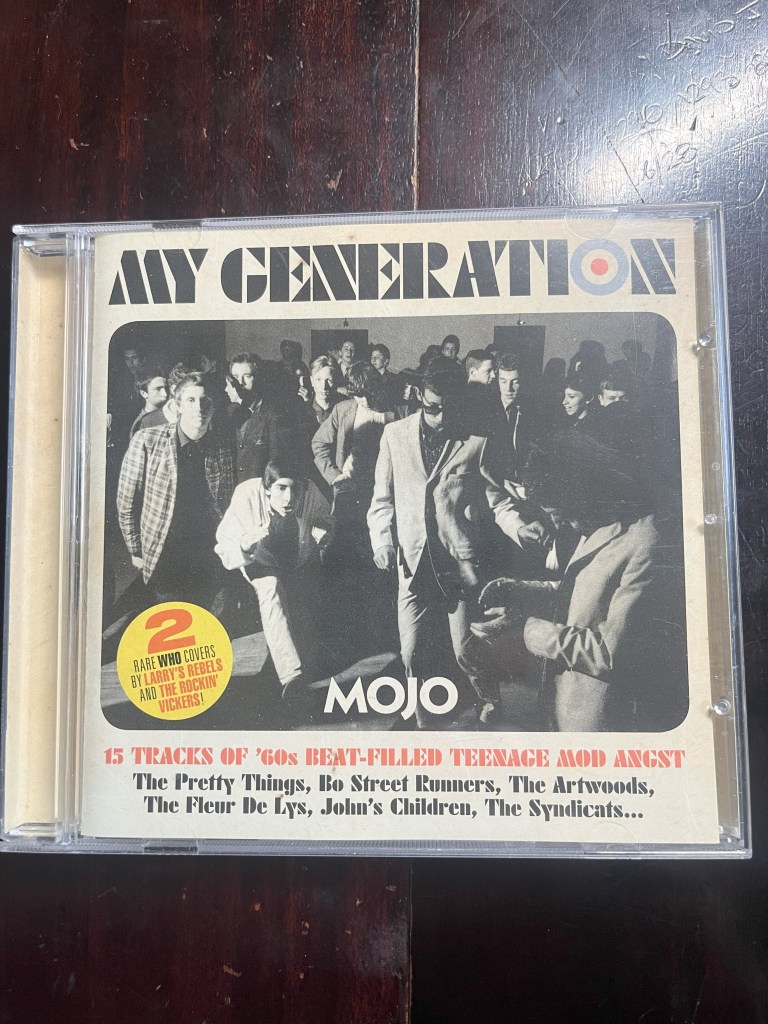
June 2015 MOJO magazine compilation CD included The Stormsville Shakers ‘Number One’ 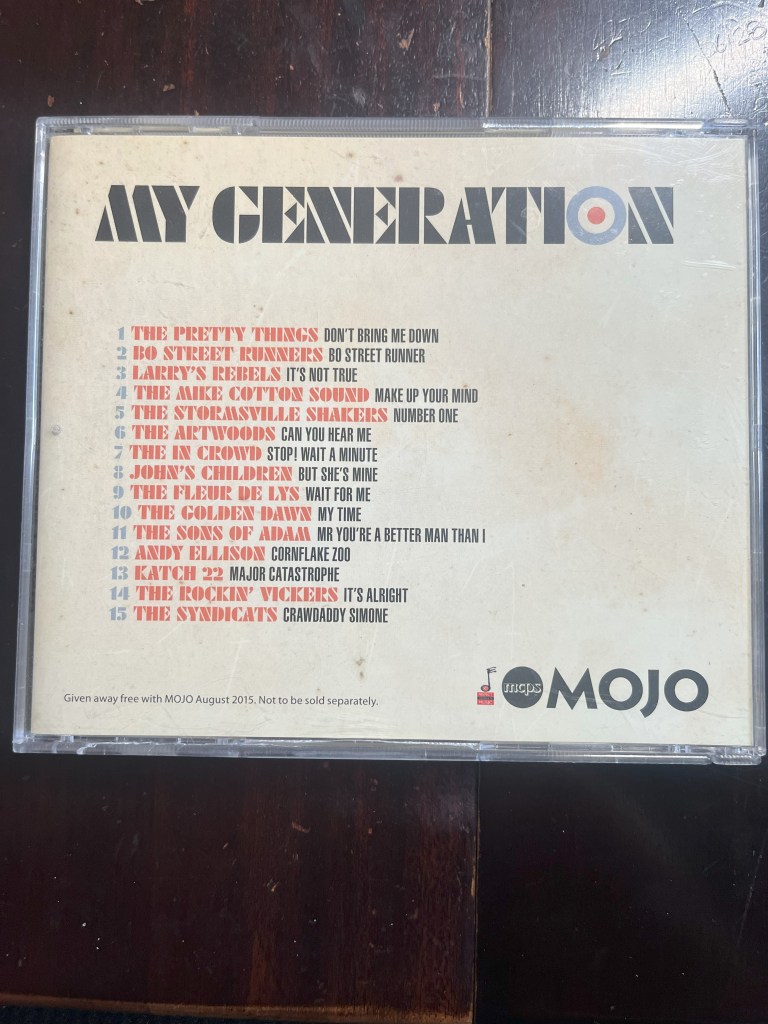
June 2015 MOJO magazine compilation CD included The Stormsville Shakers ‘Number One’ 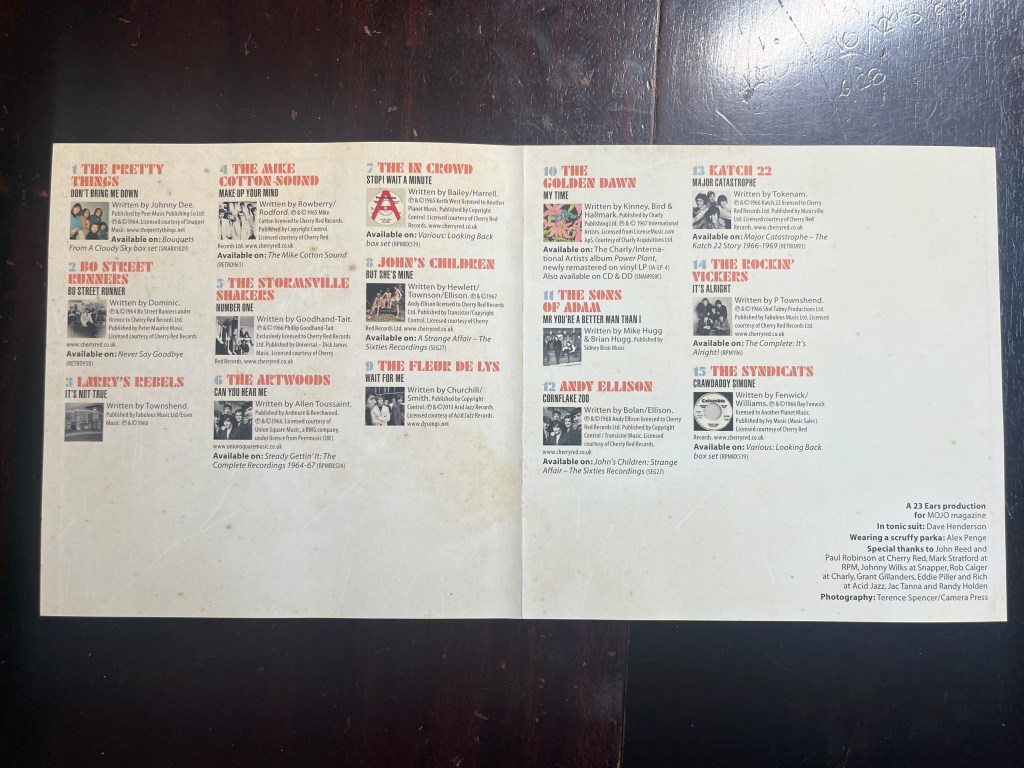
June 2015 MOJO magazine compilation CD included The Stormsville Shakers ‘Number One’ 23 Ears, Advision Studios, Aldershot, Alexis Korner, Alexis Korner's Blues Incorporated, All England Beat Competition, Allnighter Club, Ashtead, Assembly Hall, Backhurst, BBC Radio, Belfast, Belgium, Blue Moon Club, Brian Matthew, Bruce Foxton, Bushy Hill Estate, California Ballroom, Central Sounds, Charlotteville, Cherry Red Records, Chris Andrews, Chris Brayne, Chris Cassup, Churt, Circus, City of London Recording Studios, Civic hall, Clewer Mead, Club L’Omnibus, Columbia, Congo Youth Club, Crawdaddy, Croydon, Cryin’ Out Loud, David Sherrington, Decca, Decca Recording Studios, Dick Forcey, Dick James Music, Doreen Pettifer, Downliners Sect, Dunstable, Eastleigh, Echolettes, Effingham, Epsom, Epsom Baths Hall, Eric Clapton, Farnborough, Farnborough Tech, Farncombe, Flamingo Club, Friary Brewery, Geno Washington & The Ram Jam Band, Geoff Cooke, George Abbott, Georgie Fame and The Blue Flames, Georgio Gomelski, Godalming, Godalming Grammar, Graham Cooper, Guildford, Guildford School of Art, Gus Galbraith, Hayes, Holy Trinity Hall, Horse and Groom, Ian Jeffs, IBC Studios, Ilkley, Ilkley D.J. Club, Ipswich, Italy, Ivor Shackleton, Jackie Lynton's Happy Days Band, John Lee Hooker, John Mayall, John Reed, Johnny Watson, June Imrat, Kingston-Upon-Thames, Kirk Riddle, La Locomotive, La Plantation, Lacarno Ballroom, Le Club, Lee Dorsey, Les Chateaux, London, Manhole, Mark Wynter, Marquee Club, Marquee Studios, Marseille, Maximum Sound Studios, Mayfair, Mel Collins, Melody Maker, Merrow, Michael G. Burton, Michael Riddle, Mick Douglas, Mike Gee, Mojo, MOJO Magazine, Morden, Morecambe, NAAFI Club, Nantes, New Palladium, Newcastle, Oddfellows Hall, Odeon, Olympia, Ostend, Oxfam, Palladium, Paramounts, Paris, Parlophone Records, Patrick Martin, Paul Demers, Paul Robinson, Peace Memorial Hall, Peter MacGregor, Phil and The Stormsville Shakers, Phil Tone & The Midnighters, Phill and the Stormsville Shakers, Phillip Goodhand-Tate, Phillip Goodhand-Tate and the Stormsville Shakers, Piper Club, Plaza Ballroom, Poparama, Portsmouth, Potel Etoile, R.G. Jones Studio, RAE, RAE Assembly Hall, Rayrick Studios, Razzle Dazzle, Reading, Regent Sound Studios, Rendezvous Club, Ricky Tick Club, Rome, Roy Pitt, Scotland, Shalford Park, Sheffield, Sims Club, Staubanzee, Steve Howard, Stingfellow, Stoke-on-Trent, Strange Brew, Studio 1, Surrey Advertiser, Swindon, Switzerland, Technical College, Television, The Age Beaters, The Animals, The Art Woods, The Carols, The Condors, The Herd, The Jam, The Jazz Cellar, The Larry Williams Show, The Marionettes, The Mojo Club, The Moquettes, The Original Dominos, The Phantom Four, The Place, The Rik Gunnell Agency, The Rolling Stones, The Scotch of St.James, The Smokestakks, The Star, The Stormsville Shakers, The Stormville Shakers, The Surrey Rock Competition, The Switch, THe Who, The Yardbirds, Thimble Riggers, Tony Brainsby, Tony Hurley, Top Ten, Town Hall, Troutbeck Hotel, Unit Three, Village hall, Wayne Fontana and the Mindbenders, Weekend, Weekend Club, West Hampstead, Whisky A Go Go, William Neal, Windsor, Winter Gardens, Youth Club, Zoot Money -
Combo A Go Go

(c’63-’66) – Freddie Green (lead guitar/vocals), Alan Willis (bass/vocals), Jim “Jock” Edmunds (drums), Chris Minnet (rhythm guitar), Arthur Trussler (alto sax), and Pete Styles (trumpet)
Combo A Go Go, sometimes listed as Combo Agogo, were a local band, with members mainly emanating from Aldershot, that played R&B, Stax Soul & early Motown. In 1965 they secured a weekly residency at the Harvest Moon, Guildford.

Combo A Go Go at Harvest Moon, Guildford c’65/’66. Picture courtesy of Georgina and Fred Green via Guildford Town Past and Present Enugu, Nigeria-based guitarist and producer Goddy Oku bought his band The Hygrades to the Harvest Moon on 12 March ’66, where they were supported by Combo A Go Go, while the band held their own a couple of weeks later, in the evening of, 27 March ’66.
Gallery:
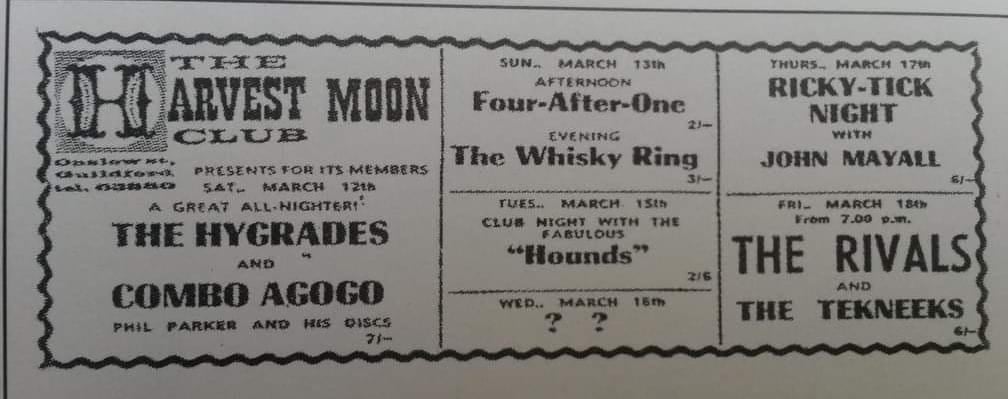
March 1966: Press Ad for The Harvest Moon Club, Guildford. Picture courtesy of Ben’s Collectors Records 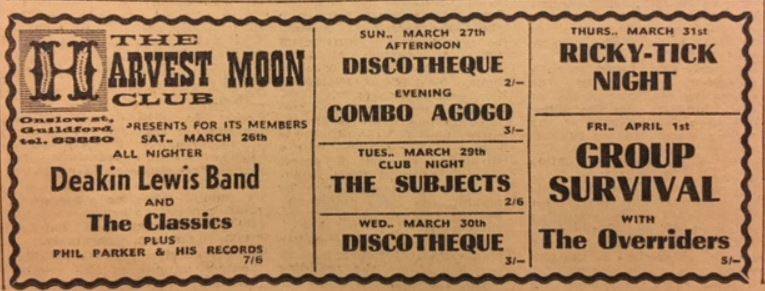
March 1966: Press Advert -
Camel

(c’71-date) Andrew Latimer (guitar), Andy Ward (drums) and Doug Ferguson (bass)

Camel, post Ferguson, with Caravan’s Richard Sinclair taking his place. Source: The Guitarists The trio started out as Guildford based The Brew when they auditioned to be the back-up band to Phillip Goodhand-Tait on 20 Feb ’71. In August that year, the resulting album, “I Think I’ll Write a Song” was released on DJM Records. After this less than successful release the band decided to regroup, placing an ad in Melody Maker. As a result Peter Bardens (keyboards), formerly of Shotgun Express and Them, joined and they played a gig as Peter Bardens’ On on 8 Oct ’71 in Belfast.
They then became Camel with a first gig supporting Wishbone Ash at Waltham Forest Technical College, London on 4 December ’71. On 10 March ’72 they backed Mungo Jerry at Goldsmith College, London and latyer in the year, on 23 July ’72, the band supported Stackridge at the Civic Hall, Guildford. By August that year they were signed with MCA Records and their debut album “Camel” was released in February ’73. It flopped and the band moved to Deram Records. That didn’t stop BBC 2’s The Old Grey Whistle Test including a recording of Camel’s ‘Never Let Go‘ from their performance at the Civic Hall, Guildford in March ’73 in the show broadcast on 22 May. Later that year the band appeared at the Windsor Free Festival, and at Fletcher Hall, Leicester on 24 October ’73.
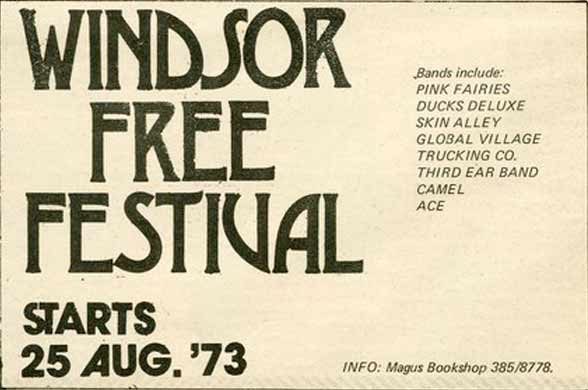
25 August 1973: Camel played the Windsor Free Festival. On 1 March ’74 they released “Mirage” on which Latimer played flute. A few months later, 23 August ’74, Camel played opening day of the 1974 Reading Festival with Nutz, Johnny Mars, Hustler, Beckett, 10cc, Fumble and The Sensational Alex Harvey Band. “Mirage” hit the mark in the U.S. leading to a three-month tour that kicked off on 19 November at Ladyland, New York City. Then came “The Snow Goose” in May ’75.
On 6 July ’75 Camel played the New London Theatre, Drury Lane, supported by The Mike Storey Band; and Winter Gardens, Malvern on 25 August 1975. The Snow Goose LPs success led to a sell out concert at the Royal Albert Hall, London, with the London Symphony Orchestra on 17 Oct ’75. With the success came a lawsuit from Paul Gallico, the author of the short story of the same name that inspired the concept album. As a result, later versions of the album have the prefix ‘Music inspired by…’ on the front cover and the story notes removed from the back cover. That didn’t stop the promoters of Friars, Aylesbury using the introduction to Gallico’s story on the flyer promoting the appearance of Camel, with support by local band Gasworks, on 8 November ’75 at the venue.
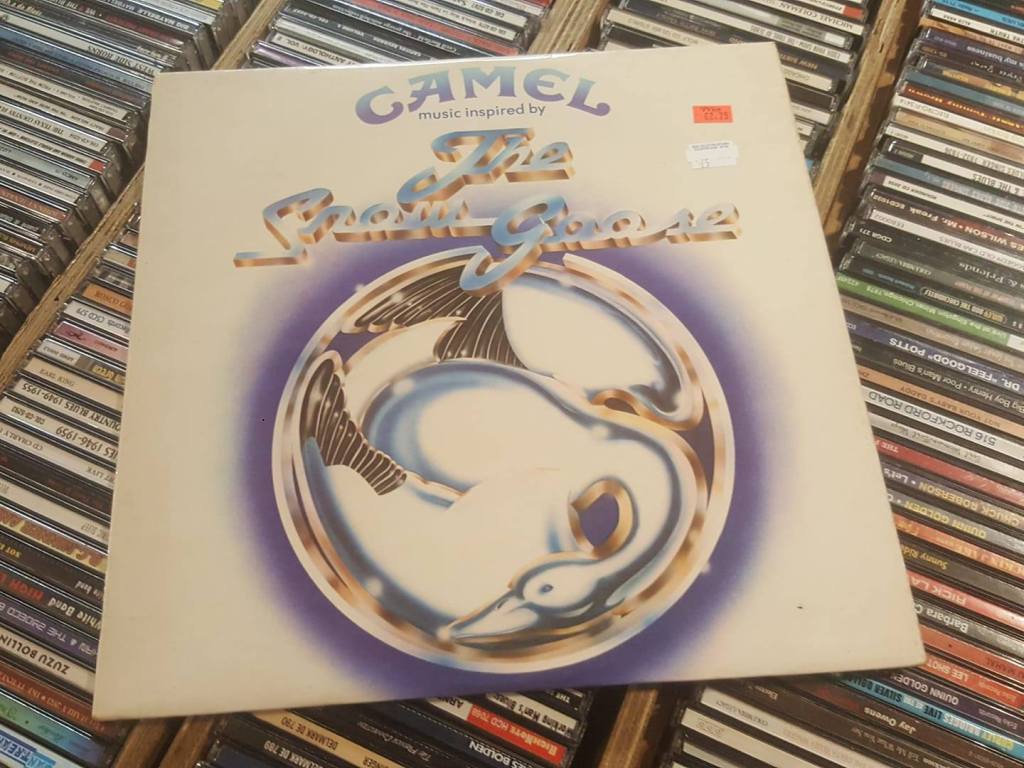
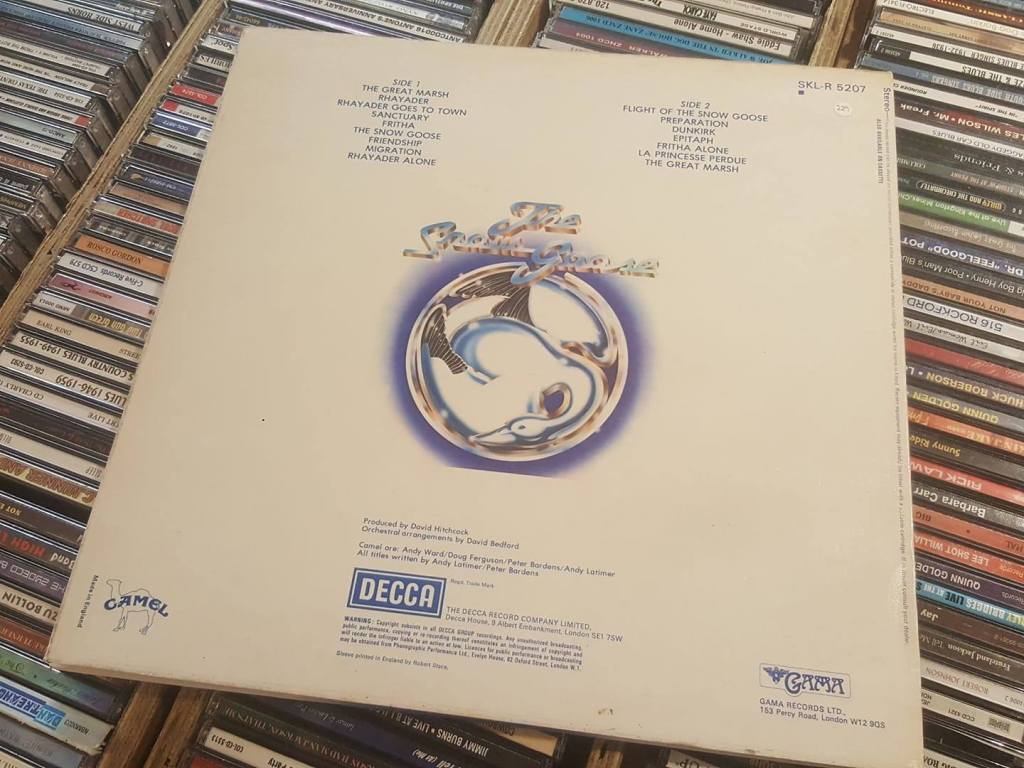
Post lawsuit version of the back cover of Camel’s “The Snow Goose”. Picture courtesy of Ben’s Collectors Records The next year they released their fourth album, “Moonmadness” which continued the success. Ex-Circus saxophonist / flutist Mel Collins’ joined the band for the subsequent tour and stayed involved with the group on and off for eight years. Ferguson departed in early 1977 and was replaced by Caravan bassist Richard Sinclair. This new line-up released “Rain Dances” in ’77 and “Breathless” in ’78. The band also appeared at the Rider Open Air Festival, Scheeßel, Germany on the 3 or 4 September ’77, along with two other local talents, namely The Stranglers and Graham Parker, back by The Rumour. The release of “Breathless” also saw the departure of Bardens, who was replaced by two keyboard players from Caravan: Dave Sinclair (Richard’s cousin) and Jan Schelhaas for the album tour. Both Sinclairs left the band after the Breathless tour, replaced by Kit Watkins (keyboards) and Colin Bass (bass). The success of Camel didn’t stop Latimer returning to his local roots and jamming with the likes of House at The Three Lions, Farncombe.

Latimer jamming with Tony Backhurst of House at Scratchers, Farncombe, 20 December 1978. Picture courtesy of Fred Pipes. The 70’s closed out with the release of “I Can See Your House from Here”. On 6 October ’79, Camel played at the Recreation Centre, Farnborough. The band had been booked to play at Farnborough Tech months earlier, but had cancelled at the very last minute. Having been burnt once, the college’s Social Secretary did not want to book the band again. As a result Cris Savill, unable to find anyone else to take it on, booked the band himself and went down to the Recreation Centre and put down the deposit. Camel’s agency charged him £1500 for the band to play, which Savill recalls as being half what Thin Lizzy charged at the time. The band lived up to expectation and reportedly performed “ICE”, from “I Can See Your House from Here”, live for the very first time – If only the venues acoustics could have done the performance justice. Tim Naylor worked on the stage crew that night and remembers the head roadie telling the crew to “Move this…but watch out…it’s heavy…”; and amazingly being right every time. On 18 October ’79, Camel play Friars, Aylesbury followed by the Apollo, Glasgow on 22 October.

Validated ticket for Camel at Farnborough Rec. Picture Courtesy of Martin Davies via Farnborough (Hants) Nostalgia 1981’s “Nude” saw their return to the concept album; based on the story of Hiroo Onoda, the Japanese soldier found on an island many years after World War II had ended. Duncan Mackay provided most of the keyboards in lieu of Watkins and Schelhaas, who were involved in other projects, but returned for the tour. This was the first album to feature lyrics by Latimer’s future wife Susan Hoover. The Nude Tour was followed by the band’s 10th Anniversary tour over May and June ’81.

May/June 1981: Camel’s 10th Anniversary Tour. Source: Jim Jones In mid-’81, Ward stopped playing drums as a result of alcohol and drug abuse and Camel quietly disbanded. Years later it was revealed that Ward had attempted suicide. However, there was still a contract to fulfill and pressure from Decca lead to Latimer being joined by guest and session musicians, including David Paton (bass), Chris Rainbow (vocals) and Anthony Phillips (guitar / keyboards). The band continued touring through ’82 and produced “The Single Factor” album and the Tenth Anniversary Tour, featuring Paton, Rainbow, Watkins, Stuart Tosh (drums) and Andy Dalby (guitar) accompanying Latimer. Royalty disagreements lead to a five year legal battle with their former manager. For ’84s “Stationary Traveler” Latimer was joined by Kayak keyboardist Ton Scherpenzeel and ex-10cc drummer Paul Burgess. Bass returned for the tour, which also included Rainbow. Shows at the Hammersmith Odeon were filmed and included additional keyboardist Richie Close and guest appearances by former members Bardens and Collins.
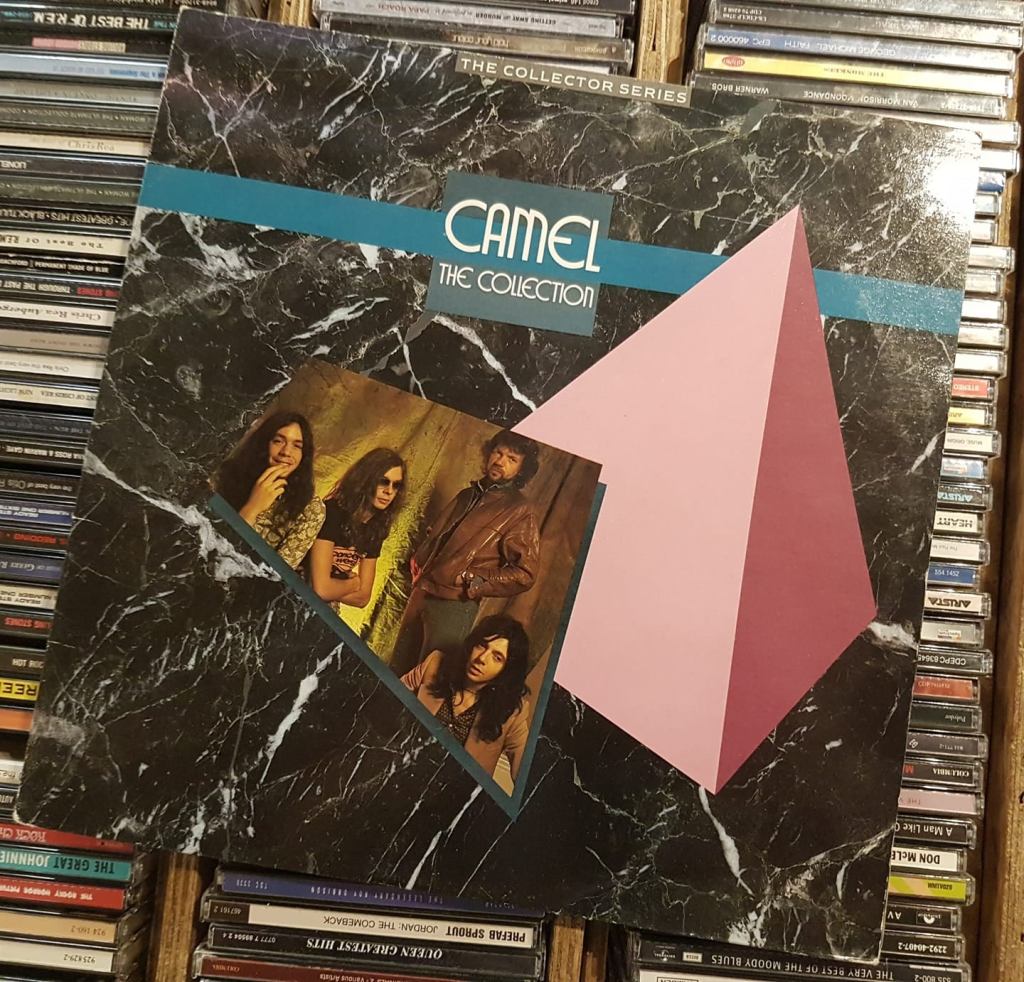
Camel’s “The Collection” compilation double LP was released 1985 on the Castle Music label. Picture courtesy of Ben’s Collectors Records The release of the live album “Pressure Points” in late ’84 wrapped up the the contract with Decca. Then in ’85 “The Collection” a double LP compilation was released on the Castle Music label. But, unable to interest other British record companies Camel quietly disappeared and Latimer moved to California when the aforementioned management lawsuit ended in his favor.
Seven-year later, Latimer revived Camel, releasing “Dust and Dreams”, in ’91. Partly recorded before Latimer’s move stateside it was inspired by John Steinbeck’s classic novel The Grapes of Wrath and released under Latimer’s own label Camel Productions. Mickey Simmonds (keyboards) joined Latimer, Bass and Burgess for the 1992 “comeback” world tour from which the live double CD, recorded in the Netherlands, “Never Let Go”, was released in ’93.
The next year, former members Bardens and Ward formed Mirage with members of Caravan. Their set list included numerous Camel tracks, but this quickly faded as Barden left and the band dropped all the other Camel or Caravan alumni. Inspired by the death of his father, Latimer and Hoover wrote “Harbour of Tears” under the Camel name, released in 1996. They toured again in ’97 with Latimer, Bass, Dave Stewart (drums), and Foss Patterson (keyboards) releasing the “Coming of Age” live double-CD and VHS in ’98.
In ’99 Latimer, Stewart, Bass and Scherpenzeel, recorded “Rajaz”. Stewart left to manage a drum store in Scotland and was replaced by Denis Clement (drums). This was quickly followed by Scherpenzeel’s departure, who was replaced by Guy LeBlanc (keyboards). In 2002 this new quartet released “A Nod and a Wink”, dedicated to Bardens, who died in January 2002. Latimer’s Camel Productions announced that the 2003 tour would be Camel’s ‘Farewell Tour’. LeBlanc quit shortly before the tour due to the illness of his wife, and was replaced by Tom Brislin in the US and Scherpenzeel for the European leg.
In May 2007, Hoover announced through Camel Productions that Latimer has suffered from polycythaemia vera since ’92 which had progressed to myelofibrosis. Latimer underwent chemotherapy and a bone marrow transplant in November 2007. He responded well, but has suffered fatigue and severe joint pain since, as recovery progresses.
In March 2013, Camel Productions confirmed a ‘Retirement Sucks Tour’ with the announcement of a concert at the Barbican Arts Centre, London on 28 October, where Camel would perform The Snow Goose “in its entirety for the first time since the Royal Albert Hall concert in 1975” (the last full performance was actually at Reading Town Hall on 18 December 1975) with other dates across Europe. The band also released a new and extended re-recording of The Snow Goose album on 4 November 2013, “dedicated to the memory of Peter Bardens (1945-2002)”, and also thanks Ferguson and Ward for their contributions to the original music and album.
Shortly after the 2013 tour, Camel announced a further 14 dates in 2014. Ill health prevented LeBlanc taking part, and was replaced by Scherpenzeel. LeBlanc died in April the next year. In October 2017, Camel announced a concert at the Royal Albert Hall, London for the following September; and 30 more dates in Japan, Turkey, Israel, Netherlands, Poland, Germany, Spain, Portugal and England, where the band would perform ‘Moonmadness’ in its entirety.
When Ferguson left in ’77 he formed Headwaiter and later became a property developer.
Gallery:

10 March 1972: Camel supported Mungo Jerry at Goldsmiths College. 
23 July 1972: Stackridge w/ Camel 
Cover of Camel’s Camel, their debut studio album, released on MCA Records in February 1973. Picture courtesy of Ben’s Collectors Records 
25 August 1973: Camel played the Windsor Free Festival. 
24 October 1973: Camel play Fletcher Hall, Leicester 
Camel played the 1974 Reading Festival on Saturday, 23rd August. Source: John Berry’s post in The Reading & Thames Valley Area “Memories of another day” 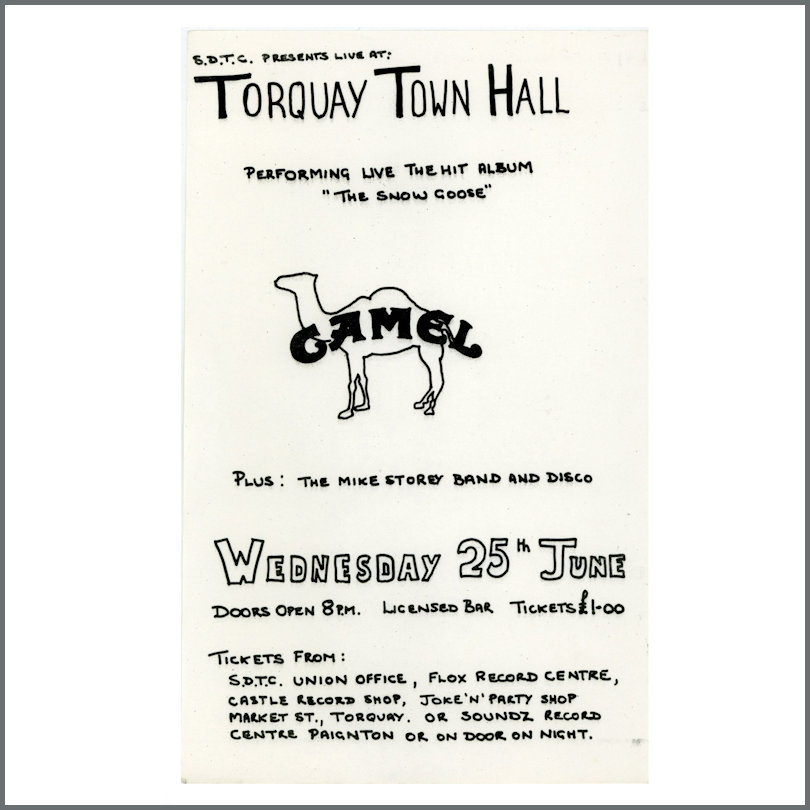
25 June 1975: Camel played the Town hall, Torquay. Source: www.tracks.co.uk 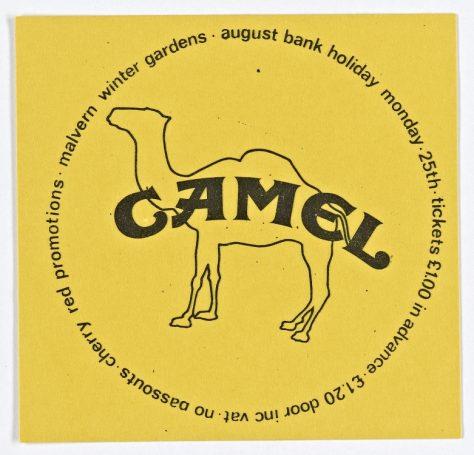
25 August 1975: Ticket to see Camel at Winter Gardens, Malvern. Source: www.malvernrockarchive.org.uk 
6 July 1975: Advert for Camel, supported by The Mike Storey Band, playing the New London Theatre, Drury Lane. Source: Mark Stang vis Keep It Out Of Sight 
8 November 1975: Handbill (front) for Camel at Friars, Aylesbury. Source: www.track.co.uk 
8 November 1975: Handbill (back) for Camel at Friars, Aylesbury. Source: www.track.co.uk 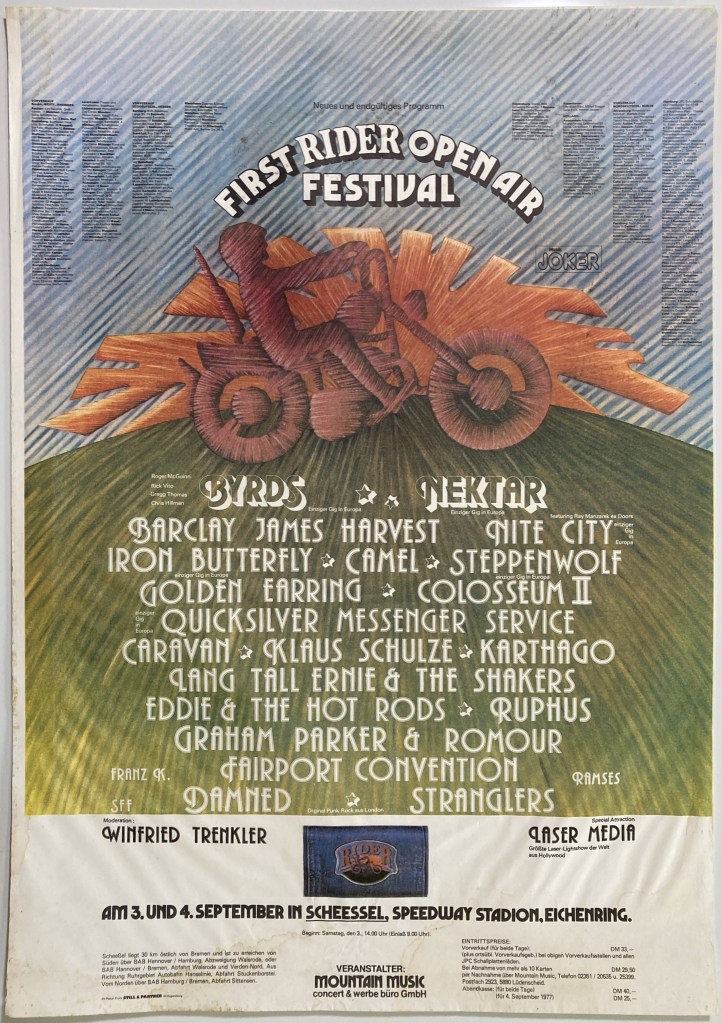
3 & 4 September 1977: Camel, Stranglers, and Graham Parker all on the bill for Rider Open Air Festival in Scheeßel, Germany. Source: www.omegaauctions.co.uk 
Barbed Wire cover featuring Andy Latimer of Camel. Gus Garside interviewed Latimer for this Feb/March 1979 issue of the fanzine. Picture Courtesy of Fred Pipes 
First page of Gus Garside’s interview with Andy Latimer of Camel on page 4 of the Feb/March 1979 issue of the Barbed Wire fanzine. Picture Courtesy of Fred Pipes 
Second page of Gus Garside’s interview with Andy Latimer of Camel on page 5 of the Feb/March 1979 issue of the Barbed Wire fanzine. Picture Courtesy of Fred Pipes 
Third page of Gus Garside’s interview with Andy Latimer of Camel on page 6 of the Feb/March 1979 issue of the Barbed Wire fanzine. Picture Courtesy of Fred Pipes 
Forth and final page of Gus Garside’s interview with Andy Latimer of Camel, covering the first column of page 7 of the Feb/March 1979 issue of the Barbed Wire fanzine. Picture Courtesy of Fred Pipes 
18 October 1979, Friars, Aylesbury: 
22 October 1979: Camel play the Apollo, Glasgow 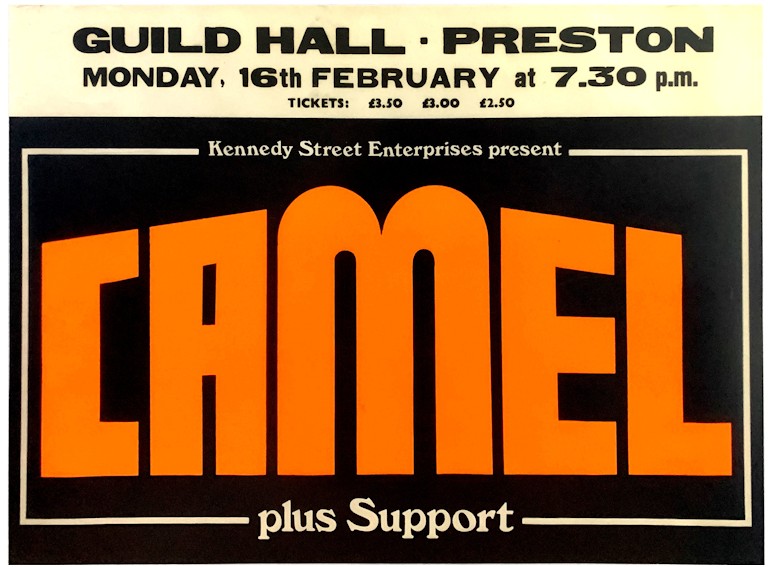
16 February 1981: Camel played the Guild Hall, Preston. Source: www.tracks.co.uk 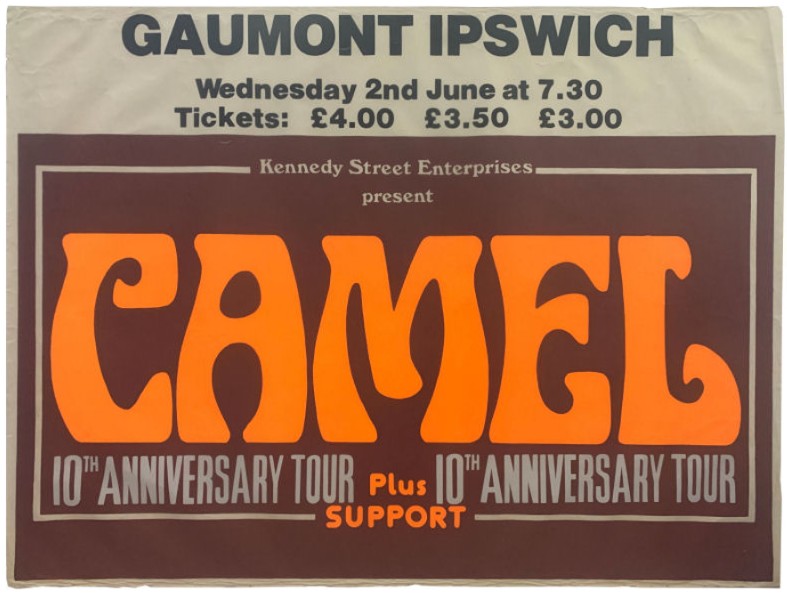
2 June 1981: Camel played the Gaumont, Ipswich. Source: www.tracks.co.uk 
15 May 1982: Camel at West Runton. Source: West Runton Pavilion…Gone But Not Forgotten 
15 May 1982: Camel at West Runton.. Source: Robert Coleman via West Runton Pavilion…Gone But Not Forgotten 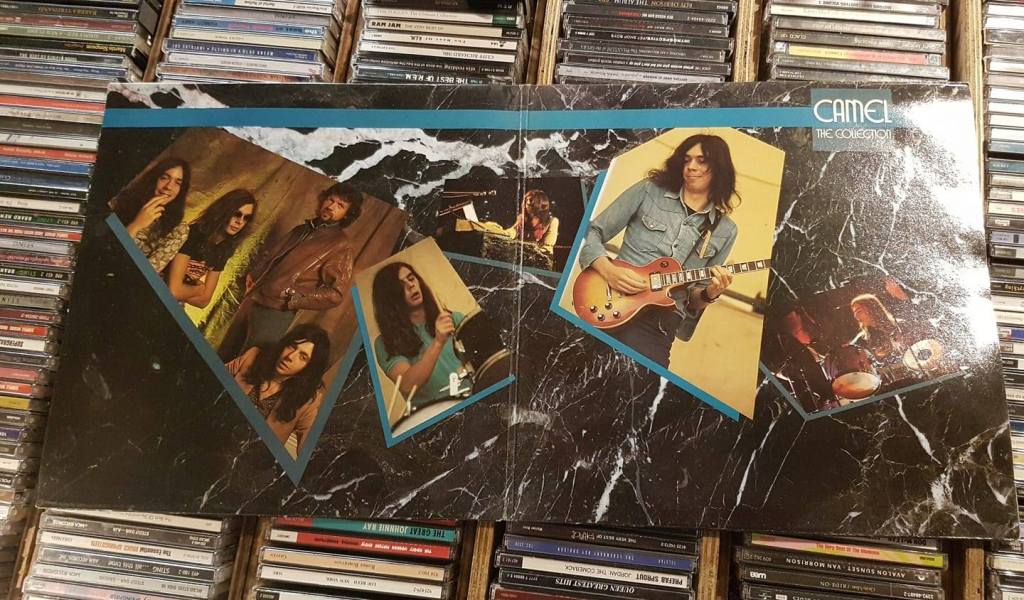
Camel’s “The Collection” compilation double LP was released 1985 on the Castle Music label. Picture courtesy of Ben’s Collectors Records 
Cover of Camel’s “MoonMadness”. Picture courtesy of Ben’s Collectors Records 
Interior gatefold of Camel’s “MoonMadness”. Picture courtesy of Ben’s Collectors Records 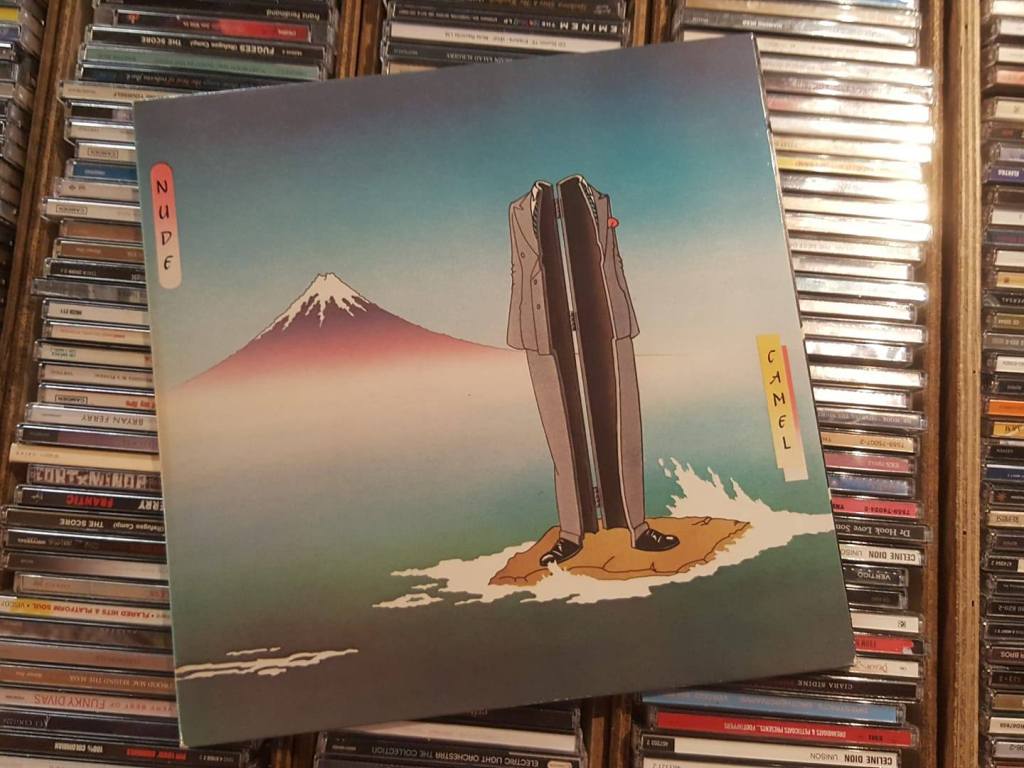
Cover of Camel’s “Naked”. Picture courtesy of Ben’s Collectors Records 
Camel featured in Oct 2019 issue of Prog. Picture courtesy of Sev Lewkowicz 
Camel’s “Lunar Sea, An Anthology 1973-1985” CD. Picture courtesy of Ben’s Collectors Records 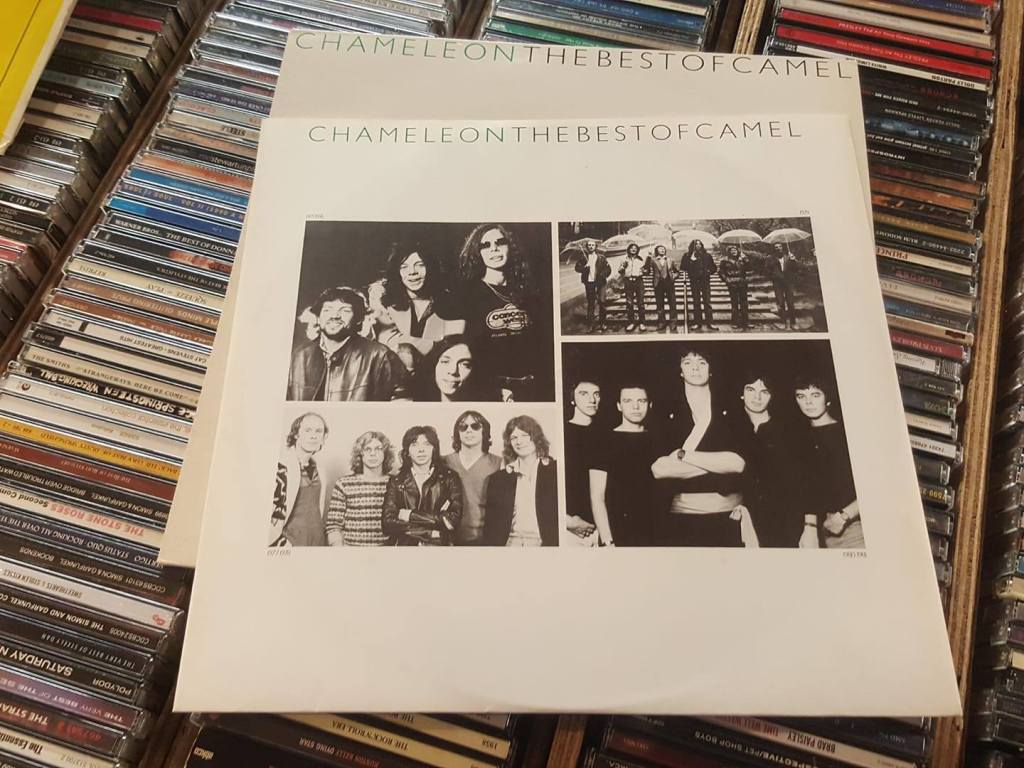
Camel’s “Cameleon The Best of Camel”. Picture courtesy of Ben’s Collectors Records 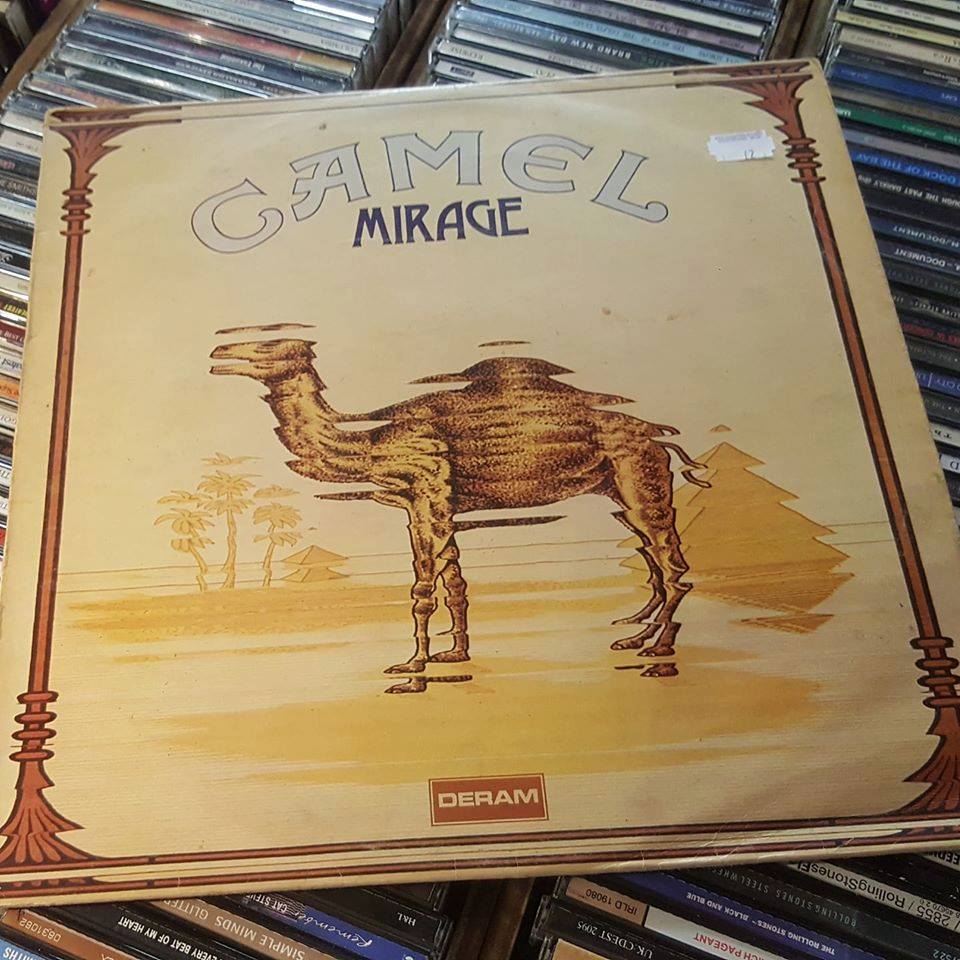
Camel’s “Mirage”. Picture courtesy of Ben’s Collectors Records 
Camel’s “Mirage” inner sleeve. Picture courtesy of Ben’s Collectors Records 10cc, Andrew Latimer, Andy Dalby, Andy Ward, Anthony Phillips, Apollo, Aylesbury, Barbican Arts Centre, BBC 2, Beckett, Belfast, Camel, Camel Productions, Caravan, Castle Music, Chris Rainbow, Circus, Civic hall, Colio Bass, Cris Savill, Dave Paton, Dave Sinclair, Dave Stewart, Decca, Denis Clement, Deram Records, DJM Records, Doug Ferguson, Duncan Mackay, Farnborough, Farnborough Tech, Fletcher Hall, Foss Patterson, Friars, Fumble, Gasworks, Gaumont, Germany, Glasgow, Goldsmiths College, Graham Parker, Graham Parker & The Rumour, Guild Hall, Guildford, Guy LeBlanc, Hammersmith Odeon, Headwaiter, Hiroo Onoda, House, Hustler, Ipswich, Jan Schelhaas, John Steinbeck, Johnny Mars, Jon Benns, Kayak, Kit Watkins, Ladyland, London, London Symphony Orchestra, Malvern, MCA Records, Mel Collins, Melody Maker, Mickey Simmonds, Mirage, Mungo Jerry, New London Theatre, New York City, Nutz, Old Grey Whistle Test, Paul Burgess, Paul Gallico, Pavilion, Peter Bardens, Peter Bardens On, Phillip Goodhand-Tate, Preston, Reading, Reading Festival, Recreation Centre, Richard Sinclair, Richie Close, Rider Open Air Festival, Royal Albert Hall, Scheeßel, Shotgun Express, Stackridge, Stuart Tosh, Susan Hoover, Technical College, The Brew, The Mike Storey Band, The Sensational Alex Harvey Band, The Stranglers, Them, Thin Lizzy, Tim Naylor, Tom Brislin, Ton Scherpenzeel, Torquay, Town Hall, Waltham Forest, West Runton, Windsor Free Festival, Winter Gardens, Wishbone Ash -
Drowning Craze

(c.’81-’82) – Paul Cummins (guitar), Simon Raymonde (bass), Simon Godfrey (drums) and Angela Jaeger (vocals).
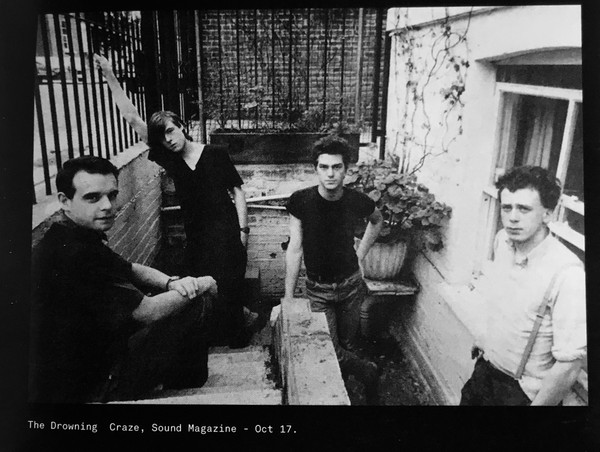
The Drowning Craze, from Sounds Magazine Prior to Jaeger ‘joining’; Cummins, Raymonde – the son of Dusty Springfield hit writer and arranger for The Walker Brothers, Ivor Raymonde – and Godfrey had been in Guildford based Disruptive Patterns with Andy McInnes (vocals). Situation Two label founder Peter Kent heard their instrumental demo – Raymonde worked below the office of this Beggars Banquet label offshoot at Beggars Banquet Record shop in Earls Court – and decided they would make a great vehicle for a singer on their books. Kent introduced the band to New Yorker Jaeger. Who knows who broached what with McInnes, but the band become Drowning Craze and were now fronted by Jaeger. Both changes instigated by Situation Two with whom they had now signed joining The Associates, and New Asia as the labels first recording artists.
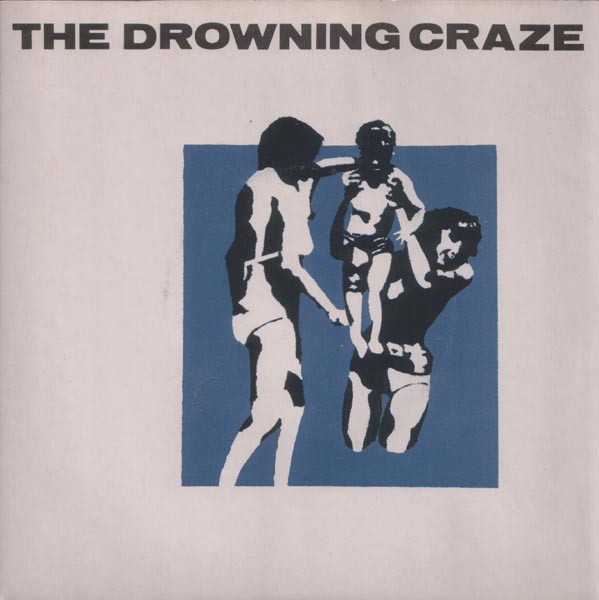
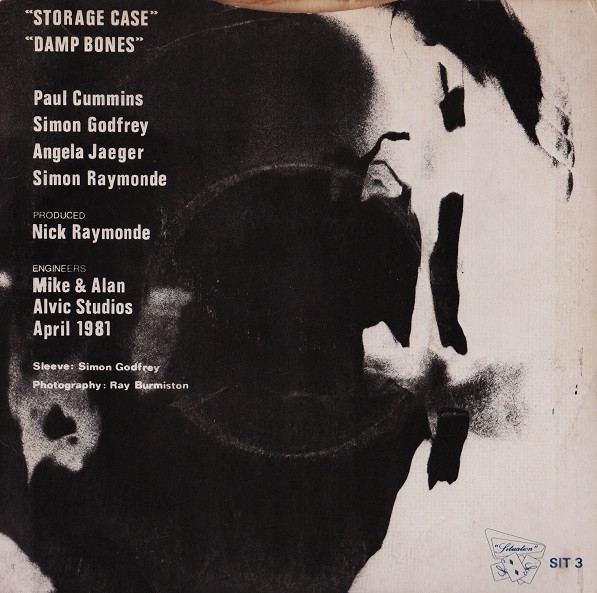
Drowning Craze’s 1981 “Storage Box” 7in single The next week they recorded their debut single in the Alvic Studios, produced by Nick Raymonde, “Storage Case” [SIT 3] which was released on 24 June ’81, becoming Paul Morley of NME and Melody Maker’s “Single of the Week”. Jaeger undertook that recording session and only one live gig with the band before leaving for the US, and was replaced by another Kent contact, Frank Nardiello (vocals) from Chicago.
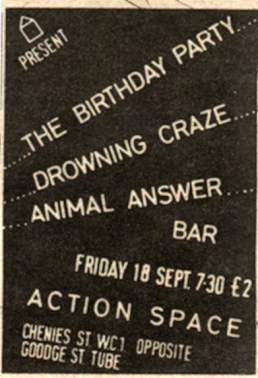
18 September 1981: The Birthday Party with Drowning Craze and Animal Answer. Source: UK Mag dated Sept ’81 from collection of http://www.fromthearchives.org In September ’81, Drowning Craze, along with Animal Answer, supported The Birthday Party at Action Space in London with subsequent music press reviews ignoring Nick Cave’s tales of violence and perversion and focusing in on the support. They also support visited Heaven, under the arches at Charing Cross to support Divine, with Dead or Alive. “Trance” [SIT 13], their second single, was released on 17 October ’81. In November ’81, an excerpt of “Trance” was included on the third issue of Morrocci Klung!; a C60 audio magazines.
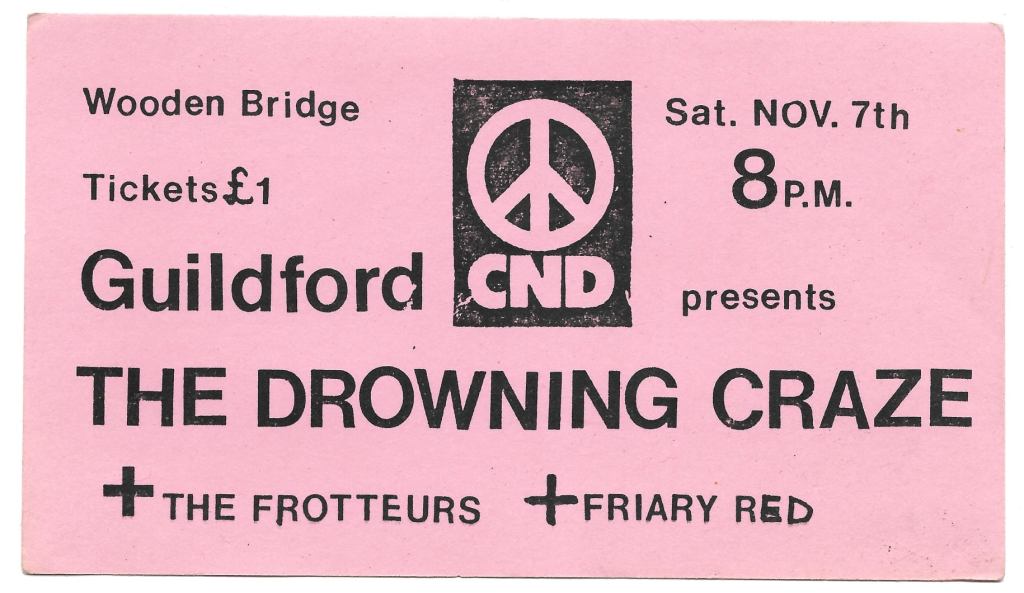
Flyer from 1981 for a CND benefit gig at the Wooden Bridge. Friary Red was a misprint – the band was actually Ferrari Red. That same month, on 7 November, they headlined a benefit gig at The Wooden Bridge, Guildford for CND, with The Frotteurs, and Ferrari Red in support. They recorded a Peel Session that aired on 13 Jan ’82, featuring: “In the Heat”, “Keep Fit”, “Out of Order” and “He Was”. During this time they could also be seen supporting the likes of Bauhaus, and Modern English. The group disbanded after a third single, “Heat” [SIT 16]; released 3 March ’82. Raymonde is reported as saying “Artistic differences and the guitarist qualifying as an accountant led to the band’s demise, probably a blessing in disguise”.
Raymonde went on to become a Cocteau Twin and now owns / runs the Bella Union label that he set up. Jaeger did backing vocals for Billy MacKenzie, Monochrome Set, and Pigbag. Nardiello, aka Groovie Mann, became the lead singer of Thrill Kill Kult in the late 80s. Godfrey subsequently appeared in Freefall, Tinyfish, and – after moving to the US – Valdez. Cummins became an accountant.
2004’s “1981” compilation Jumping ahead to 2003, three Drowning Craze tracks: “The Heat”, “He Was”, and “Trance” were included on the limited Thrill Kill Kult fan club release “My Life With The Thrill Kill Kult [Groovie 13]. The next year, the band’s “Storage Case” appeared on the nine CD and 251 MP3 compilation titled “1981”. “Storage Case” also appeared on the Cherry Red Records ‘To The Outside Of Everything (A Story Of UK Post Punk 1977-1981)’ compilation released in 2017. In 2018, Raymonde’s label, Bella Union, announced the release of a Drowning Craze compilation album, Singles ’81-’82, collecting all three singles as well as the Peel Session tracks.
Gallery:
Short piece from the Bitch Bitch fanzine on formation of Drowning Craze. Picture courtesy of John Hudson 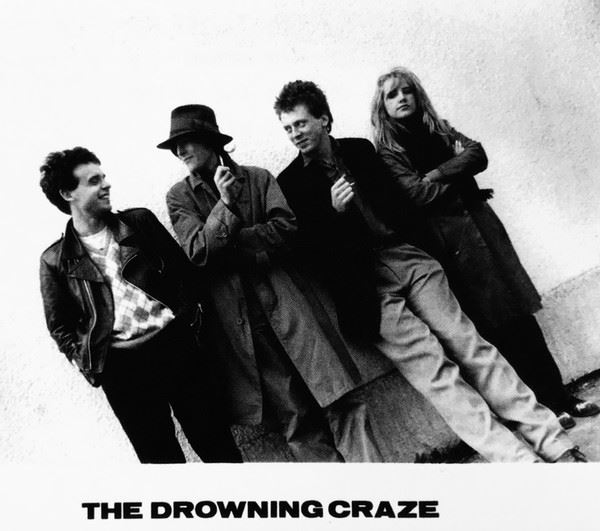
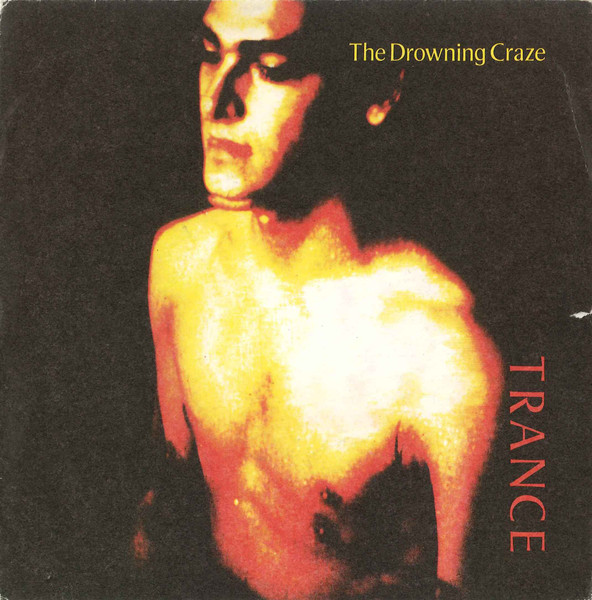
Drowning Craze’s 1981 “Trance” 7in single sleeve front 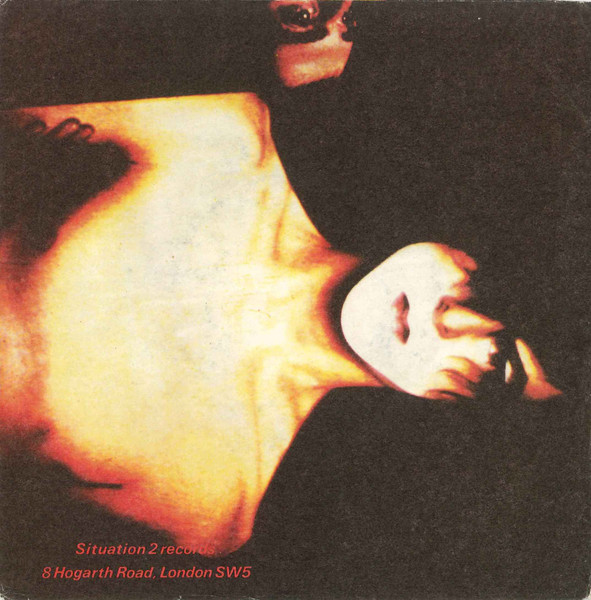
Drowning Craze’s 1981 “Trance” 7in single sleeve back 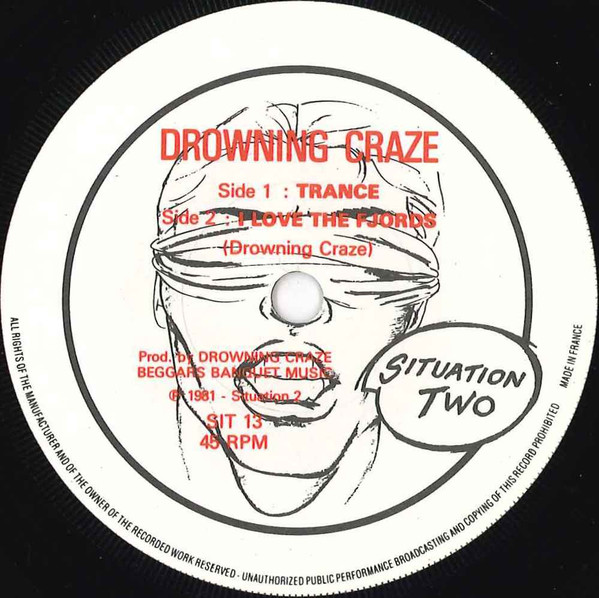
Drowning Craze’s 1981 “Trance” 7in single side-A 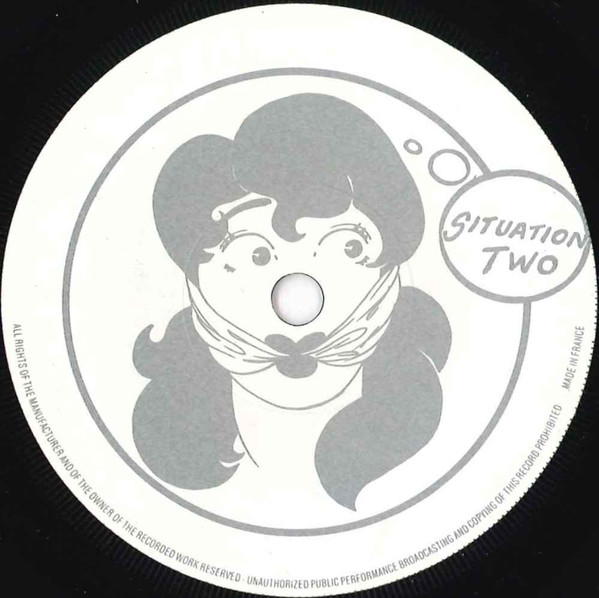
Drowning Craze’s 1981 “Trance” 7in single side-B 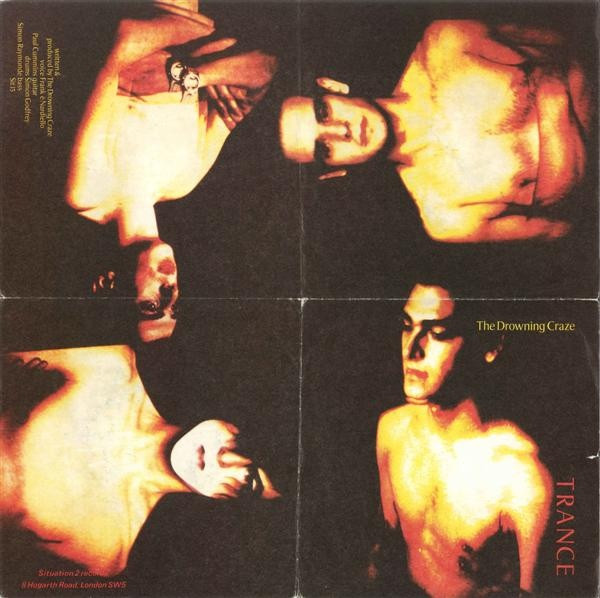
Drowning Craze’s 1981 “Trance” 7in single’s poster insert 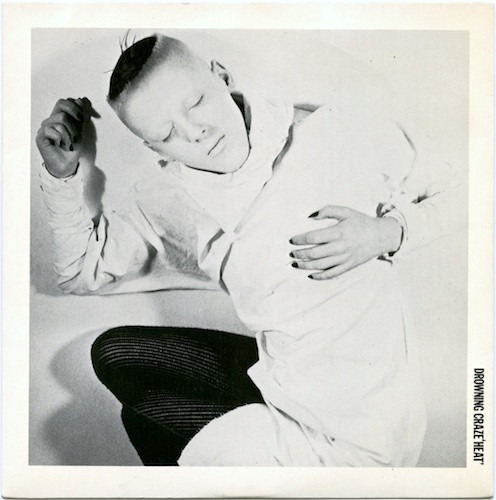
Drowning Craze’s 1982 “Heat” 7in single sleeve front 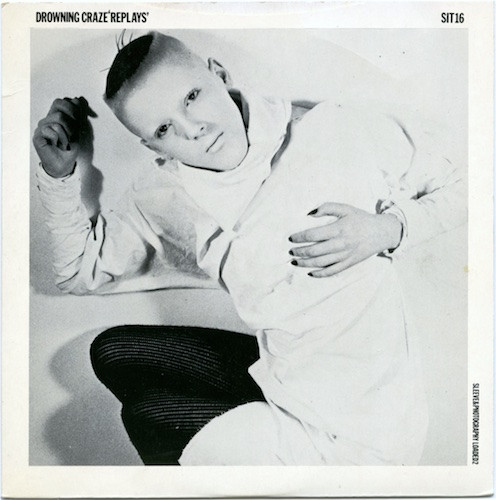
Drowning Craze’s 1982 “Heat” 7in single sleeve back 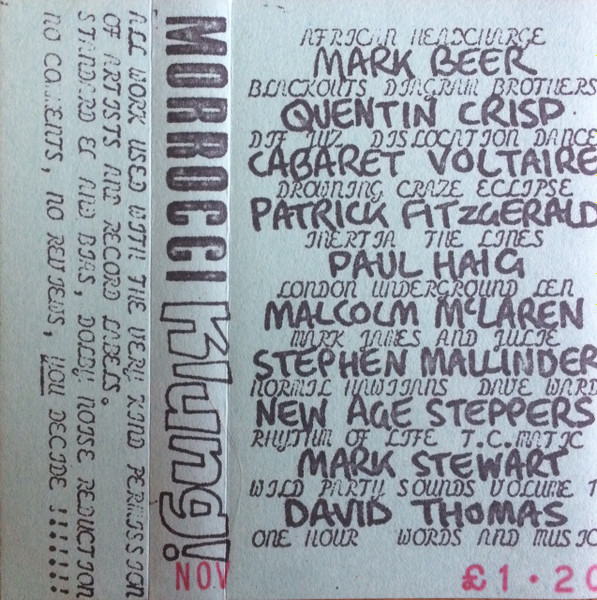
The 3rd issue of Morrocci Klung! 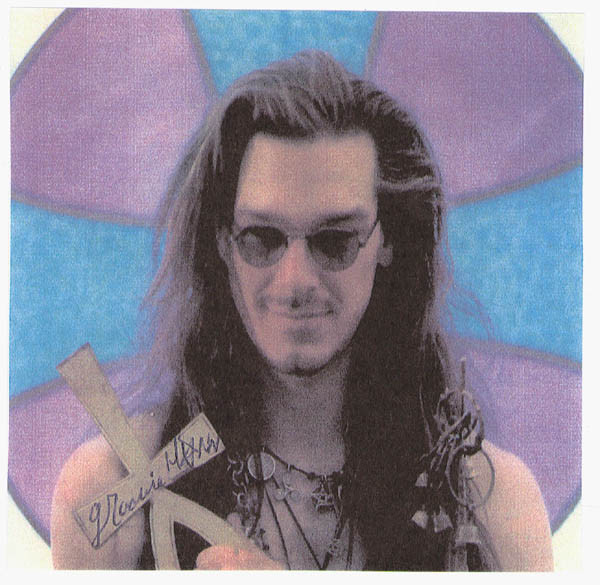
Front sleeve of Thrill Kill Kult fan club release “My Life With The Thrill Kill Kult [Groovie 13] 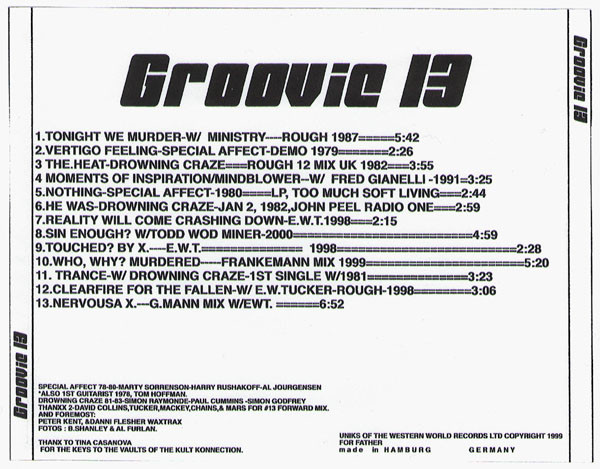
Back sleeve of Thrill Kill Kult fan club release “My Life With The Thrill Kill Kult [Groovie 13] 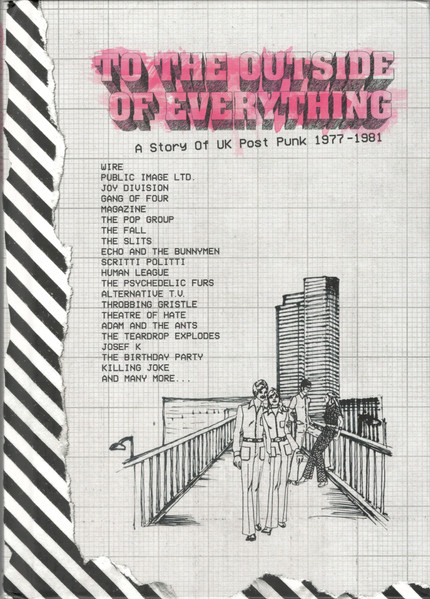
The Cherry Red labels ‘To The Outside Of Everything (A Story Of UK Post Punk 1977-1981)’ compilation released in 2017 – Front Cover 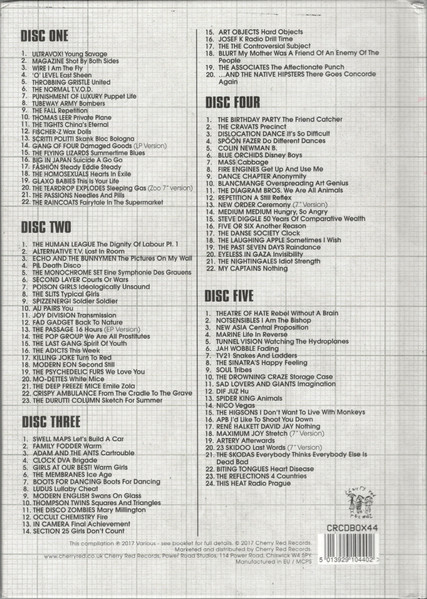
the Cherry Red labels ‘To The Outside Of Everything (A Story Of UK Post Punk 1977-1981)’ compilation released in 2017 – Track Listing 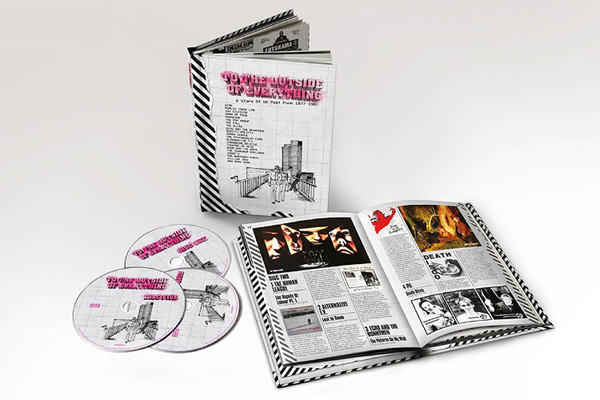
the Cherry Red labels ‘To The Outside Of Everything (A Story Of UK Post Punk 1977-1981)’ compilation released in 2017 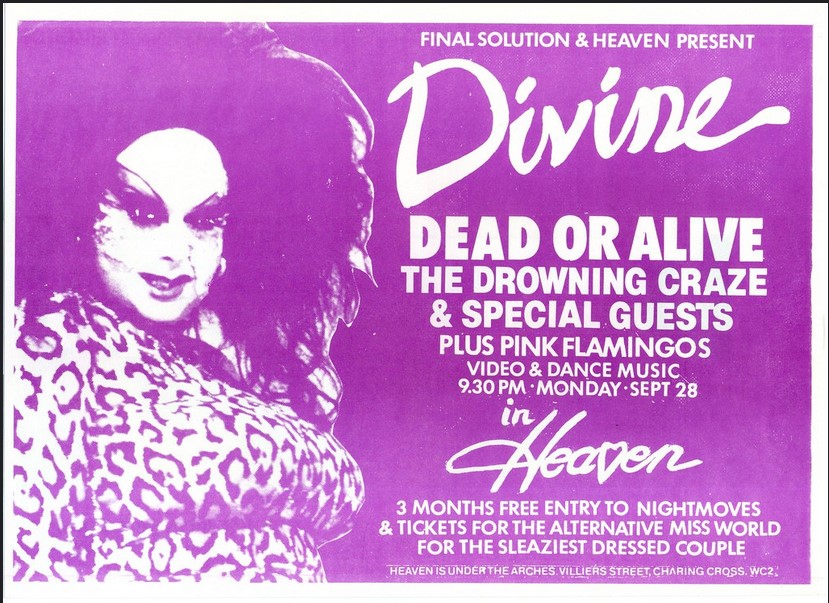
28 September 1981: Divine with Drowning Craze and Ded or Alive. Action Space, Alvic Studios, Andy McInnes, Angela Jaeger, Animal Answer, Bauhaus, Beggars Banquet, Bella Union, Billy MacKenzie, Charing Cross, Cherry Red Records, Cocteau Twins, Dead or Alive, Disruptive Patterns, Divine, Drowning Craze, Dusty Springfield, Ferrari Red, Frank Nardiello, Freefall, Groovie Mann, Guildford, Heaven, Ivor Raymonde, London, Melody Maker, Modern English, Monochrome Set, Morrocci Klung!, New Asia, Nick Cave, Nick Raymonde, NME, Paul Cummins, Paul Morley, Peel Session, Peter Kent, Pigbag, Simon Godfrey, Simon Raymonde, Situation Two, The Associates, The Birthday Party, The Drowning Craze, The Frotteurs, The Walker Brothers, Thrill Kill Kult, Tinyfish, Valdez, Wooden Bridge -
Ricky & The Rhythmics

(c’60-’67) – Peter “Ricky Clayton” Arthur (vocals), Errol “Lew / Lou” Newman (bass), Chris “Butch” Butcher (guitar), Tom O’Looney (guitar) and Geoff Salmon (drums).

Ricky & The Rythmics (L-R: George Trask (roadie), Butcher, Salmon, O’Looney, Arthur and Ted Cassell (bass guitar). Picture courtesy of Peter Arthur Guildford based Ricky & The Rhythmics were sometimes seen under just The Rhythmics or fuller Ricky Clayton and the Rhythmics monica at gigs around Guildford, Woking, Horsham, Lymington, etc. They played every weekend and up to three week nights – including the Social Club, Farncombe; Village Hall, Merrow, Civic Hall, Guildford and T.A. Centre, Guildford – in fact just about every club within a 60 mile radius of Guildford is likely to have hosted the band at least once. They were also house band at The Tunsgate Club, Guildford for a while.

Ricky & the Rhythmics (R-L: Butcher, Erroll Newman, Tom Terny, Arthur, Salmon) on the Tunsgate Club roof over Russell & Bromley. Picture courtesy of Bens Collectors Records Arthur, who joined the O’Looney led band about a year after they were formed by Butcher, only recently revealed that the Ricky Clayton name is a combo of his second name ‘Richard’ and a pin in a list of names that blindly landed on ‘Clayton’. Arthur had previously been in The Leopard Spots and The Canal Street Ramblers. O’Looney had replaced Tom Terny (guitar). Newman had attended the Royal Grammer School where he picked up the nickname Lew, and was not the bands first bassist; that was Ted Cassell, who was O’Looney’s neighbour on Hillspur Close, Westborough. The band could be heard practicing at Onslow School.
The Village Hall, Merrow hosted the band on 18 May ’63 and on 27 November ’63, The Rhythmics took part in a charity gig at Civic Hall, Guildford for Oxfam along with Humphrey Lyttleton, Cyril Davis All Stars, Long John Baldry and the Velvettes, and The Yardbirds.
At some point Penny Collins, from Aldershot, joined the boys as a vocalist. George Trask, on leaving the Navy in ’61, used to roadie for the band while Salmon drove the band’s 40-seat coach. Prior to the coach the band had their own van owned and driven by Richard “Sim / Simo” Simpson.

Ricky and the Rythmics first transport in the early 60s. Richard “Sim / Simo” Simpson (with guitar alongside Arthur) owned and drove the van. Picture courtesy of Peter Arthur. O’Looney moved to America and became a pilot, flying out of Newark, NY. He still lives in New York. Newman sadly passed away in 2016/17 at his home in North Somerset after being diagnosed with cancer. Arthur moved to France where he passed in September 2019. Collins also sadly left us in 2017. Salmon now lives in Ross-on-Wye. Butcher was contacted by Arthur c’2018 and was still in Fairlands.
Gallery:

Press clipping of Ricky & The Rythmics (date unknown). The photo was taken at Tunsgate Square in front of Boxers coffee house. Picture courtesy of Peter Arthur 
Clippings (date/s unknown) covering the ‘Guildford and Godalming Times’ pop dance featuring Ricky Clayton and the Rhythmics. Picture courtesy of Bens Collectors Records 
18 May 1963: Handbill for Ricky Clayton & The Rythmics gig at Merrow Village Hall. Picture courtesy of Bens Collectors Records 
Ricky & The Rhythmics in early special effect picture taken at The Tunsgate Club, Guildford. Picture courtesy of Bens Collectors Records 
27 November 1963: Flyer for charity gig at Civic Hall, Guildford featuring: Humphrey Lyttleton, Cyril Davis All Stars, Long John Baldry and the Velvettes, The Yard Birds and The Rhythmics. Picture courtesy of Bens Collectors Records 
Ricky and the Rythmics (L-R O’Looney, Butcher, Arthur, Salmon, and Newman). Picture courtesy of Peter Arthur Aldershot, Chris Butcher, Civic hall, Cyril Davis All Stars, Errol Newman, Erroll Newman, Farncombe, Geoff Salmon, George Trask, Guildford, Horsham, Humphrey Lyttleton, Long John Baldry and the Velvettes, Lymington, Merrow, Penny Collins, Peter Arthur, Richard Simpson, Ricky & The Rhythmics, Ricky and the Rhythmics, Ricky Clayton, Ricky Clayton & The Rhythmics, Social Club, T.A. Centre, Ted Cassell, The Canal Street Ramblers, The Leopard Spots, The Rhythmics, The Yardbirds, Tom O’Looney, Tom Terny, Tunsgate Club, Village hall, Woking -
The Phantom Four

(c’64-’68) – Richard Over (rhythm guitar), Ian Latimer (bass / vocal), Andrew Latimer (guitar) and Alan Butcher (drums).
Started by Butcher and the Latimer brothers – Andrew was 15 at the time – this 4-piece beat/harmony/blues group formed in ’64. They gigged in and around their Guildford hometown developing a positive notoriety with appearances at the Civic Hall, Guildford and supporting the likes of Artwoods, Savoy Brown, John Mayall, Graham Bond, and Alan Bown at The Wooden Bridge, Guildford. In addition to guitar, Andrew Latimer had learnt to play the piano with Mrs Shoebridge, but this skill was never used in The Phantom Four.
On 17 December ’64, the band, along with Smokestakks, supported Hogsnort Rupert and His Band at the End of Term Dance organized by Guildford School of Art Student Union and held at the school. They won a Battle of the Bands at Charlotteville Youth Club were the Primevals were runners-up. When Over left he was replaced by Graham Cooper and they became Strange Brew. Then, in summer 1968, Ian Latimer and Cooper departed, leaving the remaining Latimer brother and Butcher to form The Brew.
In June 2003: Phillip Goodhand-Tait and the Stormsville Shakers, The Switch, The Phantom Four and Razzle Dazzle got together and played a final gig at the Civic Hall, Guildford.
Gallery:
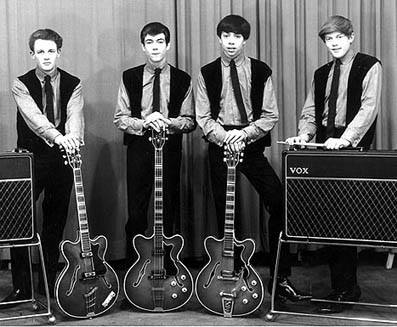
The Phantom Four: Richard Over (rhythm guitar), Ian Latimer (bass / vocal), Andrew Latimer (guitar) and Alan Butcher (drums). 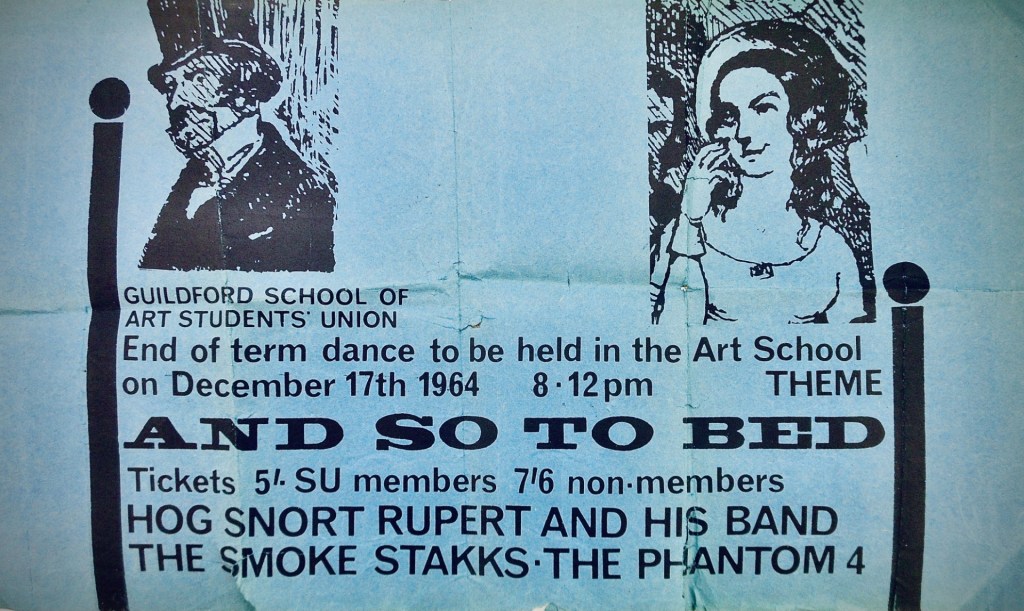
17 December 1964: The Phantom Foiur and Smokestakks supported Hogsnort Rupert and His Band. Image courtesy of William Neal 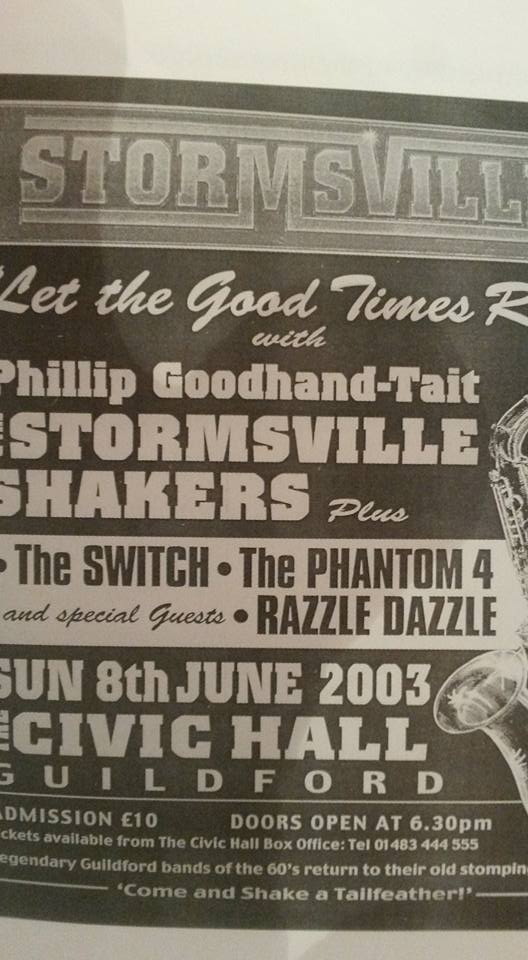
8 June 2003: Poster for “Let The Good Times Roll” featuring The Phantom Four at the Civic Hall, Guildford. Picture courtesy of Bens Collectors Records 8 June 2003: Page 1 of the programme for the ”60’s Return” gig at the Civic Hall, Guildford featuring The Phantom Four. Source Tina Lambley via Guildford Town Past & Present 8 June 2003: Page 2 of the programme for the ”60’s Return” gig at the Civic Hall, Guildford featuring The Phantom Four. Source Tina Lambley via Guildford Town Past & Present 8 June 2003: Page 3 of the programme for the ”60’s Return” gig at the Civic Hall, Guildford featuring The Phantom Four. Source Tina Lambley via Guildford Town Past & Present 8 June 2003: Page 4 of the programme for the ”60’s Return” gig at the Civic Hall, Guildford featuring The Phantom Four. Source Tina Lambley via Guildford Town Past & Present 8 June 2003: Page 3 of the programme for the ”60’s Return” gig at the Civic Hall, Guildford featuring The Phantom Four. Source Tina Lambley via Guildford Town Past & Present 8 June 2003: Page 6 of the programme for the ”60’s Return” gig at the Civic Hall, Guildford featuring The Phantom Four. Source Tina Lambley via Guildford Town Past & Present Alan Bown, Alan Butcher, Andrew Latimer, Artwoods, Battle of the Bands, Charlotteville, Civic hall, Graham Bond, Graham Cooper, Guildford, Guildford School of Art, Hogsnort Rupert and his Band, Ian Latimer, John Mayall, Mrs Shoebridge, Phillip Goodhand-Tate, Primevals, Razzle Dazzle, Richard Over, Savoy Brown, Smokestakks, Stormville Shakers, Strange Brew, The Brew, The Phantom Four, The Switch, Wooden Bridge, Youth Club -
University of Surrey, Guildford

A WORK IN PROGRESS
[Ed] Followers of Soundscene Does Facebook will know the history: Facebook decided that many of that groups’ posts were spam and deleted content and it couldn’t be retrieved. The most demoralizing was the University of Surrey, Guildford venue post with over 150 images, videos, sounds, and countless memories. Below is our work in progress, it is raw, but we are gradually piecing together all the source material once again – I hope you enjoy the process and progress and do please contribute whenever and whatever you can via the Facebook group, comments below, or email – Thank you.
Previously known as Battersea College of Technology and located in Battersea Park, London. In 1965, the university-designate acquired a greenfield site in Guildford from Guildford Cathedral, Guildford Borough Council and the Onslow Village Trust. On 9 September 1966 the University of Surrey was established by royal charter. During the transition from Battersea to Guildford, the Battersea campus on 25 October ’68 hosted Led Zeppelin’s very first gig – which is often incorrectly listed as occuring on the Guildford campus. By 1970 the move from Battersea to Guildford was complete.
The early days of live music at the Guildford campus are not the clear. We have found a listing that puts Shirley Collins at the University of Surrey on 7 June 1967, but this could have easily been at Battersea, not Guildford. We also have a listing ten days earlier than the Led Zeppelin gig at Battersea, on 15 October ’68, The Yardbirds did perform on the Guildford campus and the following month, on 8 November, Barclay James Harvest appeared. The university had a thriving Folk Club and as well as invited acts local folk groups, such as Jumble, performed. Then, to the best of our knowledge Valentine’s Day 1969 saw Barclay James Harvest return to the campus. This was followed on 11 March by Feathers. It would take a while for the Student Bar and Great Hall to become the de facto indoor venues, and on 30 May the Mechanical Engineering Block was utilized for a gig by Cage; who the next month, on 6 June, found themselves performing at the Backchat Symposium – wherever that was – and at the Stag Hill Dance on campus on 21 June.
In that first full year on the Guildford campus the university’s Student Union ENTS team kicked it all off with Mott the Hoople supported by Champion Jack Dupree on 17 January. At the end of the month Grimsby Dyke opened for The Small Faces, on 31 January. Guildford Sanitation Authority paid the university a visit on 14 March ’70, who along with Horse and Barnabus, supported David Bowie.

14 March 1970 Genesis appeared on 16 May ’70 and returned on 27 June to perform at the first Surrey Free Festival at the university along with Patto, May Blitz, Horse, Bridget St. John, CMU, Poppa Ben Hook, and Plinth. On 30 October ’70, Yes were on campus. The next month Tudor Lodge appeared on 4 November, Stray the next night, and Grail the night after that; with Jelly Bread, Marble Orchard, Poppa Ben Hook, Exhibit ‘A’, and The Paranoids wrapping up the four consecutive nights of live bands on 7 November ’70. A few days later, on 11 November the university was pulsing to the sounds of Jugular Vein. Two days later, on 13 November ’70, it was the Charter Ball with live music provided by Stoneground supported by Scaffold, Stan Faulkner Sextet, and Red Onions. Tinkers performed on 18 November, and Lindisfarne supported van Der Graaf Generator on 21 November ’70. On 25 November, the last listing we’ve found for 1970 to date, was singer-songwriter Harvey Andrews.
Jumping into 1971 and the University of Surrey hosted Colosseum on 13 February and Trees on 27 February. During the week long 1971 Guildford Festival, the Staff Bar was the venue for Howard Riley on 8 March; Lecture Theatre D hosted the Westminster Trio and Jasper Carrott performed in the Student Bar on 10 March; and on 12 March, University Hall saw High Tide and university band Cage support Osibisa. The poster for the 1971 Autumn term entertainments at the University of Surrey, puts Chicken Shack supported by Gypsy and Unicorn at the venue on 2 October. A week later The Who took to the stage, with Mick Greenwood, who also supported the Amazing Blondel on 15 October. The Rag Ball in 1971 was on 29 October and included Lindesfarne. The following month the SENT crew booked Stoneground to perform on 11 November and local blues-man Duster Bennett, listed as The Duster Bennett Band, to support Warm Dust, along with Swegas and Champion Jack Dupree on Saturday, 25 November ’71 in the Great Hall; however, that was a Thursday and other listings have Warm Dust and Brian Auger’s Oblivion Express playing there on the 27 November, without any mention of Duster. The 4-piece folk group, Purple Banana, started out at a Christmas party at the University with two female vocalists as the Keith Spillet Ensemble.
The boys from Charterhouse called Genesis were at the university on 29 January ’72, and a few days later, on 4 February, John Martyn and Claire Hammill supported Bronco. On 12 May ’72 the New Riders of the Purple Sage took to the stage in the Main Hall. The 1 July was the date set for Guildford Free Festival, and we know that Capability Brown were booked. The Roy Young Band supported Hackensack on 6 October followed a week later, on 13 October, by Hardin & York with the Gary Moore Band in support. On 27 October Capability Brown supported East Of Eden and Skin Alley perform at the campus on 10 November ’72. Rare Bird appeared on 17 November and almost a month later, on 15 December, Fusion Orchestra wrapped up 1972.
On 19 January ’73, Camel dropped by. Paul Brett headlined with Hunter Muskett in support on 23 March. The Flying Aces provided the opening volley for Help Yourself on 8 June ’73. Ebling Mis were one of the local bands at 1973’s Free Festival that also included Roger Ruskin-Speare, Jonesy, Strider, Keith Christmas, Colin Scot, Byzantium and many more. On 5 October, Welsh professional touring band Good Habit headlined for once. A few days later, on 12 October, Man were supported by ex- and future-Man member Deke Leonard’s Iceberg. UFO let the university down on 19 October ’73, but were ably replaced by Ebling Mis who stood in at short notice and received support from Glyder, who ‘forced’ a band called Glider to change their name, and so Glider became Plummet Airlines. On 2 November Bronco were booked to perform. ’73 was also the year that Tiger supported Ellis, whose second LP “Why Not” wasn’t the success the band hoped for were on a final university circuit tour before breaking up.
Stackridge, supported by Henry Cow, opened ENTS bookings at the University on 18 January 1974; with the Spencer Davis Group appearing on 1 February. Two weeks later it was Strider’s turn, on 15 February, followed by Nektar on 22 February. Coast Road Drive supported Camel on the 1 March ’74, then jumping to 3 May, Caravan rolled onto campus, with Gong performing on 24 May. Almost a month later, on 21 June, French “Zeuhl” progressive rock band Magma performed at the university. The Surrey Free Arts Festival Surrey was held on 6 July ’74 and featured String Driven Thing, Starry Eyed and Laughing, Global Village Trucking Co, Narnia, and Gryphon. After the summer break the first concert listing we can find is for Cocky on 30 October ’74. In the second week of November, on 9 November, Hatfield & The North were supported by Lol Coxhill & Steve Miller, and Kevin Coyne. The following week, on 15 November, it was Procul Harum’s turn followed by Curved Air on 20 November as part of their Reunion Tour, supported by The Watt-Roy Turner Band, that consisted of Garth Watt-roy and ex-Cat Iron members Glen Turner and Kim Turner. We have unconfirmed reports that at some point in December Curved Air and The Watt-roy Turner Band returned to campus.
The University of Surrey hosted G.T. Moore and the Reggae Guitars sometime in January ’75, String Driven Thing on 24 January, and Al Stewart on 31 January. On 21 February the Great Hall rang to the sounds of popular French progressive rock band Ange – popular in France anyway – who were supported by West German krautrock group Ash Ra Tempel and the university’s own Moonmouse. Seven days later, on 28 February Cozy Powell’s Hammer performed. On 14 March ’75 Stephane Grappelli was supported by The Diz Disley Trio; and on 25 April, Fruupp were at the university. Well known Guildford band, The Stormsville Shakers performed on 2 May, ably assisted by Badge. The next week American Gypsy opened for Dr Feelgood on 9 May. Melody Maker’s 24 May edition carried a review of the 16 May gig at the university, which was headlined by John Martyn with supporting appearances by Danny Thompson, John Stevens and Wizz Jones, Clancy, Brand X, Tim Hardin, and Frogmorton. Cocky kicked off the Autumn semester on 30 September. October was a busy month for the university’s ENTS crew, on 8 October Curved Air performed; they returned on 10 October to support Squeeze, Van Der Graaf Generator dropped in on 16 October, followed by Gryphon on 24 October; and to close out the month Baker Gurvitz Army appeared on 31 October’ 75. On the 7 November, Ace arrived and Stackridge did the same two weeks later, on 21 November. To wrap up ’75, the ENTS department pulled in Captain Beefheart and the Magic Band – who were in the 28th iteration – towards the end of their European tour, with Danish prog rockers Secret Oyster in support on 27 November.
At some point in January ’76, Stray were supported by Blitz. On 27 February Quiver were up first, preceding headlining Sutherland Brothers. Strapps appeared on 14 May, and a few days later, on 28 May, AC/DC supported Back Street Crawler at the university. Sassafras were up the following week, on 4 June ’76. The following semester, on 4 November, Motorhead rolled in. Also in ’76 local band House supported Liverpool Express – who incidentally had three singles mixed by Guildford born record producer and engineer David Tickle – at the University of Surrey.
On 3 February ’77, Osibisa were supported by John Miles, who was touring his new LP: Stranger in the City. The next month, on 4 March, Procol Harum performed. On 7 May ’77, Godalming based band Jasmine Pie won the Surrey heat of Melody Maker’s Rock/Folk Contest 1977 held at the university, going onto the South of England heats held at the Marquee, London, Roy Harper and Chips were preceded on stage by Black Sheep on 23 April. Early the following month, the 6 May to be precise, Richard & Linda Thompson were joined by Richard Digance to warm up the audience. They were followed a few days later, on 19 May, by the John Mayall Band. The Free Festival held on the University of Surrey Campus on 2 July ’77 featured local Headwaiter along with Darts, Warren Harry, John Martyn and many others. After the summer break the first gig we can find at the university is on 13 October and featured Phil Manzanera. This was followed on 28 October by the The Stranglers with Dictators in the supporting role. Barbara Dickson may have performed “Another Suitcase in Another Hall” from Evita, which had became her second hit earlier in ’77 when she appeared on 11 November. A week later John Martyn found support in the form of The Brains Trust on 18 November ’77. The following week, on 25 November, it was Linda Lewis turn. This was followed by Frankie Miller and Meal Ticket on 3 December; Cousin Joe From New Orleans on 9 December ’77; and The Damned on 12 December.
Rumble Strips supported Darts on 3 March ’78 and The Enid played on 12 May. A few days later, on 27 May, Steve Hillage was supported by progressive rock band National Health, a gig that featured Hillage’s partner Miquette Giraudy. The 1978 Free Festival did feature Squire and on The Stranglers ‘return’ to Guildford for their 11 October ’78 appearance at the University of Surrey for the BBC TV program Rock Goes to College, the group walked off stage because an agreement to make tickets available to non-university students had not been honored. The gig still aired on 20 October ’78 as Episode 5 of Season 1. The band’s track “Social Secs” was written after that BBC “Rock goes to College” debacle. Seven days after The Strangles gig aired and 21 days after the release of non-charting “Rock ‘n’ Roll Bolero” single, Slade took to the stage at the University of Surrey. The 18 November ’78 saw Wreckless Eric, Lene Lovich, Rachel Sweet, Jona Lewie, and Mickey Jupp on stage.
The Vapors performed at a National Union of Journalist benefit gig at the University on 25 January ’79. Rock Goes to College returned to the university on 7 February with Pete Drummond presenting the Average White Band for Season 2 Episode 7, which was broadcast on 17 February ’79. On 2 March the Guildford campus was attended by Joe Public. The New Wave Society booked The Vapors who performed on 16 May, and three days later The Skids slid into the venue. Another three days passed before Misty took to the stage on 22 May ’79 followed by The Piranhas the day after. Iron Maiden headline on 26 May, with Samson in support, followed the next month, on 19 June by Scottish band the Skids. This was part of an 11-date British tour to promote their new single, which was in fact a two-single “double pack” gatefold, and the band performed two shows at the university that day. 11 days later, on 30 June, by Mungo Jerry took to the stage. On 26 October ’79, The Ruts ‘Grin & Bare It’ tour visited the University, with The Flys and local band Crisis in support. John Martyn attended on 4 November and the U.K. Subs supported by The Last Word, and Lost Property rolled in on 9 November. The Vapors returned, supported by The Beat, on 16 November ’79 for an appearance at the John Peel Roadshow concert at the university.
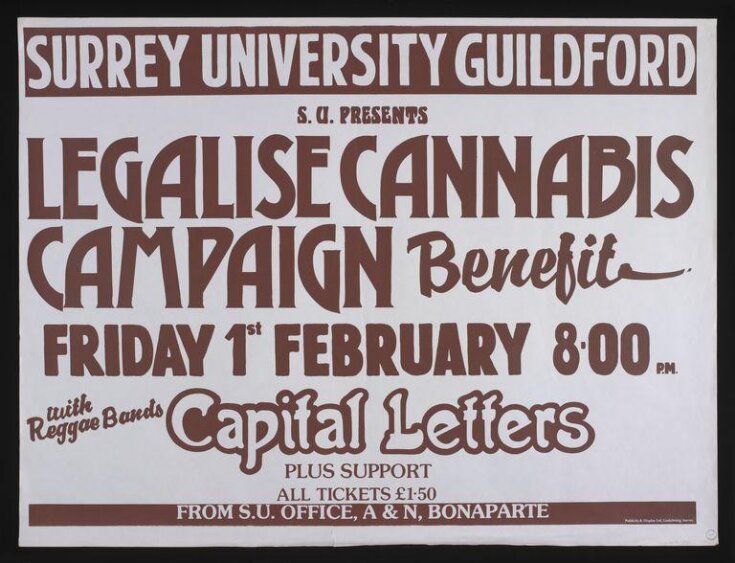
1 February 1980 Osibisa launched 1980 on 25 January, followed by the Capital Letters of 1 February for a Legalize Cannabis Campaign Benefit gig. Sore Throat were booked to perform on 16 February ’80, but vocalist Justin Ward left the band abruptly on 15 January, the night they appeared on The Old Grey Whistle Test’s Stage B, while The Ramones were on stage A, causing the tour to be cancelled. The Smirks headlined with The Charlies Parkas in support for the ‘March of the Slobs’ at the university on 22 February ’80. The next month the Pirates grab the stage on 8 March ’80. The 22 April saw Richard Digance grace the union’s stage with Roy Harper doing the same 4 days later, on 26 April. On 9 May it was the turn of Dr. Feelgood followed the next night by Magazine, supported by Bauhaus, and Crisis. May came to an end, on 31 May, with Gary Glitter and The Glitter Band. The 1980 Freshers Ball was held on 4 October and featured Voyager, who’d had a turntable hit, heavily played on radio, without ever entering the charts, called “Sing Out (Love Is Easy)”. The following week, fresh from recording for Dennis Potter’s LWT production Cream In My Coffee (to be aired that November), Writz under the new moniker Famous Names turn up as part of their Circus Tour on 11 October ’80, then Alvin Lee rolled through on 17 October. Interestingly, we also show a listing for Splodgenessabounds with Lethal Dose in support on the same day. On 24 October The Blues Band were supported by The Hitmen. Vardis supported Hawkwind on 31 October ’80 at the Halloween Spectacular. Bullseye performed on 13 November, followed two days later by Girlschool and Angelwitch. On 19 November ’80 the university’s Rock Club booked Loaded Dice. Black Slate turned up ten days after, on 29 November, and Roy Wood’s Helicopter, supported by Trespass, arrived on 6 December ’80 for the Xmas Spectacular.
UFO landed at the university on 13 January ’81, followed by Slade with Export in support three days later, on 16 January. On 23 January ’81, the Au Pairs opened for Delta 5 and eight days later, on 31 January, you would have seen The Look. Hazel O’Connor’s Megahype rolled into the campus on 6 February, with Prime Suspects in support. The Free Festival was held on 23 May ’81 and featured Squeeze, who were touring “East Side Story”. On 28 May ,81, Classix Nouveaux opened their Night People Tour at the University; while local group Just So Stories appeared at the Student Union Bar the next month. The Birthday Party appeared four months later, on 24 October ’81, supported by two local bands: The Sleep and Imperfect Hold, at which Nick Cave puked on stage. The next week, on 30 October, it was Nine Below Zero’s turn, followed seven days after that by Clint Eastwood with General Saint on 6 November ’81. Level 42 appeared on 13 November ’81, andThe Europeans and Wild Willy Barrett opened the show on 28 November ’81 for John Otway. The following week The Good, The Bad and The Ugly tour brought The Bureau, with The Mo-dettes, Roddy Radiation, and The Tearjerkers to the university on 5 December.
On 6 February ’82, Wishbone Ash rocked the University. A few months later, on 25 May ’82, those in love with a German film star rolled up to university to catch The Passions. The Free Fest fell in May ’82 and we know it featured Sheep in Fog on 29 May. The University’s Jazz Club welcome Sheep in Fog back on 22 June and booked Vanishing Point to support. On 24 November 1982, as part of the Corridors of Power tour, ex Thin Lizzy member Gary Moore rolled into town with Ian Paice (ex Deep Purple), Neil Murray (ex Whitesnake and Black Sabbath), and John Sloman (ex Lone Star and Uriah Heep).
Longpig played the May Bug Ball at the university on 7 May ’83, along with Creatures of Darkness, La Maison Du Chants, and Freedom Dance.
The Autumn term in ’83 kicked off with Haircut One Hundred (also known as Haircut 100), without Nick Heyward who’d left in January that year, on 13 October ’83. Two days later The Fall, supported on the night by Serious Drinking and Shadow Planet, got through twelve tracks despite a barrage of abuse from punks / skinheads in the crowd.
Towards the end of the opening track Mark E. Smith was assaulted and a pint was thrown; leaving him to towel beer off a keyboard and himself. The Fall continued with tracks intersperse with shouts of ‘sieg heil’ and ‘Hitler’ from the saluting skinhead contingent. “Totally Wired” was accompanied by a can-canning skins stage invasion addressed by a lone bouncer. The band, after walking off, did an encore.
Later that month, on 27 October, The Fall performed at the Concord Bar, Brighton and amended the lyrics to ‘English Scheme’ to “Down pokey quaint streets in Guildford was our distant mongol heritage. It’s dull red, round head, Army career, Actifed. If we were smart, we’d emigrate. Down pokey quaint corridors and channels crawl mobile lords, ladies, sons, daughters, uncles, aunts…”
Six days prior, on 21 October ’83, to The Falls dig at Guildford, Black Roots performed and The Bloomsbury Set appeared on 28 October. John Martyn took to the stage on 4 November, with Steve Hackett booked for 12 November and Pallas, Solstice, and Trilogy closing out November as the Brave New World Tour visited the university. Osibisa visited on 3 December ’83
[Ed – Roll in material from https://indiethroughthelookingglass.com/2019/05/28/the-fall-interview-and-photos-1983-previously-unseen/ and backlink.]
On 27 January ’84 the John Peel Road Show visited the university and featured local band Shoot! Dispute – thanks to their demo and some shenanigans by their manager, “The Weasel” – and Geisha Girls. Shoot! Dispute’s performance resulted in Peel coming to their dressing room and offering them the first of two Peel Sessions. Sometime in March ’84 both Longpig and Dark Paradise performed in the Student Union bar. Dark Trio joined LongPig, La Maison Du Chants, Freedom Dance and Funtime for Phillip at the University’s New Wave Society’s event on 7 May ’84 in the Great Hall. Dark Trio’s performance received a brief review in The Werewolf fanzine. Both Longpig and Dark Paradise were back on 9 June, for the university’s June Jitterbug, with D Fabulous, No Joy, Betrayed, and Asylum Sounds. A week later Hanoi Rocks were supported by Pet Hate, and Asylum Sounds at the venue. The first gig we’ve found for the Autumn Semester in ’84 was on 27 October featuring Shoot! Dispute with Press Any Key, Buddy & the Bloodsuckers, Line Design, and Swivelcorps. We also know that Lifespan performed at the university in December ’84, after which their vocalist left the band.
On 25 January ’85, Clint Eastwood and General Saint were supported by local reggae band Spliff Riff. Northern Irish hard rockers, Mama’s Boys wrapped up the UK leg of their tour promoting their fifth album ‘Power and Passion‘ at the university on 4 May ’85. The prior couple of years of Free Fest had not been overly successful, to the point that there was to be no event in ’85. A number of enthusiasts however had other ideas and independently organize Not The Free Fest, across the 24 and 25 May ’85. On the Friday, 24 May, the Bouncing Czecks performed as part of an initial cabaret night. On 25 May ’85, Holy Durex and two other bands, Fantasy Lies and Swivel Corps, qualified in the afternoon heats of the University of Surrey Student Band Competition to appear at the finale that night. After extended sets both Holy Durex and Fantasy Lies lost out to Swivel Corps, before the evening was headlined by the Geisha Girls. While not winning the competition, Holy Durex did go on to appear at the University’s Blues All-Dayer later in the year. The Blow Monkeys supported Lloyd Cole & The Commotions on 13 October ’85; later in the month Rattlesnake returned to the university, playing in the Lower Bar on 30 October, and Voodoo Child were supported by Steel Bill and The Buffalos on 31 October. The next day Eek-A-Mouse were supported by Spliff Riff in the Main Hall, and Namoza occupied the Lower Bar on 3 November, followed by the Dave Walters Band on 5 November. Ten days later the Miller Family were supported by Function at the university; with Captain Sensible appearing on 20 November. The next month, on 7 December, The Pogues were at the university followed by Inspector Tuppence and the Sexy Firemen, supported Catfish, the next day.
On 26 January ’86, Swivel Corp (it was to be their penultimate gig) and The Larks opened up for The Higsons, at the University of Surrey’s No-Wave Society’s main hall gig. Record Mirror’s gig listing for the day before, 25 January, had The Higsons and The Larks supporting Nick Kershaw at the university. Holy Durex headlined the university’s Rugby Club Drag Disco on 31 January ’86. Later that year Holy Durex performed at the University’s Royal Charter Disco, supporting Bad Manners along with Inspector Tuppence & the Sexy Firemen; with the event starting at 8:00pm on 27 June and ending at 6:30am the following morning. There was reunion gig for Holy Durex at the University, involving the four main members, on 3 July ’86. Shoot! Dispute’s final gig of which we are aware was as headliners for the ‘Dance Your Rocks Night’ at the university on 27 September ’86 with Press Any Key (ex-After The Fire), Buddy & The Bloodsuckers, Line Design, and Swivel Corps. Towards the close of ’86, Cutting Crew were touring to promote their Broadcast LP appearing at the university on 22 November.
On 22 February ’87, Pop Will Eat Itself played the university. A week later, on 1 March ’87, The Stage, who were touring to promote their new single Nothing Stranger Than Today performed in the main hall. Rolling forward the university also hosted The Mighty Lemondrops, supported by Bluetrain, on 9 May ’87. The next month The Christians took to the stage, supported by Danny Wilson, on 13 June ’87. In ’86 Julian Lennon and Yoko Ono agreed that the University of Surrey’s new recording studio be named in memory of John Lennon. By November ’87 it was ready to use and to officially mark its opening and pay tribute to John Lennon the university held a concert in the Main Hall, on 22 November, that featured David Essex and Alvin Stardust, along with Beatles tribute band Cavern, compered by Mike Reid.
On 5 February ’88 The Wild Swans were supported by The Mighty Lemon Drops. On 7 May, The Soup Dragons with Something Happens. The following month, on 30 June, Jo Jo Namoza took to the stage. A month after that on July 30 the Students Union hosted Steel Bill & The Buffaloes, who returned on 29 October. The Jazz Butchers appeared on 30 November,
The next year, Pop Will Eat Itself were on patrol in mid solar spring calling in at the University of Surrey on 12 May ’89. Bonfire Night, 5 November ’89, Carter the Unstoppable Sex Machine. A few days later, on 10 November, The House of Love, who had just released their I Don’t Know Why I Love You single appeared at the university. Two days later, on 12 November ’89, Bliss performed in the main hall before trekking over to Cardiff the next night.

10 November 1989: The House of Love played the University of Surrey, Guildford. Photograph by Nathan Jones. Source: www.thehouseoflovearchive.co.uk On 15 January ’90, Energy Orchard released the debut single ‘Belfast’ and arrived at the University of Surrey on 21 January as part on a national tour to promote it. Rag Week that year was in late February, with the All-Evening Greeny/Blues event, featuring Sammy Rats Big Big Blues Band, going down on 24 February. Later in the year, neo-psychedelic rock band Stress visited the university on 17 October ’90, as part of their Beautiful People Tour, followed eleven days later by the Milltown Brothers on 28 October ’90, who were touring the Apple Green single. The next month, on 12 November, Railroad Earth played the SU Bar and Sammy returned on 1 December to join Yellow Darkness, The Hamsters, Gypsie Fiddler, Big Belief, Ample Cleavage, The Ant Hill Mob, and Dr. Brown on stage.
On 22 June ’91 Surrey Court at the University hosted The Flowerpot Men with Railroad Earth, The Ha Ha Men, Redwood, and Trousershock BC in support. Around the 23 November ’91 the university’s Student Union held a Crab Feast at which The Ant Hill Mob – their final gig of which we are aware -, Sammy Rats Big Big Blues Band, Big Belief and Yellow Darkness performed.
On 5 February ’92, Mega City Four headlined at the University of Surrey’s Main Hall, along with Big Boy Tomato, Pretty Green, and Phobia. Trousershock BC supported Railroad Earth on 10 May ’92
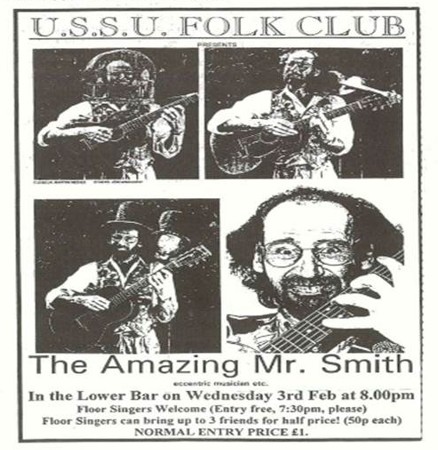
Midwest Flower opened for The Outcast Band on 31 January ’93 at the university and returned three days later to do the same for The Amazing Mr. Smith at the USSU Folk Club on campus. A few months later, on 19 June ’93, another local band, Redwood took to the stage. The university’s Student Union’s All-Day Blues event on 19 November ’94 featured Sister Wendy, Wildwood, Eat the Sofa, The Hamsters, Winterfall, and The Bogus Brothers.
On WOB‘s return to the UK we found him supporting Who Moved the Ground?, on 12 May ’96, at the University. Semester One 96’s itinerary began on 22 September with SubCircus, a week later it was David Devant and his Spirit Wife. 6 October saw The John Mizarolli Band take to the main stage in the SU, followed by Salad on 13 October, and My Life Story a week later; Vent 414 closed out the month’s roster on 27 October. The following month opened with Oliver’s Army storming in on 3 November, Wildwood on 10 November, The Egg on 17 November, and University regulars Redwood on 24 November.
Gallery:
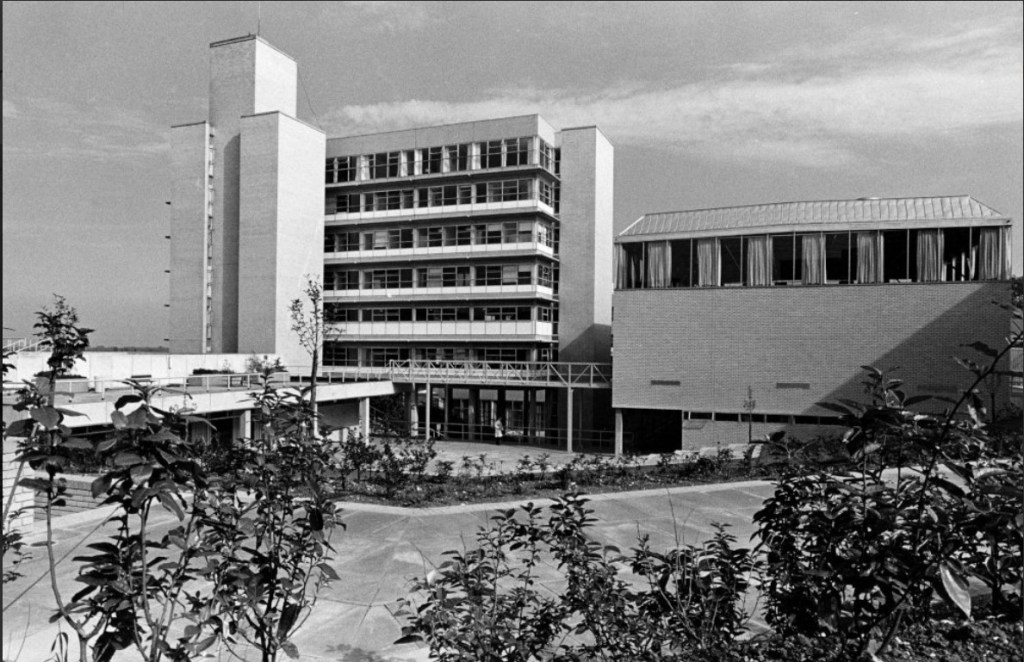
On the right is the Main Hall at the University of Surrey c’1970 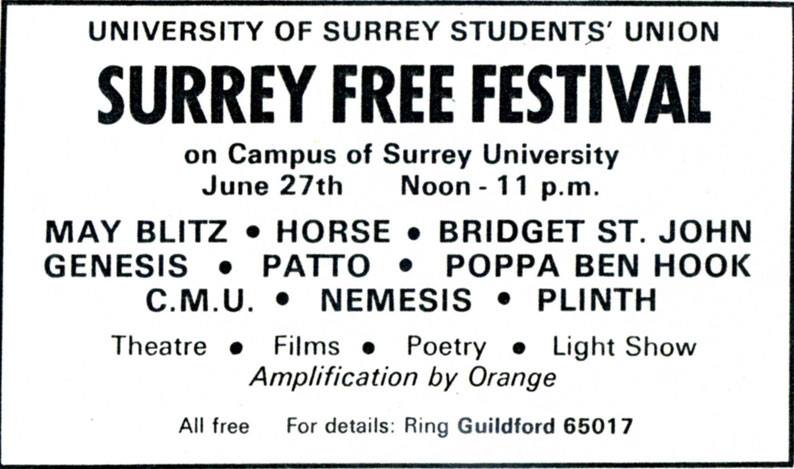
A clipping for the Surrey Free Festival ’71 
Surrey Free Festival ’71 flyer 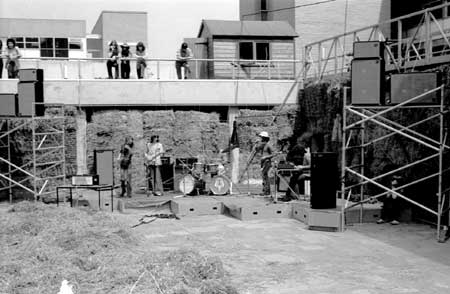
27 June ’71: Poppa Ben Hook at the University of Surrey Free Festival ’71. Picture courtesy of Fred Pipes 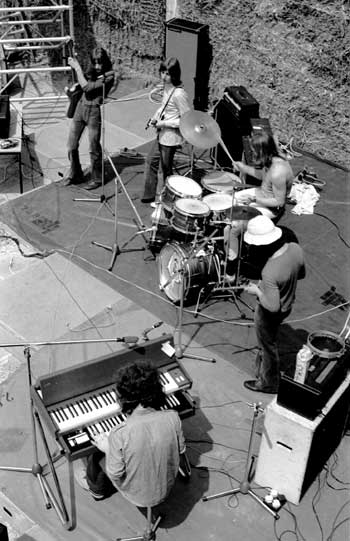
27 June ’71: Poppa Ben Hook at the University of Surrey Free Festival ’71. Picture courtesy of Fred Pipes 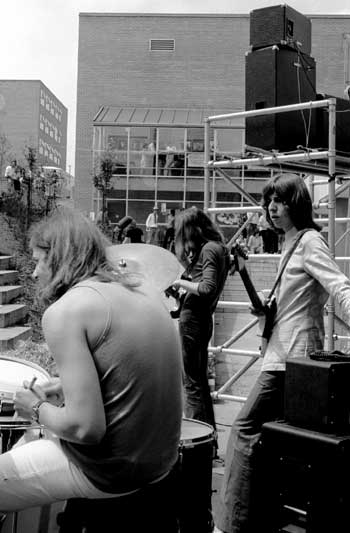
27 June ’71: Poppa Ben Hook at the University of Surrey Free Festival ’71. Picture courtesy of Fred Pipes 
27 June ’71: Poppa Ben Hook at the University of Surrey Free Festival ’71. Picture courtesy of Fred Pipes 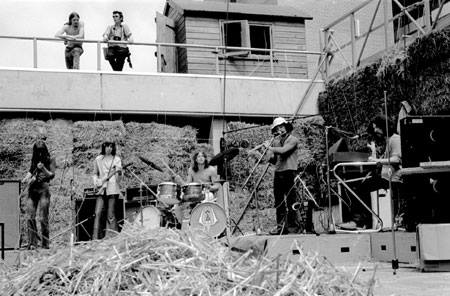
27 June ’71: Poppa Ben Hook at the University of Surrey Free Festival ’71. Picture courtesy of Fred Pipes 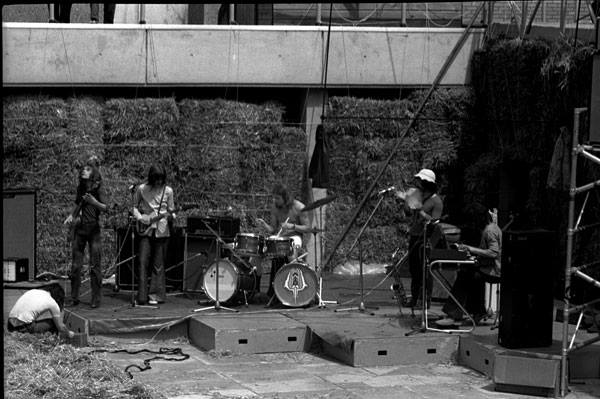
27 June ’71: Poppa Ben Hook at the University of Surrey Free Festival ’71. Picture courtesy of Fred Pipes 
27 June ’71: Poppa Ben Hook at the University of Surrey Free Festival ’71. Picture courtesy of Fred Pipes 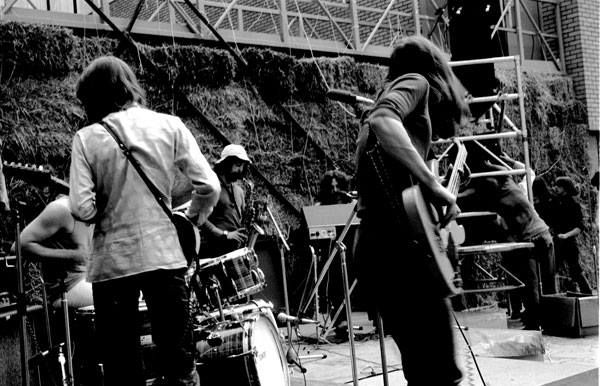
27 June ’71: Poppa Ben Hook at the University of Surrey Free Festival ’71. Picture courtesy of Fred Pipes 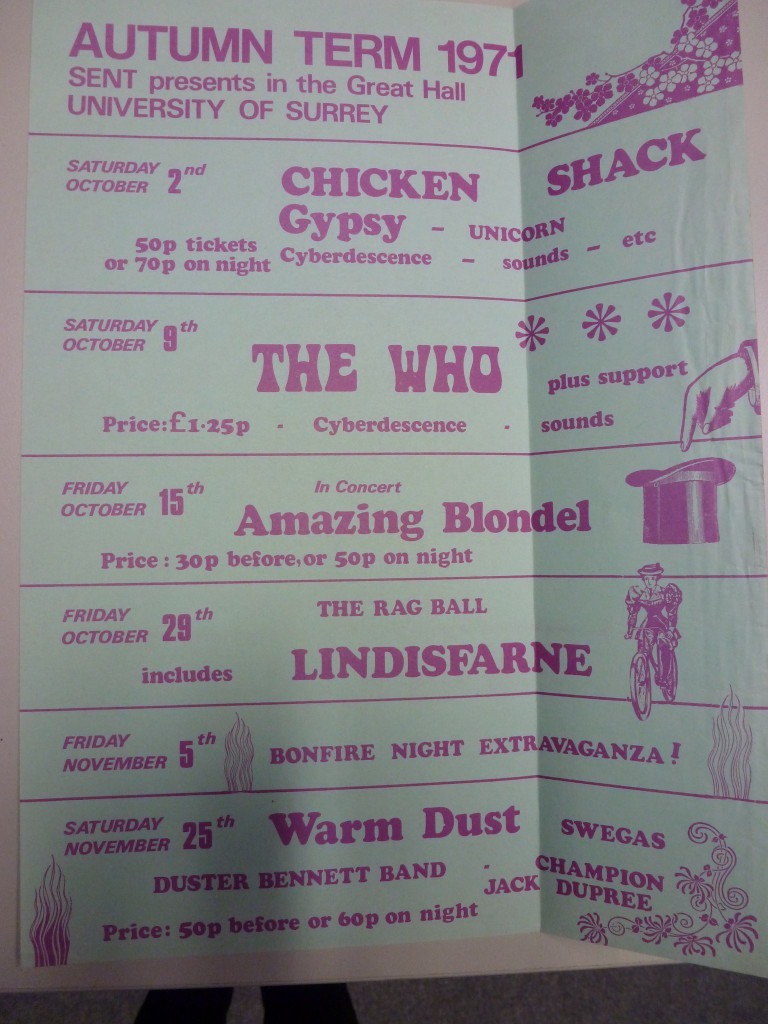
Autumn Term 1971… 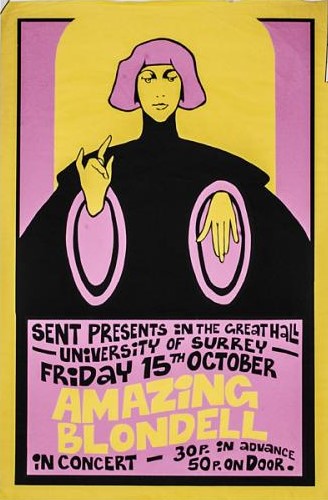
15 October 1971: Amazing Bondel with Mick Greenwood in support 
6 October 1972 – Hackensack. Source: Hackensack – band 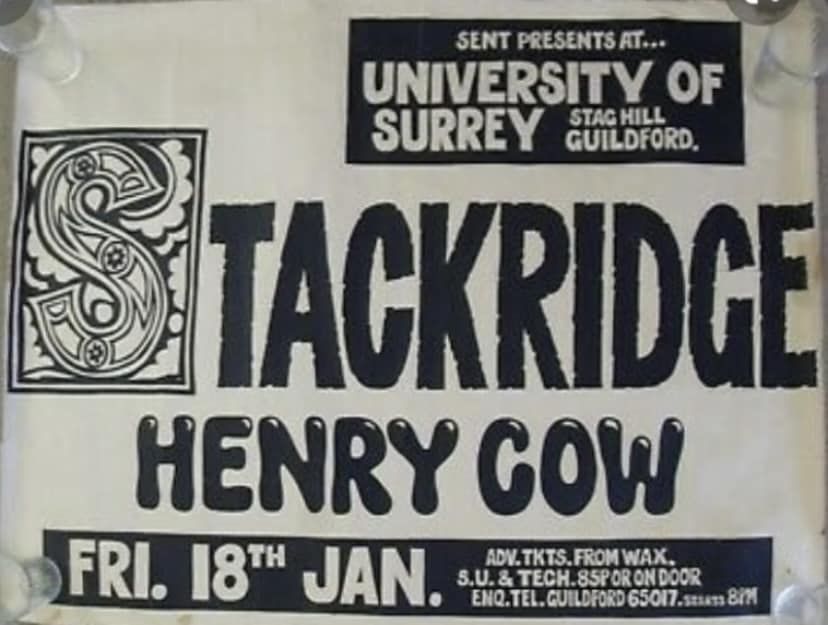
18 January 1974: Stackridge, supported by Henry Cow, were at the University of Surrey. Image courtesy of Chris Branch 
21 February 1975: Ange, supported by Ash Ra Tempel and Moonmouse, played the Great Hall. Picture courtesy of Jon Downing 
31 October 1975 
House’s Wheatley at the University of Surrey in ’76. Source: House-Guildford 
House’s Lewkowicz and Wheatley at the University of Surrey in ’76. Source: House-Guildford 
House’s Backhurst at the University of Surrey in ’76. Source: House-Guildford 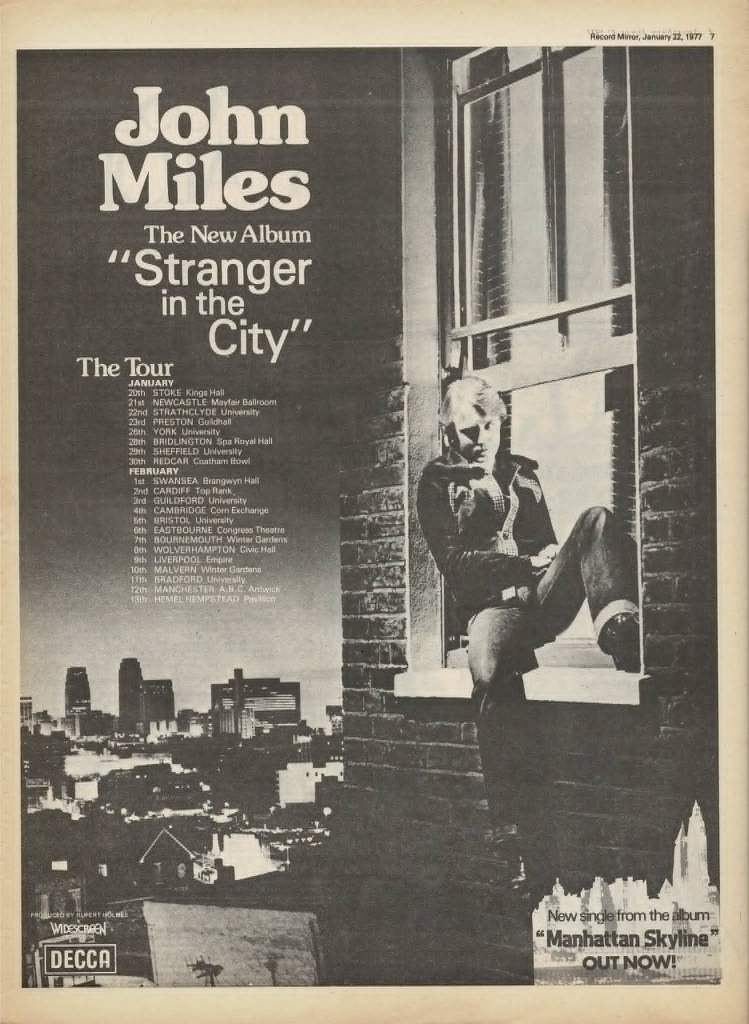
3 February 1977: John Miles appeared at the University of Surrey, Guildford. Ad from Record Mirror 22 Jan ’77. Image courtesy of Pete Cole 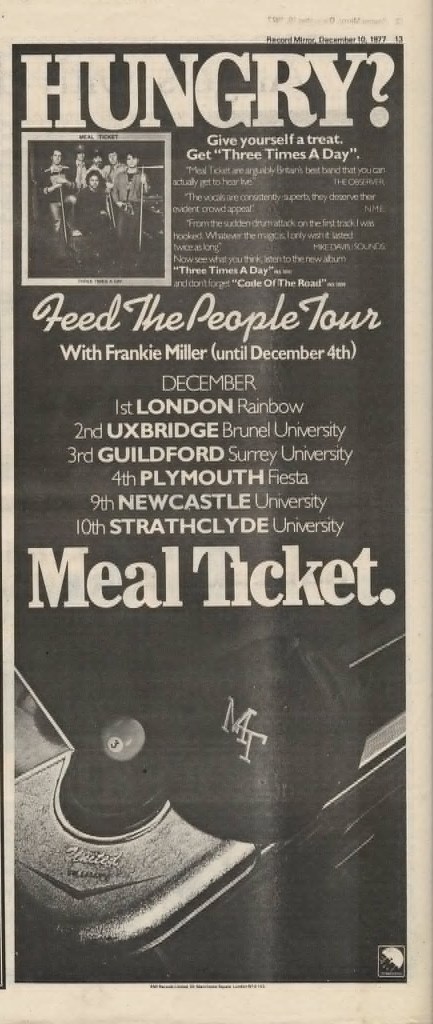
3 December 1977: Meal Ticket support Frank Miller at University of Surrey. Image courtesy of Pete Cole 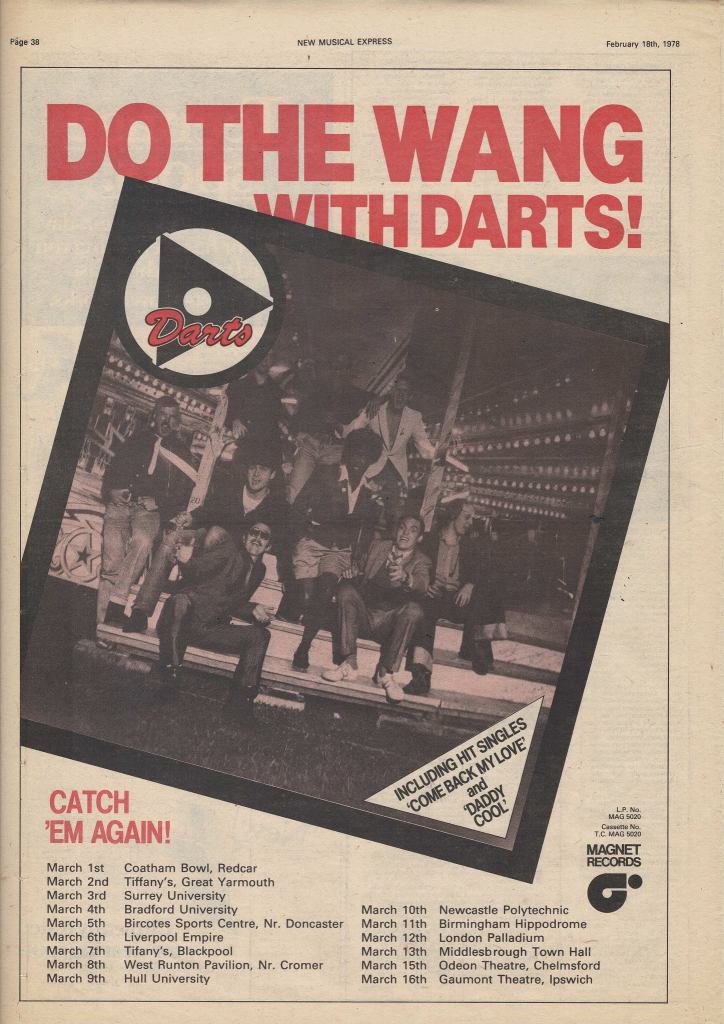
3 March 1978: Darts played University of Surrey, Guildford. Advert from NME 18 February ’78. Image courtesy of Pete Cole. 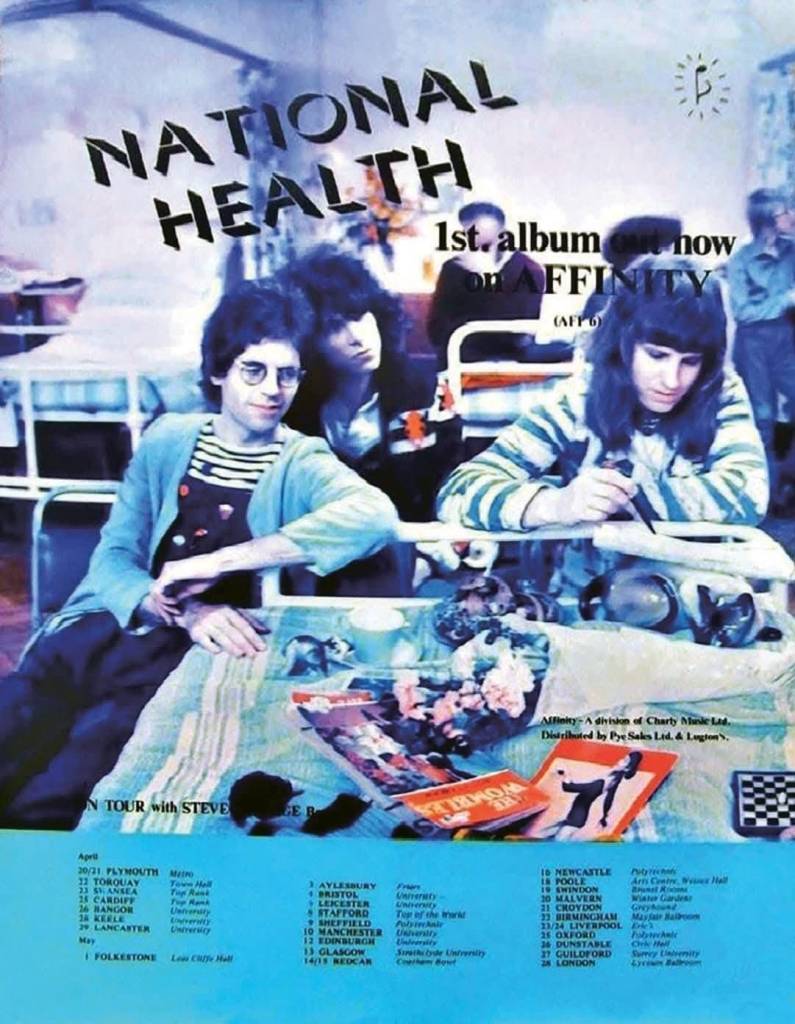
27 May 1978: Steve Hillage was supported by National Health, featuring Miquette Giraudy, at University of Surrey, Guildford 
25 January 1979: NUJ Benefit gig poster 
25 January 1979: Ticket for NUJ Beneft gig. Picture courtesy of Fred Pipes 
C’79: UBz, when called Umpty’s Balcony, at Surrey University. Picture courtesy of Mark Charles. 
26 October 1979: The Ruts. Source: Lighthouse Poole 
26 October 1979: The Ruts, with The Flys, and Crisis 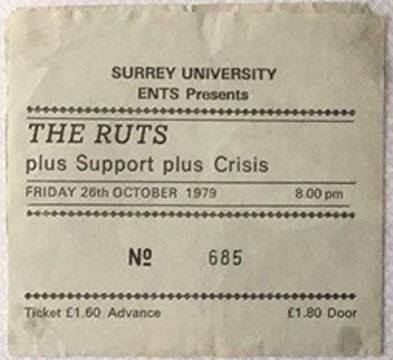
26 October 1979: The Ruts, with The Flys, and Crisis 
9 November 1979: Record Mirror Advert from 20 Oct issue for UK Subs tour. Image courtesy of Pete Cole 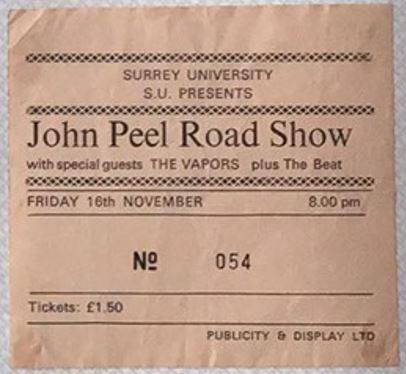
16 November 1979: Ticket for the John Peel Road Show at University of Surrey, featuring The Vapors and The Beat 
16 November 1979: Press ad for The Vapors appearance on the John Peel Roadshow at University of Surrey. Source: Vinny Webster via The Vapors UK 
9 May 1980 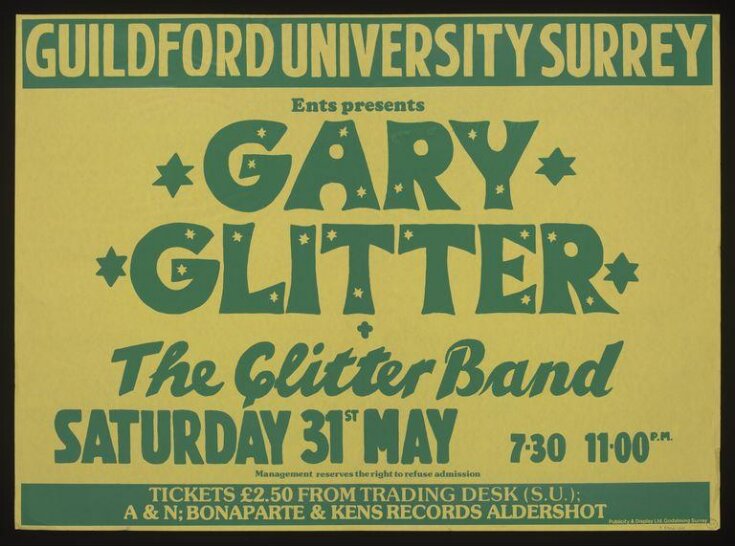
31 May 1980 
4 October 1980: Freshers Ball 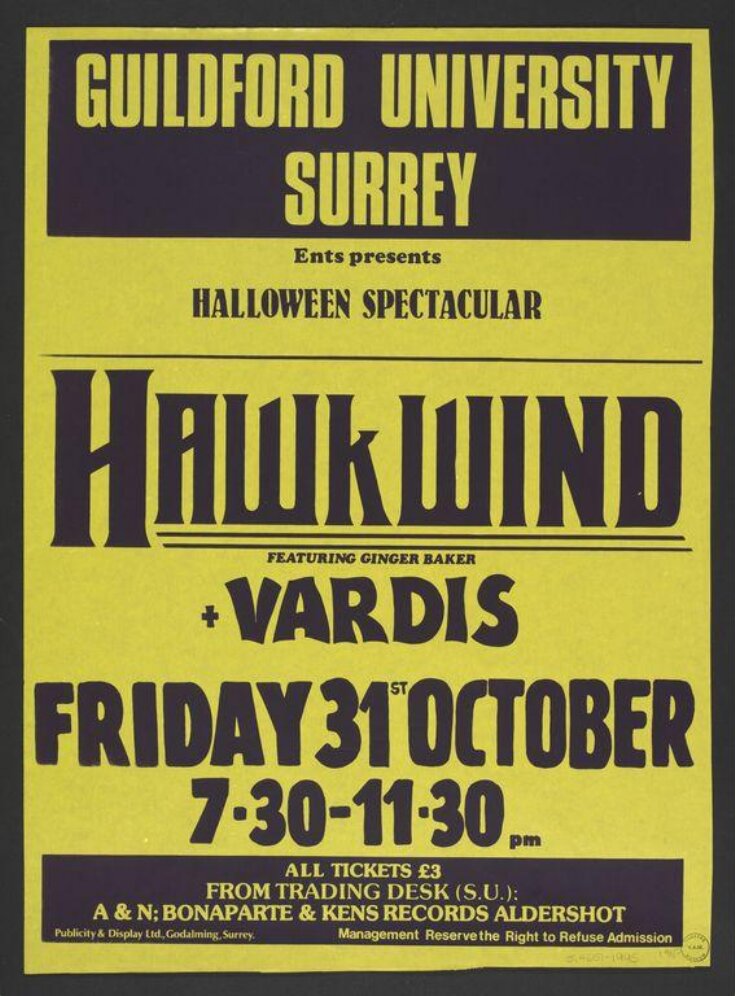
31 October 1980: Halloween Spectacular 
15 November 1980: Girlschool and Angelwitch 
6 December 1980: Xmas Spectacular with Roy Wood’s Helicopter and Trespass 
16 January 1981: Slade, supported by Export, played the University of Surrey 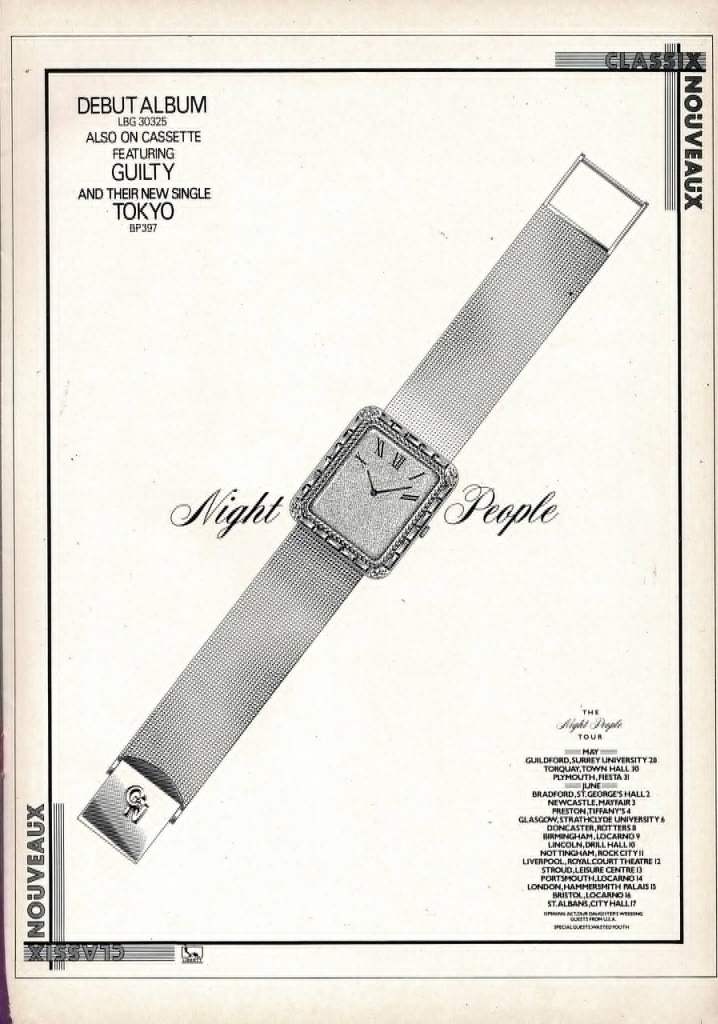
28 May 1981: Classix Nouveaux were at the University of Surrey, Guildford. Ads from Flexipop July 1981. Image courtesy of Pete Cole. 
Just So Stories at University of Surrey SU Bar in June 81. Picture courtesy of Fred Pipes 
Just So Stories at University of Surrey SU Bar in June 81. Picture courtesy of Fred Pipes 
Just So Stories at University of Surrey SU Bar in June 81. Picture courtesy of Fred Pipes 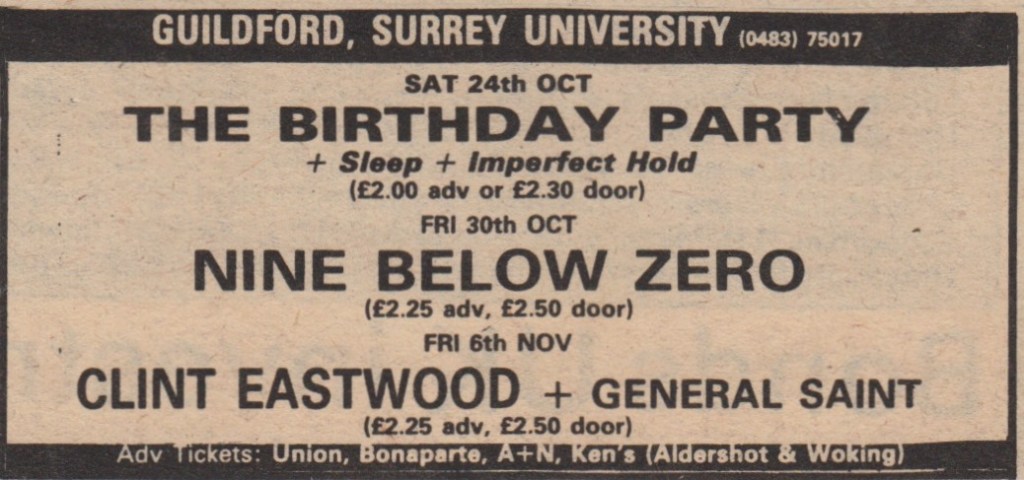
24 Oct 1981: The Sleep and Imperfect Hold supported The Birthday Party at University of Surrey. Picture reproduced with permission of From The Archives 
24 October 1981: Ticket for The Birthday Party supported by The Sleep at University of Surrey 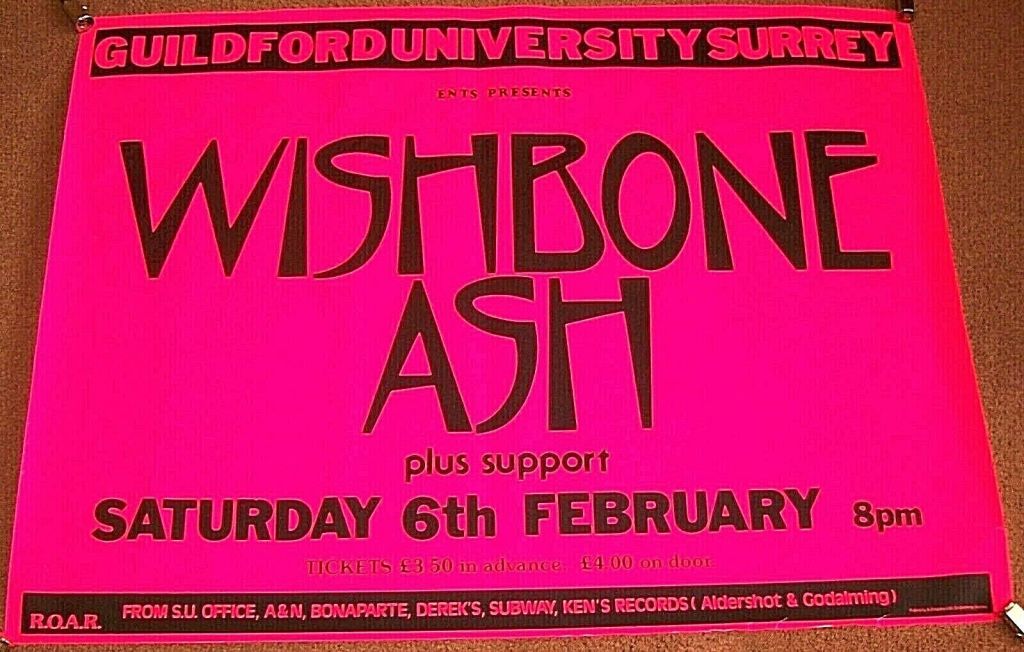
6 February 1982: Wishbone Ash 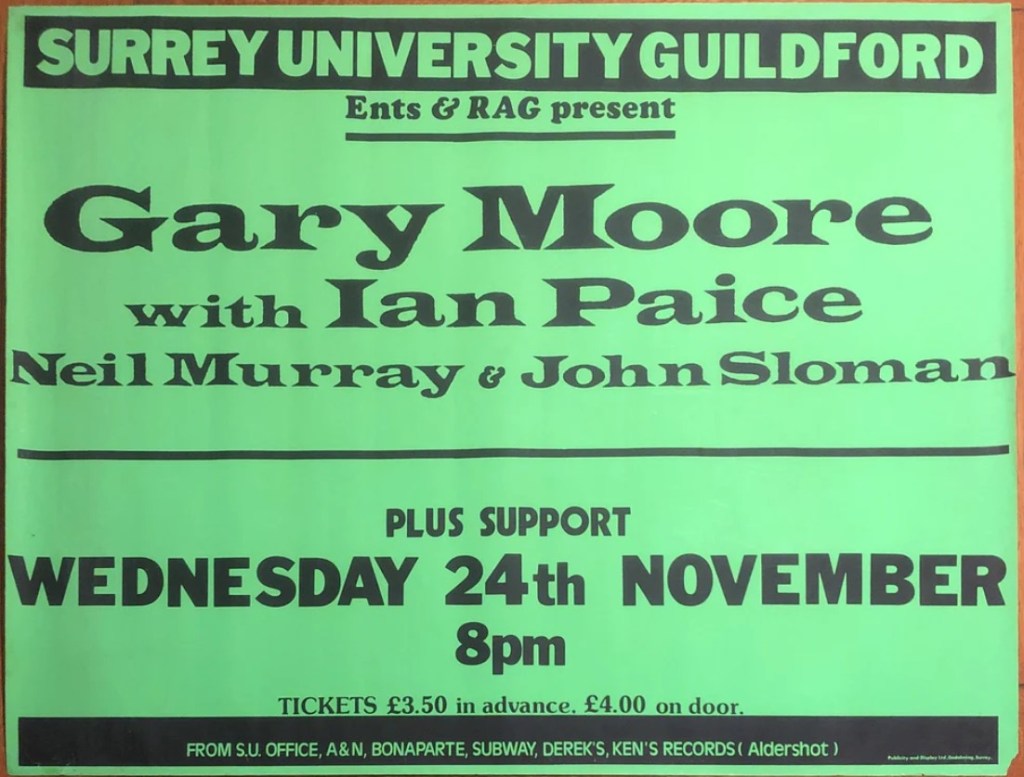
24 November 1982: Poster for Gary Moore supported by Ian Plaice, Neil Murray, and John Sloman. Source: Fincharie 
7 May 1983: Ticket for The May Bug Ball at University of Surrey, Guildford with LongPig, Freedom Dance, Creatures of Darkness, and La Maison Du Chante. 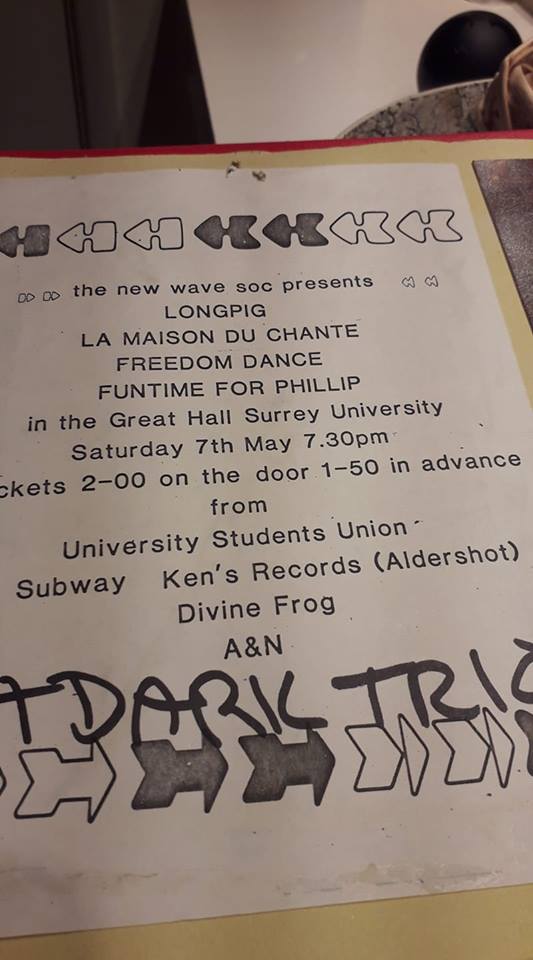
7 May 1983 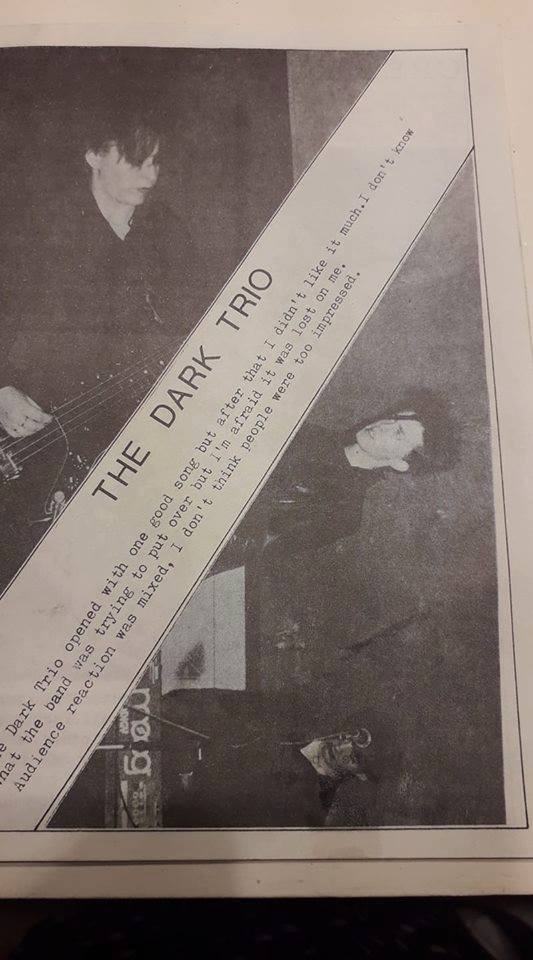
7 May 1983 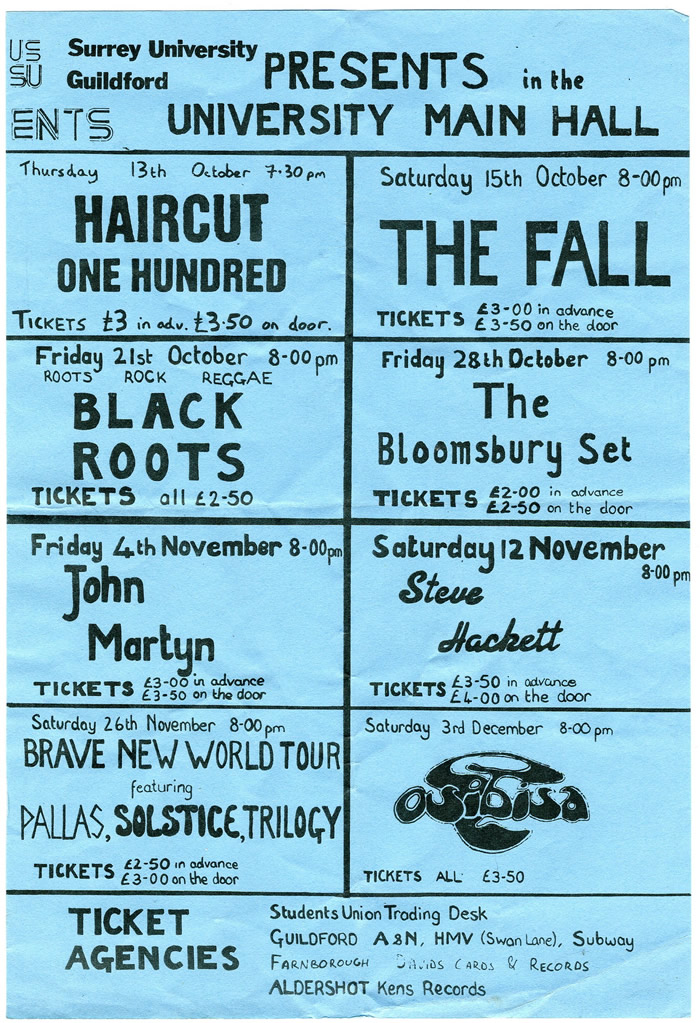
Autumn Term 1983 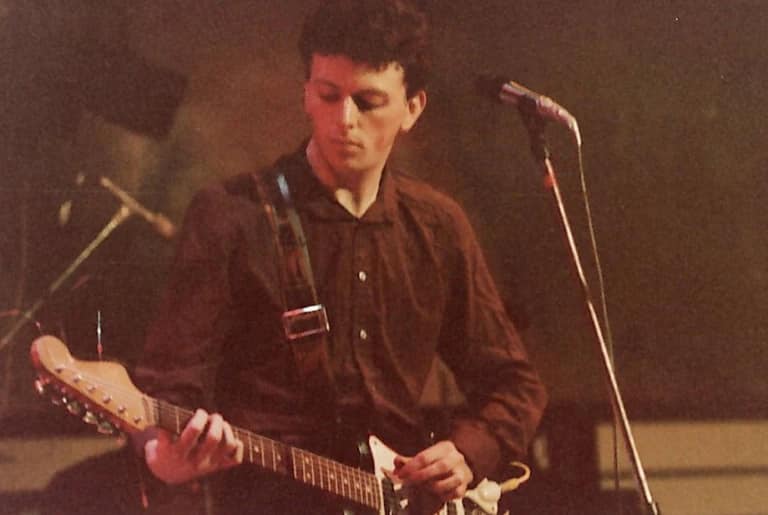
15 October 1983: The Fall’s Craig Scanlon on stage at UoS. Source: Rob Bamford via thefall.org 
27 January 1984 
7th May 1984: LongPig, La Maison du Chants, Freedom Dance and Funtime for Philip are at Surrey University. Picture courtesy of Alan and Jackie Wallis 
9 June 1984: Ticket for the June Jitterbug at University of Surrey with Longpig, D Fabulous, Dark Paradise, No Joy, Betrayed, and Asylum Sounds 
4 May 1985: Mama’s Boys played University of Surrey according to this advert from Sounds 30 March ’85 issue. Image courtesy of Pete Cole 
25 May 1985: Holy Durex play the Student Band Competion. Source: Bare Facts, May 31st, 1985 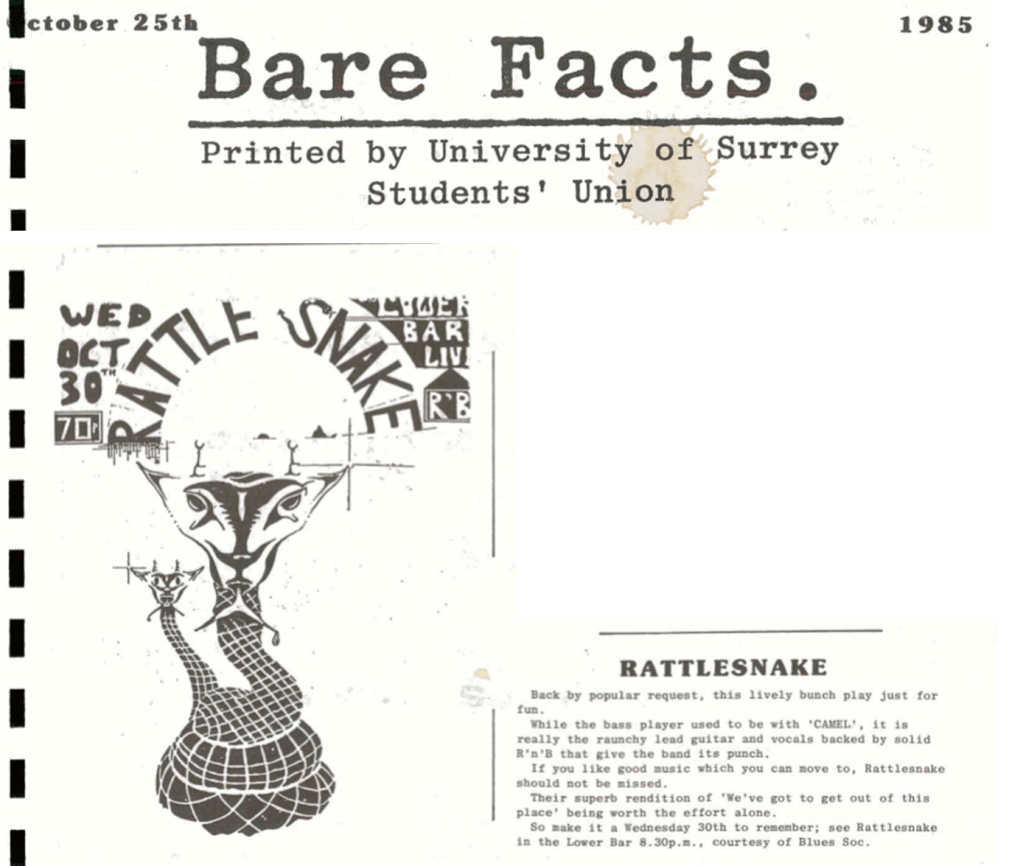
30 October 1985: Rattlesnake played the Lower Bar. Source: Bare Facts, October 25th, 1985 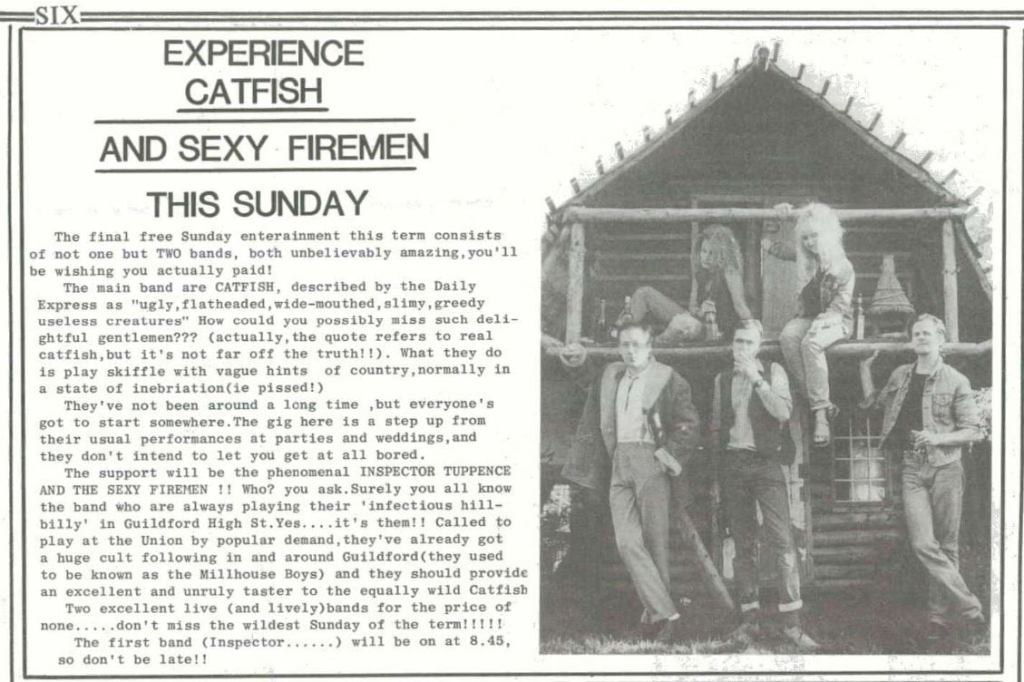
8 Dec 1985: Catfish, supported by Inspector Tuppence and the Sexy Firemen, played at University of Surrey – Article from Bare Facts The Nearly Xmas ’85 issue. 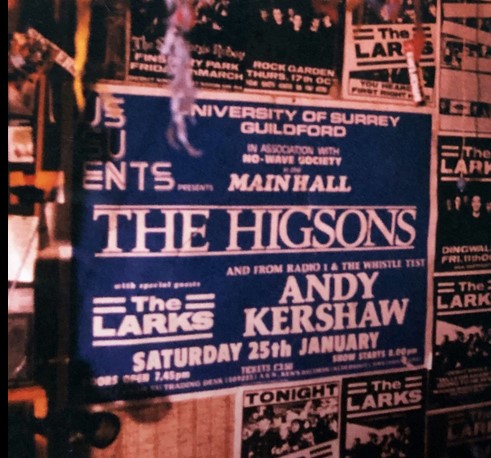
26 January 1986: Swivel Corp and The Larks opened up for The Higsons Source: Jonny Mendelsson via The LARKS 
26 January 1986: SUSU Bare Facts Magazine previews gig in 24 January 1986 issue. 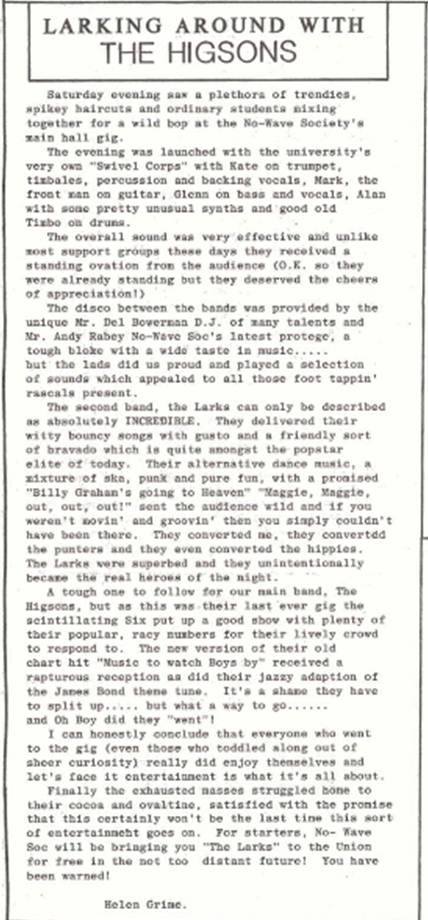
26 January 1986: SUSU Bare Facts Magazine reviews gig in 31 January 1986 issue 
31 January 1986: Holy Durex perform at Drag Disco. Bare Facts – Jan 24th 1986 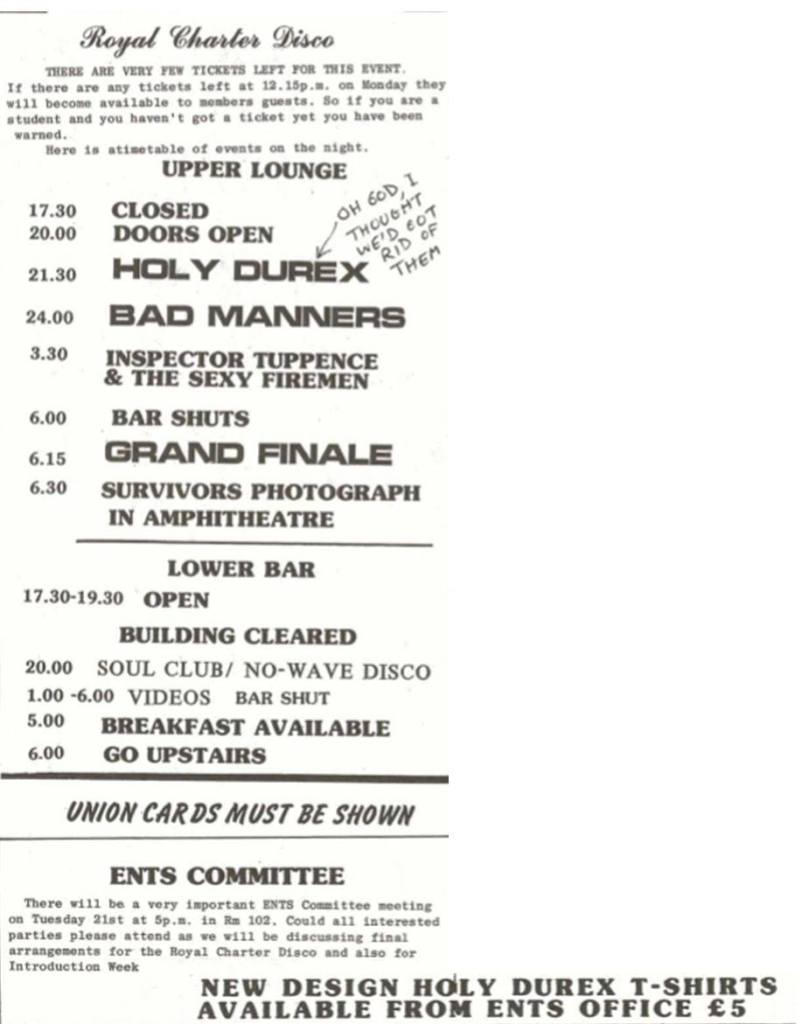
27 & 28 June 1986: Royal Charter Disco with Bad Manners headlining. Source: Bare Facts – June 20th 1986 
27 & 28 June 1986: Royal Charter Disco with Bad Manners headlining. Source: Bare Facts, June 26th 1986 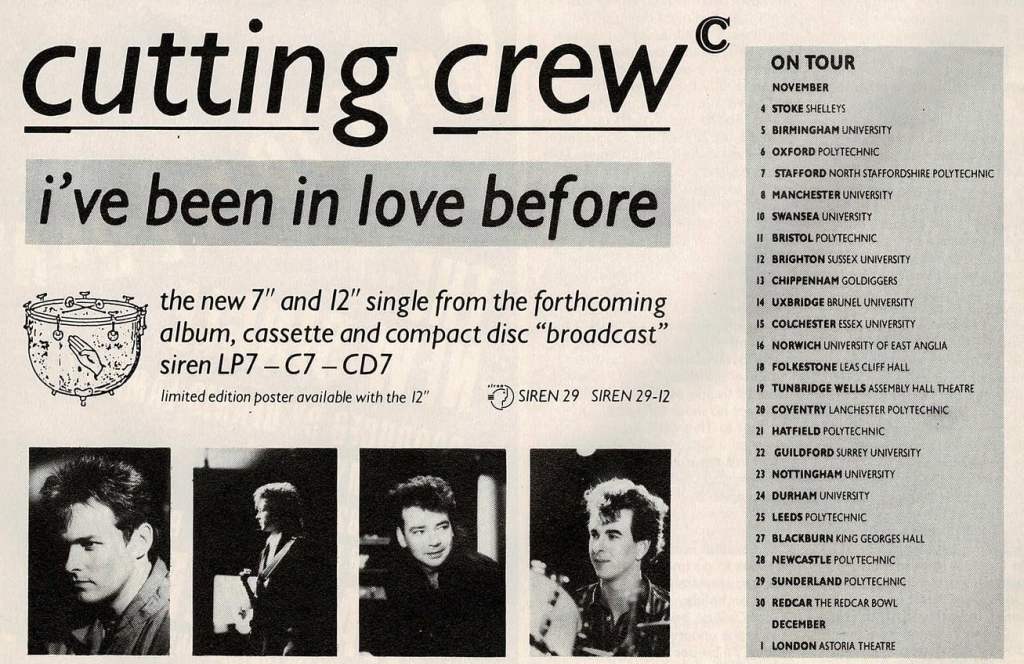
22 November 1986: Cutting Crew appear at UoS, Guildford. Ad from Record Mirror 18 October ’86 issue. Image courtesy of Pete Cole 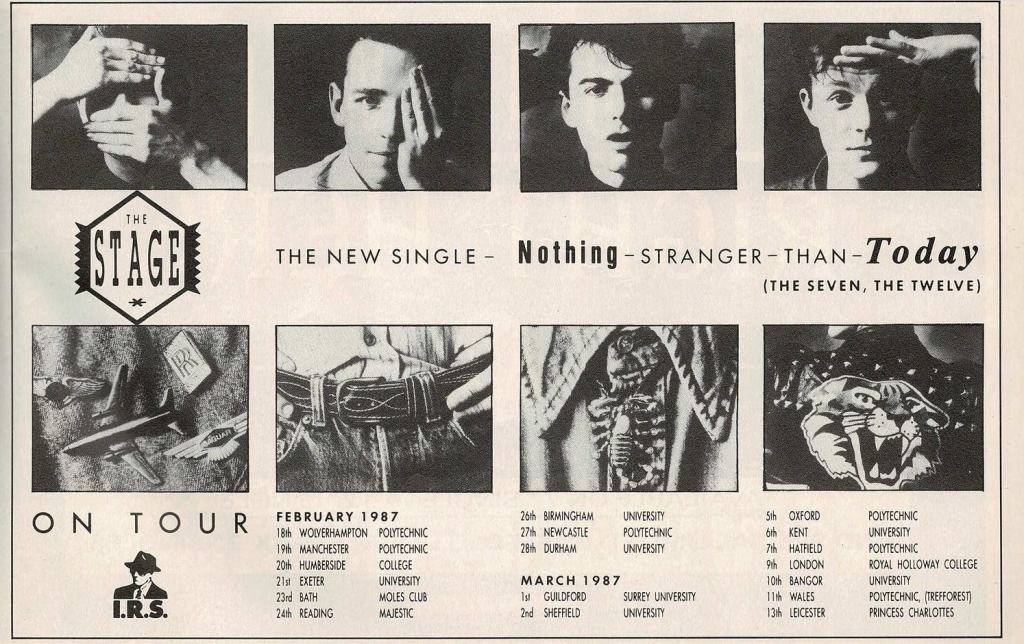
1 March 1987: The Stage played the University of Surrey, Guildford. Advert from Record Mirror and here courtesy of Pete Cole. 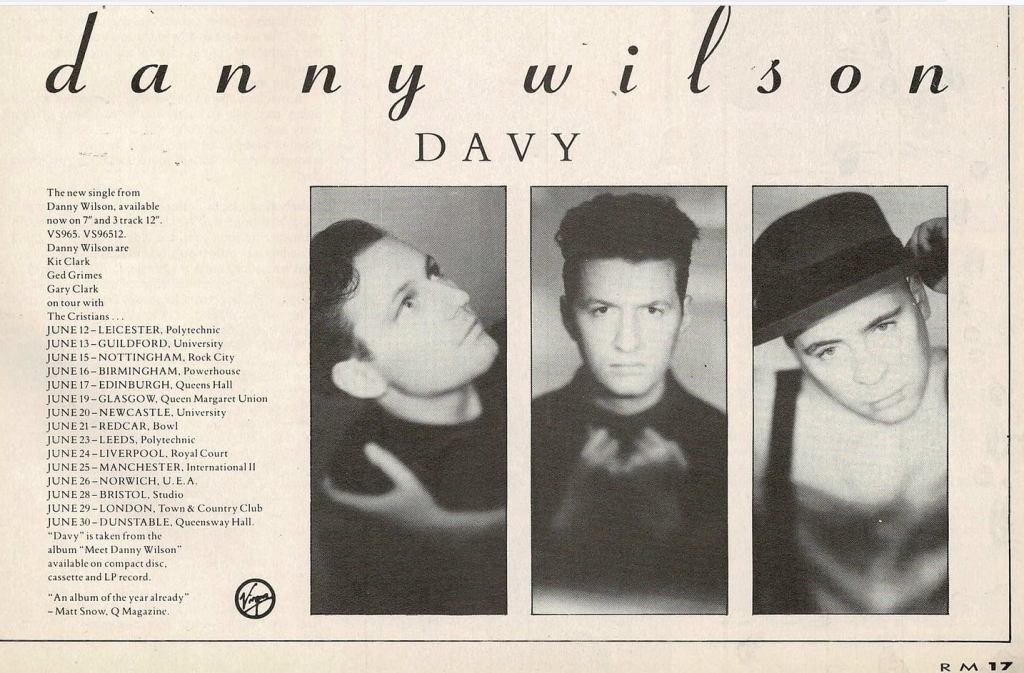
13 June 1987: Danny Wilson at University of Surrey. Ad from Record Mirror 30 May ’87. Image courtesy of Pete Cole 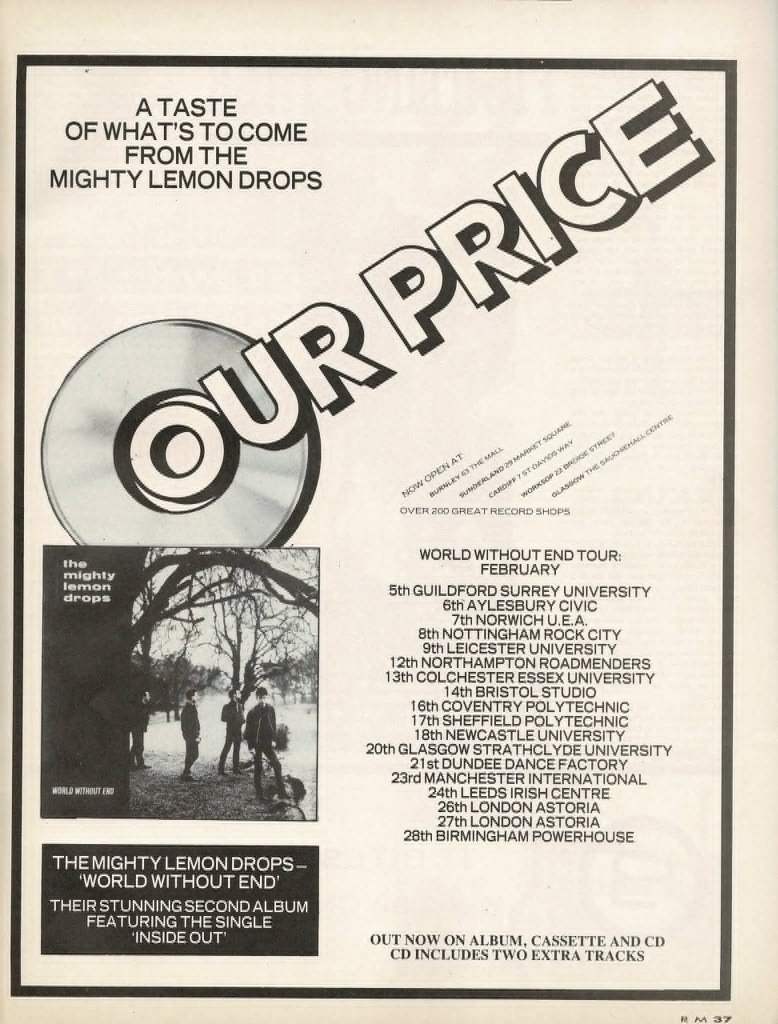
5 February 1988: The Mighty Lemon Drops played University of Surrey, Guildford. Ad from Record Mirror 20 Feb ’88 issue. Image courtesy of Pete Cole 
C’88: Two thirds of Casual Sax on the University of Surrey stage with Steel Bill & the Buffalos 
12 May 1989: PWEI at University of Surrey, Guildford. Ad from Record Mirror 6 May 1989 Image courtesy of Pete Cole 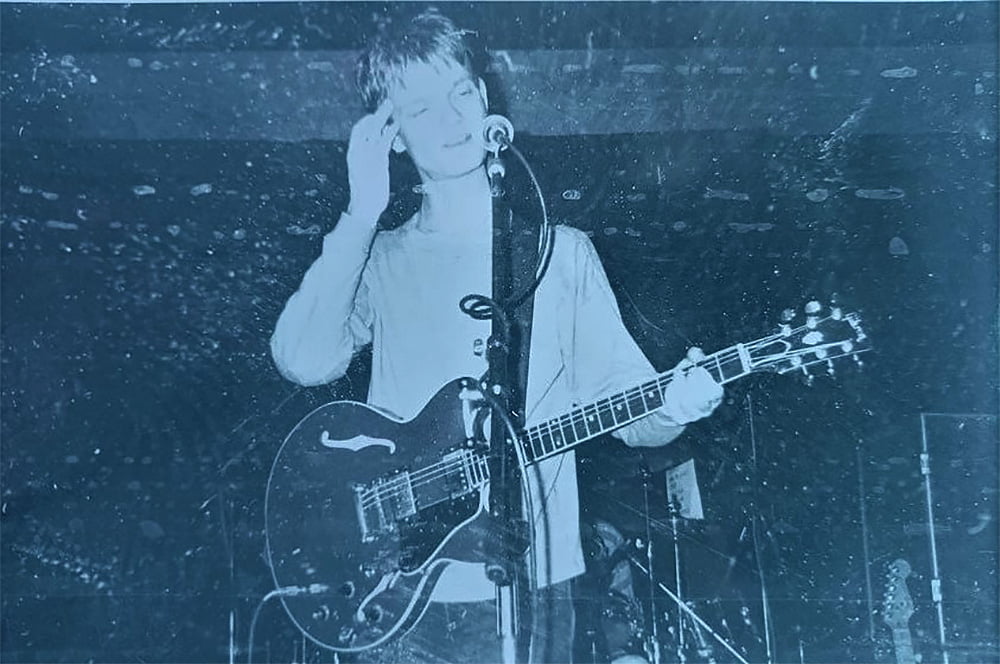
10 November 1989: The House of Love played the University of Surrey, Guildford. Photograph by Nathan-Jones. Source: http://www.thehouseoflovearchive.co.uk 
24 February 1990: Sammy Rat’s played University of Surrey Rag Week 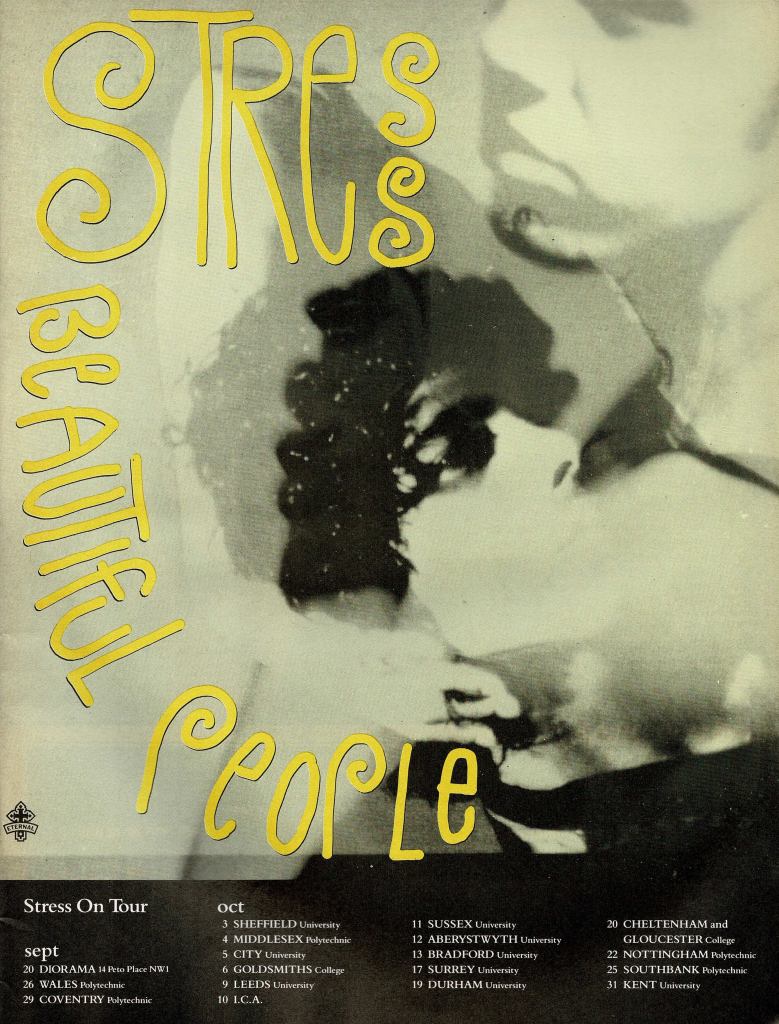
Tour advert from Record Mirror’s 22 Sept ’90 issue for Stress’ Beautiful People Tour. Image courtesy of Pete Cole. 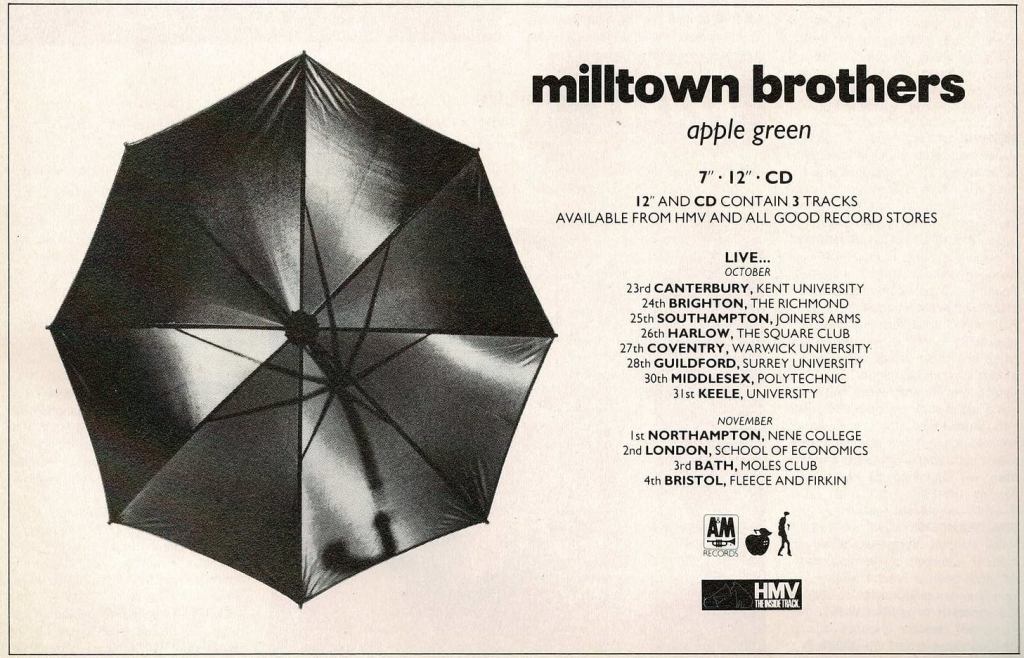
28 October 1990: Milltown Brothers play UoS, Guildford. Advert from Record Mirror 27 Oct ’90. Image courtesy of Pete Cole 
Surrey University, Surrey Court Fun Fest ’91 advert from Barefacts 21 June 1991. 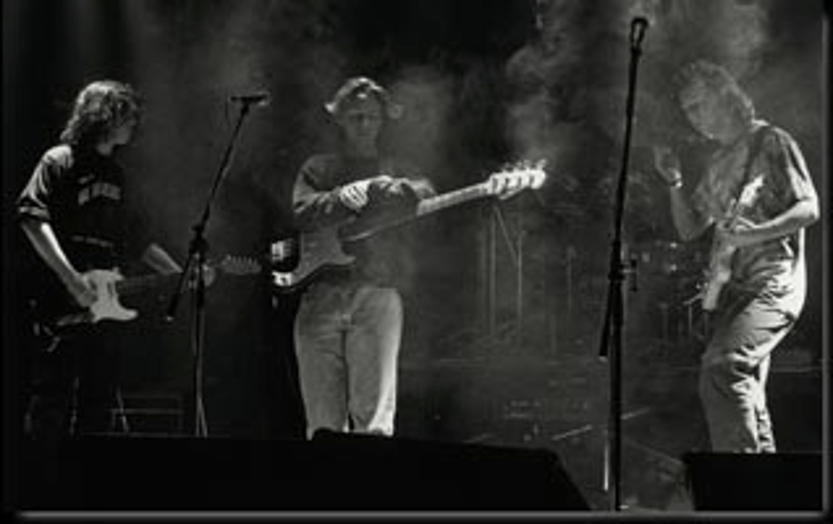
?? November 1991: Redwood are live at the University of Surrey ‘All Day Blues’ event. Source: geniustwinrecordings.com 
23 November 1991: University Surrey Student Union Crab Feast (Rag Week magazine) 
23 November 1991: University Surrey Student Union Crab Feast (Rag Week magazine) 
23 November 1991: University of Surrey Student Union Crab Feast Mag 
23 November 1991: University of Surrey Student Union Crab Feast Mag 
5 February 1992 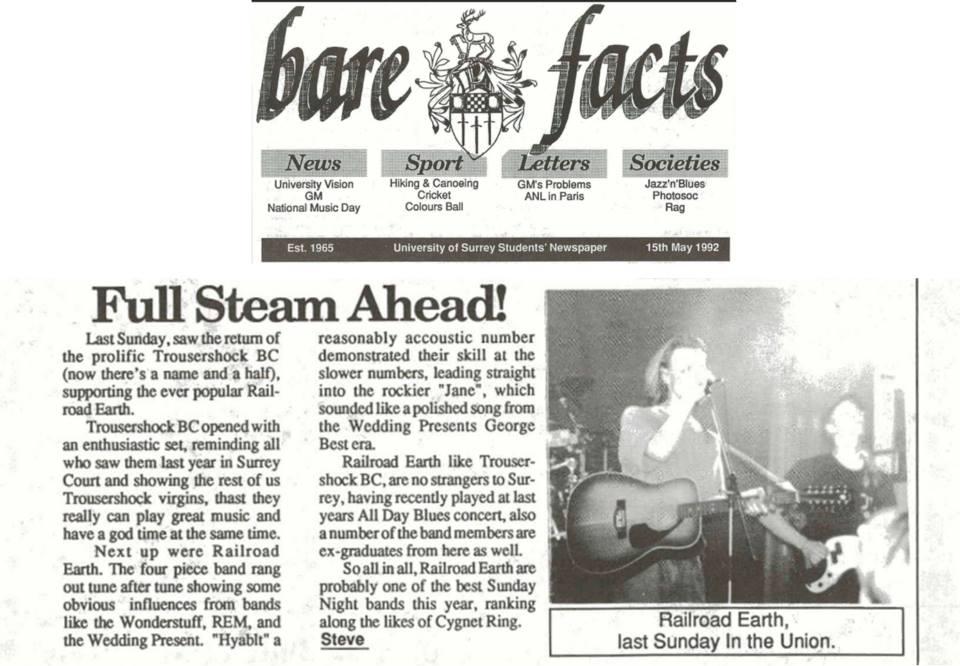
10 May ’92: rousershock BC supported Railroad Earth – Review from 15th May ’92 issue of Bare Facts. 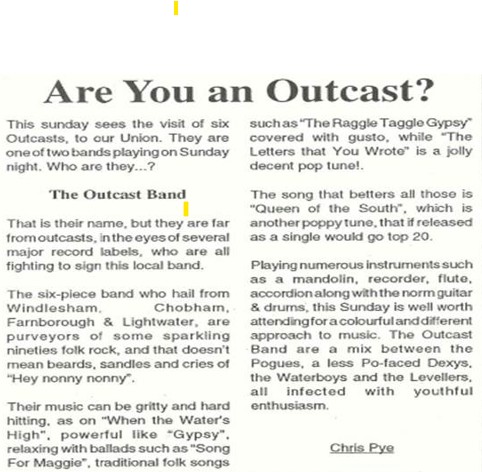
The Outcast Band to play University of Surrey on 31 January 1993. Source: Bare Facts 29 January 1993 issue 
19 June 1993: Redwood advert from early 1993 published in University of Surrey Student Union Barefacts zine. Source: The Surrey & NE Hampshire Music Scene 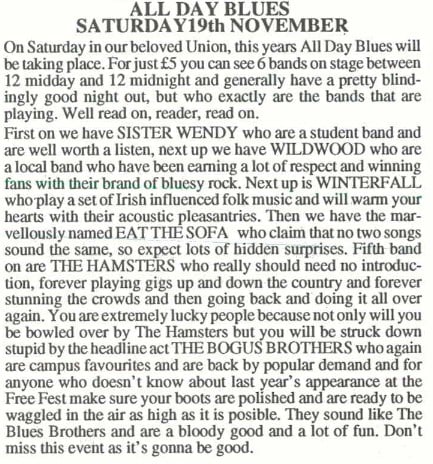
Bare Facts (Issue No.826, 18 Nov 1994) on the All Day Blues event held on 19 November 1994 featuring Sister Wendy, Wildwood, Winterfall, Eat The Sofa, The Hamsters and The Bogus Brothers.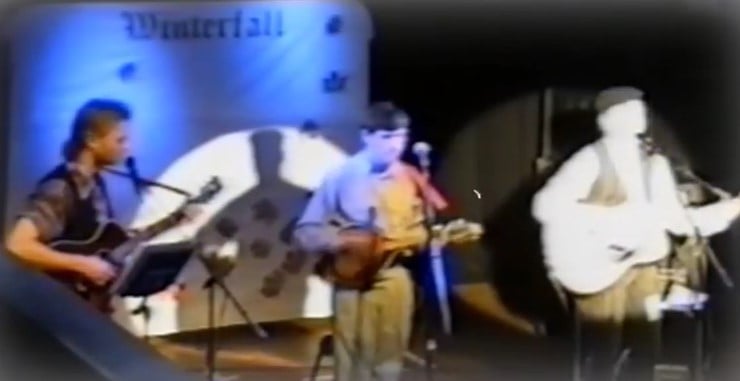
19 November 1994: Winterfall at the University of Surrey’s All Day Blues 
Semester One, 1996: Flyer front and back listing acts booked for Main Stage at University of Surrey Students’ Union. Source: The Surrey & NE Hampshire Music Scene Thank you to following for helping us to build a brand new University of Surrey post: Daren Thorpe, Fraser Donachie, Fred Pipes, Fruitier Than Thou, Rob Bamford
AC/DC, Ace, Actifed, Al Stewart, Alvin Lee, Alvin Stardust, Amazing Blondel, American Gypsy, Ample Cleavage, Ange, Angelwitch, Ash Ra Tempel, Asylum Sounds, Au Pairs, Average White Band, Back Street Crawler, Bad Manners, Badge, Baker Gurvitz Army, Barbara Dickson, Barefacts, Barnabus, Battersea College of Technology, Battersea Park, Bauhaus, BBC, Betrayed, Big Belief, Big Boy Tomato, Black Roots, Black Sabbath, Black Slate, Bliss, Blitz, Bouncing Czecks, Brand X, Brian Auger's Oblivion Express, Bridget St. John, Brighton, Bronco, Buddy & The Bloodsuckers, Bullseye, Byzantium, C.M.U., Cage, Camel, Capability Brown, Capital Letters, Captain Beefheart, Captain Sensible, Caravan, Carter The Unstoppable Sex Machine, Carter USM, Catfish, Cavern, Champion Jack Dupree, Charter Ball, Chicken Shack, Clancy, Clare Hammill, Classix Nouveau, Classix Nouveaux, Clint Eastwood, Clint Eastwood and General Saint, Coast Road Drive, Cocky, Colin Scot, Colosseum, Concord Bar, Cozy Powell's Hammer, Crab Feast, Creatures of Darkness, Crisis, Curved Air, Cutting Crew, D Fabulous, Danny Thompson, Danny Wilson, Dark Paradise, Dark Trio, Darts, Dave Walters Band, David Bowie, David Devant and his Spirit Wife, David Essex, David Tickle, Deep Purple, Deke Leonard, Deke Leonard's Iceberg, Delta 5, Dennis Potter, Dictators, Dr. Brown, Dr. Feelgood, Duster Bennett, East of Eden, Eat the Sofa, Ebling Mis, Eek-A-Mouse, Ellis, Energy Orchard, ENTS, Exhibit 'A', Export, Famous Names, Fantasy Lies, Flying Aces, Folk Club, Free Festival, Freedom Dance, Freshers Ball, Frogmorton, Fruupp, Function, Funtime for Phillip, Fusion Orchestra, G.T. Moore & The Reggae Guitars, Gary Glitter, Gary Moore, Gary Moore Band, Geisha Girls, General Saint, Genesis, Girlschool, Glider, Global Village Trucking Co., Glyder, Gong, Good Habit, Grail, Great Hall, Gryphon, Guildford, Guildford Borough Council, Guildford Catherdral, Guildford Free Festival, Guildford Sanitation Authority, Gypsie Fiddler, Gypsy, Haircut 100, Haircut One Hundred, Halloween Spectacular, Hanoi Rocks, Hardin & York, Harvey Andrews, Hatfield & The North, Hawkwind, Hazel O'Connor's Megahype, Headwaiter, Help Yourself, Henry Cow, High Tide, Holy Durex, Horse, House, Howard Riley, Hunter Muskett, Ian Paice, Iceberg, Imperfect Hold, Inspector Tuppence & the Sexy Firemen, Jasmine Pie, Jasper Carrott, Jazz Club, Jelly Bread, Jo Jo Namoza, Joe Public, John Lennon, John Martyn, John Mayall band, John Miles, John Otway, John Peel, John Peel Roadshow, John Sloman, John Stevens and Wizz Jones, Jona Lewie, Jonesy, Julian Lennon, Jumble, June Jitterbug, Just So Stories, Justin Ward, Karl Burns, Keith Christmas, Keith Spillet Ensemble, Kevin Coyne, La Maison Du Chants, Lecture Theatre D, Led Zeppelin, Lene Lovich, Lethal Dose, Level 42, Linda Lewis, Linda Thompson, Lindesfarne, Line Design, Liverpool Express, Lloyd Cole & The Commotions, Loaded Dice, Lol Coxhill, Lone Star, LongPig, Lost Property, Lower Bar, Magazine, Magic Band, Magma, Main Hall, Main Stage, Mama’s Boys, Man, Marble Orchard, March of the Slobs, Mark E. Smith, May Blitz, May Bug Ball, Mega City Four, Melody Maker, Mick Greenwood, Mickey Jupp, Midwest Flower, Mike Read, Miller Family, Milltown Bros, Milltown Brothers, Miquette Giraudy, Misty, Moonmouse, Motorhead, Mott The Hoople, Mungo Jerry, My LIfe Story, Namoza, Narnia, National Health, Neil Murray, New Riders of the Purple Sage, New Wave Society, Nick Cave, Nick Heyward, Nick Kershaw, Nine Below Zero, No Joy, Not The Free Fest, NUJ, Oliver’s Army, Onslow Village Trust, Osibisa, Pallas, Patto, Paul Brett, Paul Hanley, Pet Hate, Pete Drummond, Phil Manzanera, Phobia, Plinth, Plummet Airlines, Pop Will Eat Itself, Poppa Ben Hook, Press Any Key, Pretty Green, Prime Suspects, Procol Harum, Purple Banana, PWEI, Quiver, Rachel Sweet, Railroad Earth, Rare Bird, Rattlesnake, Record Mirror, Red Onions, Redwood, Richard & Linda Thompson, Richard Digance, Richard Thompson, Rock Goes to College, Roddy Radiation, Roy Harper, Roy Wood's Helicopter, Royal Charter Disco, Rumble Strips, Ruskin-Speare, Salad, Sammy Rats Big Big Blues Band, Sassafras, Scaffold, Secret Oyster, SENT, Serious Drinking, Shadow Planet, Sheep in Fog, Shoot! Dispute, Sister Wendy, Skids, Slade, Solstice, Something Happens, Sore Throat, Soundscene, Spencer Davis Group, Spliff Riff, Splodgenessabounds, Squeeze, Stackridge, Staff Bar, Stan Faulkner Sextet, Starry Eyed and Laughing, Steel Bill & the Buffalos, Stephane Grappelli, Steve Hackett, Steve Hillage, Steve Miller, Stoneground, Strapps, Stray, STress, Strider, String Driven Thing, Student Union, SubCircus, Surrey Court, Surrey Free Festival, Sutherland Brothers, Swegas, Swivel Corps, Swivelcorps, The Amazing Mr. Smith, The Ant Hill Mob, The Birthday Party, THe Bloomsbury Set, The Blow Monkeys, The Bogus Brothers, The Brains Trust, The Bureau, THe Charlies Parkas, The Christians, The Damned, The Diz Disley Trio, The Duster Bennett Band, The Egg, The Enid, The Europeans, The Fall, The Flowerpot Men, The Flys, The Glitter Band, The Ha Ha Men, The Hamsters, The Higsons, The House of Love, The Jazz Butchers, The John Mizarolli Band, The Larks, The Last Word, The Look, The Mighty Lemon Drops, The Mo-dettes, The Old Grey Whistle Test, The Outcast Band, The Paranoids, The Passions, The Piranhas, The Ramones, The Ruts, The Skids, The Sleep, The Smirks, The Soup Dragons, The Stage, The Stormsville Shakers, The Stranglers, The Tearjerkers, The Vapors, The Watt-roy Turner Band, The Werewolf, THe Who, The Wild Swans, Thin Lizzy, Tiger, Tim Hardin, Trees, Trespass, Trilogy, Trousershock BC, Tudor Lodge, U.K. Subs, UFO, Unicorn, University of Surrey, Uriah Heep, Van Der Graaf Generator, Vanishing Point, Vardis, Vent 414, Voodoo Child, Voyager, Warm Dust, Wattroy Turner, Westminster Trio, Whitesnake, Who Moved the Ground?, Wild Willy Barrrett, Wildwood, Winterfall, Wishbone Ash, WOB, Wreckless Eric, Writz, Yellow Darkness, Yes, Yoko Ono -
The Brew

(c’68-’71) – Andrew “Andy” Latimer (guitar), Andy Ward (drums), and Doug Ferguson (bass).
Out of the ashes of, mostly covers band, Strange Brew, which had been brothers Ian Latimer (bass) and Andrew Latimer (guitar/vocals), with Alan Butcher (drums) and Graham Cooper (guitar) came this three-piece Guildford blues band The Brew.Ian Latimer and Cooper had departed (Ian to get married) Strange Brew in the Summer of ’68, and an advert placed by Andy Latimer and Butcher in The Surrey Advertiser attracted bassist Ferguson. Ferguson auditioned on 13 November ’68 and reportedly “impressed…excellent gear…and his own roadie!”. Butcher, who was supporting his mother and sister, couldn’t afford to leave work and dedicate the time needed to The Brew and subsequently left. Ferguson then introduced his new band colleagues to drummer Ward. Ward, who had not seen his drum kit for 3 months and was only 14 at the time, left a mark on the band members, was recruited and joined the band on 15 January ’69.
As The Brew they recorded a demo of Robert Johnson’s “Crossroads” in a Cream’y mode. DJM Records showed interest and connected them with keyboardist / singer Phillip Goodhand-Tait. While not happy with how things panned out, The Brew auditioned to be Goodhand-Tait’s backing band on 20 Feb ’71. That year they played on his “I Think I’ll Write A Song” album, but it failed to take off and the trio were dropped by the label.
Front cover of Philip Goodhand-Tait “I Think I’ll Write A Song” which featured The Brew as his backing band. Undeterred, and recognizing the value of a keyboardist, an ad in Melody Maker in Sept ’71 found Peter Bardens, who had played with Shotgun Express, Them, The Peter B’s, Peter B’s Looners The Love Affair, The Cheynes, The Machine, Hamilton King’s Blues Messengers, The Village, and more, as well as releasing two solo LPs with Transatlantic Records. Bardens came with some prior commitments to a number of gigs in Ireland. As a result the new groups first gig together was in Belfast on 8 October ’71 as Peter Bardens On. Ultimately, after an agreed name change, this was to be the formation of Camel.
Butcher would later find a place in Poppa Ben Hook. Copper would be later found performing under the Graham “Cupcake” Cooper moniker, and some recall Eric Clapton joining him and other local musicians onstage at The Royal, Guildford for a charity gig in the rearly ’80s with Bruce Foxton of The Jam in the audience. Ward appeared in Marillion’s “Garden Party” video in ’83 and performed with them for a short while, and has worked in bands such as Caravan of Dreams, Going Going, Mirage, Chrysanthemums, and Bevis Frond. Bardens had joined Van Morrison’s band in ’78 and kept busy with various projects over the years, including Mirage with Ward and Latimer. He departed this world on 22 January 2002 as a result of lung cancer.
In 2003 The Brew held a studio jam reunion. This was recorded and posted to Facebook. The recorded material was originally for an album, but this never got pressed.
Gallery:

The Brew: Andrew Latimer (guitar), Andy Ward (drums) and Doug Ferguson (bass). 
Back cover of Philip Goodhand-Tait “I Think I’ll Write A Song” listing the members of The Brew. Alan Butcher, Andrew Latimer, Andy Ward, Belfast, Bevis Frond, Bruce Foxton, Caravan of Dreams, Chrysanthemums, Cream, DJM Records, Doug Ferguson, Eric Clapton, Going Going, Graham Cooper, Guildford, Hamilton King’s Blues Messengers, Marillion, Melody Maker, Mirage, Peter B’s Looners The Love Affair, Peter Bardens, Peter Bardens On, Philip Goodhand-Tate, Poppa Ben Hook, Robert Johnson, Shotgun Express, Strange Brew, The Brew, The Cheynes, The Jam, The Machine, The Peter B’s, The Royal, The Surrey Advertiser, The Village, Them, Transatlantic Records, Van Morrison


Human beings takes me back to 1981. Followed them all over the Surrey reading area for a year a great band and 3 good guys playing well written songs of the era. I wish john Tim and steve well what ever they are doing now. Should reform for a few shows just like Oasis but do the wooden bridge.
LikeLiked by 1 person