

(c’67-’97) Peter Gabriel (vocals / flute), Mike Rutherford (guitar / bass), Tony Banks (keyboards), Chris Stewart (drums), and Anthony Phillips (guitar).

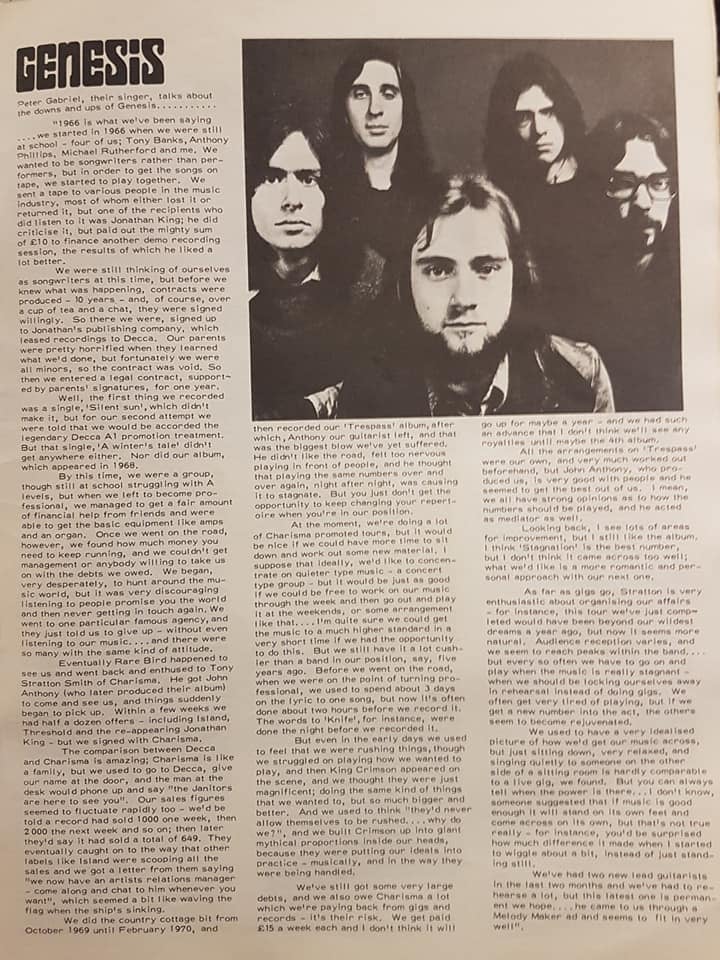
Formed at Charterhouse School, Godalming in January ’67, the band were named Genesis by former Charterhouse pupil Jonathan King. Prior to Genesis, Rutherford had been in The Anon with Richard Macphail (vocals), Rivers Job (bass), Rob Tyrrell (drums), and Phillips, who’d also been in The Garden Wall with Gabriel, Stewart and Banks. When these two earlier bands had split, Rutherford and Phillips continued to write and jam together.
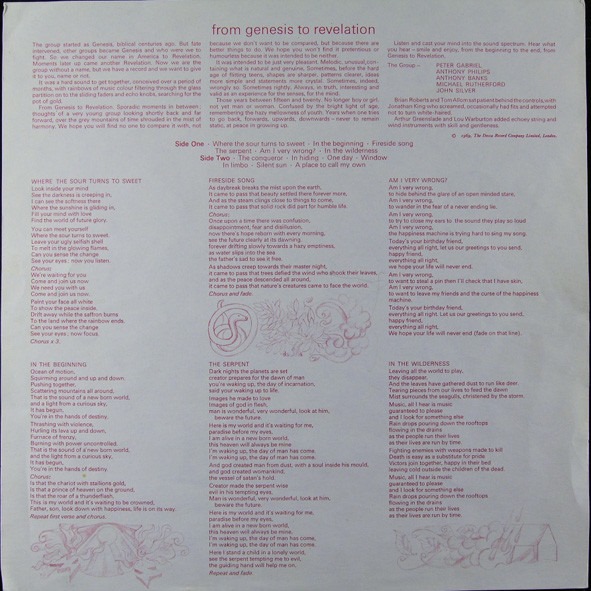
It was in January ’67 that Rutherford and Phillips invited Banks, Gabriel, and Stewart to join them at a friend’s home studio to record “Don’t Want You Back”, “Try a Little Sadness”, “She’s Beautiful”, “That’s Me”, “Listen on Five”, and “Patricia”. These were great as rough demos, but they sought out ex-pupil King – following his success with “Everyone’s Gone to the Moon” in ’65 – to arrange for and produce the professional recording of the band’s first singles and “Genesis to Revelation” their debut album in ’68; this was after King had got this bunch of 15- to 17-year-olds a one-year contract with Decca Records.
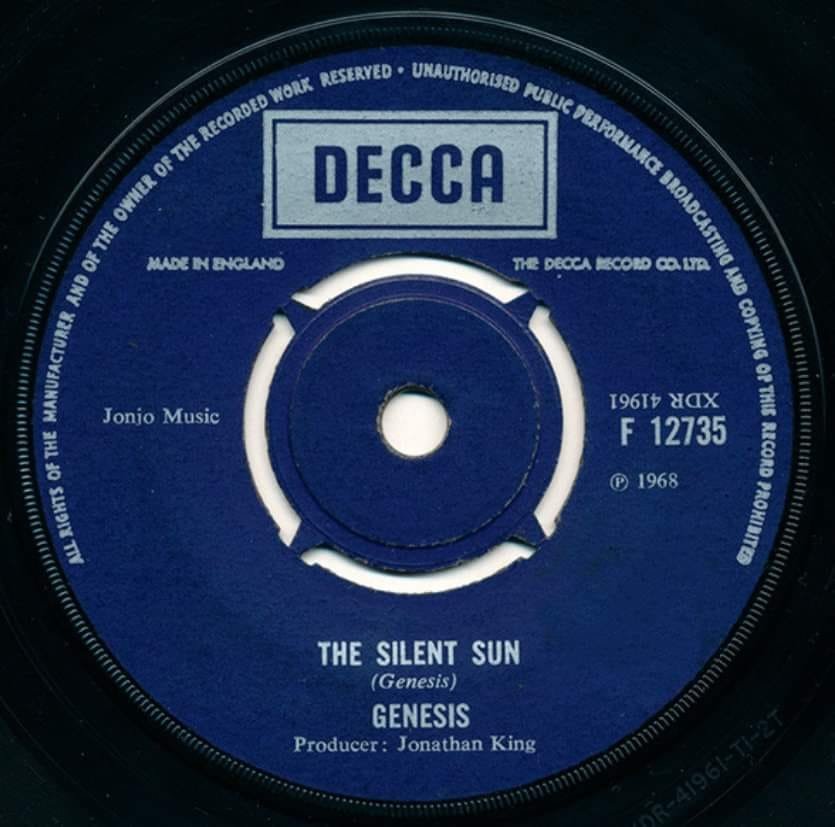
“The Silent Sun”, a Banks / Gabriel penned Bee Gees pastiche, backed by “That’s Me” was released in February ’68, securing some airtime on BBC Radio One and Radio Caroline, but no sales. Their second single, released in May ’68, “A Winter’s Tale / One-Eyed Hound” faired a similar fate. This first incarnation lasted until Mid ’68 when Stewart left to continue his studies. He was replaced by fellow Charterhouse pupil John Silver.
Their debut album, “Genesis to Revelation”, was produced at Regent Sound Studios, London over 10 days in the school’s summer holiday, with orchestral arrangements by Arthur Greenslade added in production by King without their knowledge. The album cover, when it was released in March ’69, did not include the band’s name to appease Decca – who’d discovered a US band of the same name and was often found in the religious section – ultimately it was a failure, selling only 650 copies in the first year. There was little activity after the album release: Phillips and Gabriel finished their exams at Charterhouse; Rutherford went to Farnborough College of Technology, while Banks went to Sussex University. The bands third single “Where the Sour Turns to Sweet / In Hiding” was also not successful on its release in March ’69. They got together at the end of the school year to decide their future.
Phillips. Rutherford, Banks and Gabriel decided to pursue a music career. They entered Regent Sound in August ’69 with Silver and laid down “Family”, “White Mountain”, “Going Out to Get You” and “Pacidy”. The lack of prior success led to a split from Decca and King, who retained the rights to the debut album, but their new demo tape was rejected by every record company that received it. Silver, having been with the group for just over a year, left to study in America with John Mayhew joining on drums in September ’69. Genesis took up residency in a cottage, belonging to ex-Anon member Macphail’s parents, in Wotton to write and rehearse, reportedly playing together for up to 11 hours every day.

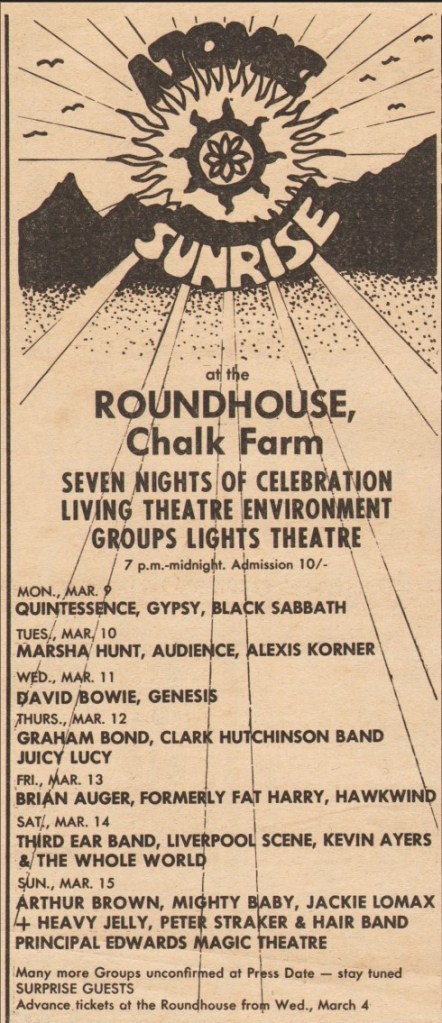
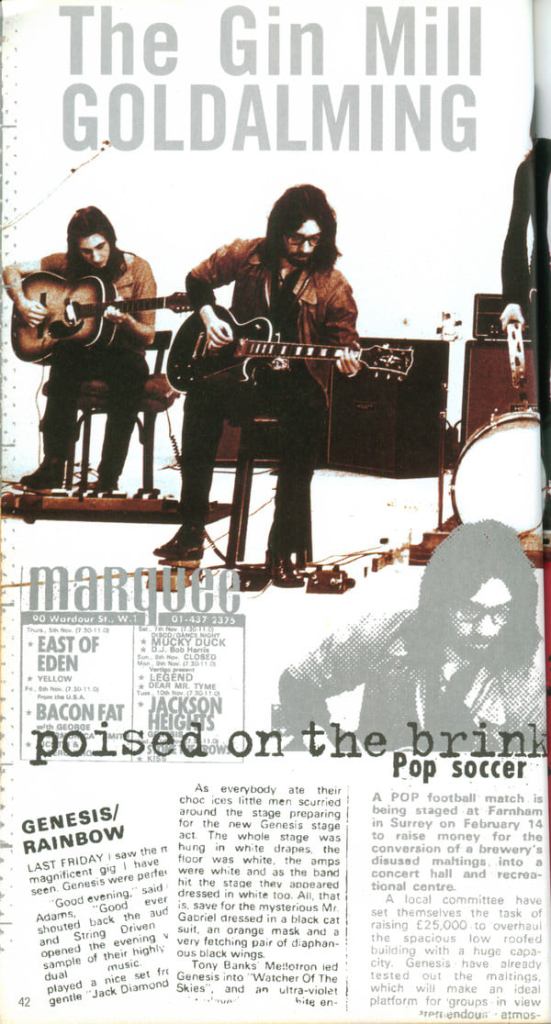
Their first live gig was in September ’69 at a teenager’s birthday. This is when things started to pick up, and Macphail became the bands tour manager from ’69 through ’73. Macphail drove them around in an old Hovis delivery van to regular spots at the Gin Mill Club, Goldalming, a support slot with Rare Bird for Tyrannosaurus Rex at Brighton Done on 18 February ’70, an appearance on BBC’s Night Ride on 22 February ’70, and the Atomic Sunrise Festival on 11 March ’70 – to an audience of less than 20, supporting David Bowie, at the The Roundhouse, London – preceding a six-week Tuesday night residency at Ronnie Scott’s Jazz Club in Soho. At the recommendation of Rare Bird, A&R man John Anthony of Charisma Records came to see them, then convinced Tony Stratton-Smith to watch them the following week.
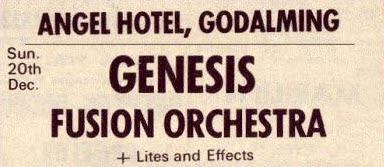
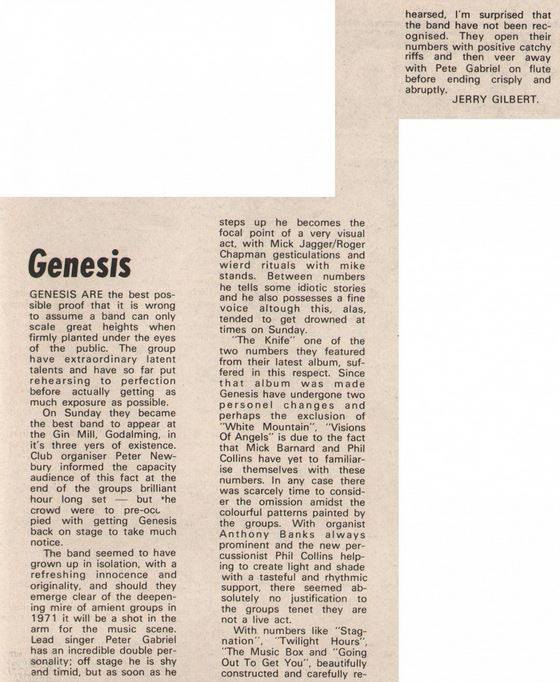
An early Genesis gig at the Gin Mill, one of their first, was witnessed by a 14 year old Bill Leabody, who went on to be Production Manager for the likes of Peter Gabriel and Coldplay, who was also the ex-tech for The Edge. Pete Newberry, the brains behind Gin Mill, was good friends with Stratton-Smith which helped him secure Genesis for the venue; although Newberry knew Genesis when they were still at Charterhouse as they used to hang around at the Record Corner, Godalming. Eventually, Genesis rehearsed their music at The Gin Mill in June and July 1970, and their 20 December ’70 gig, supported by Fusion Orchestra, at the Gin Mill got a rave review in Sounds; “the best new band to appear here in its three years of existence” said club organizer, Newberry.
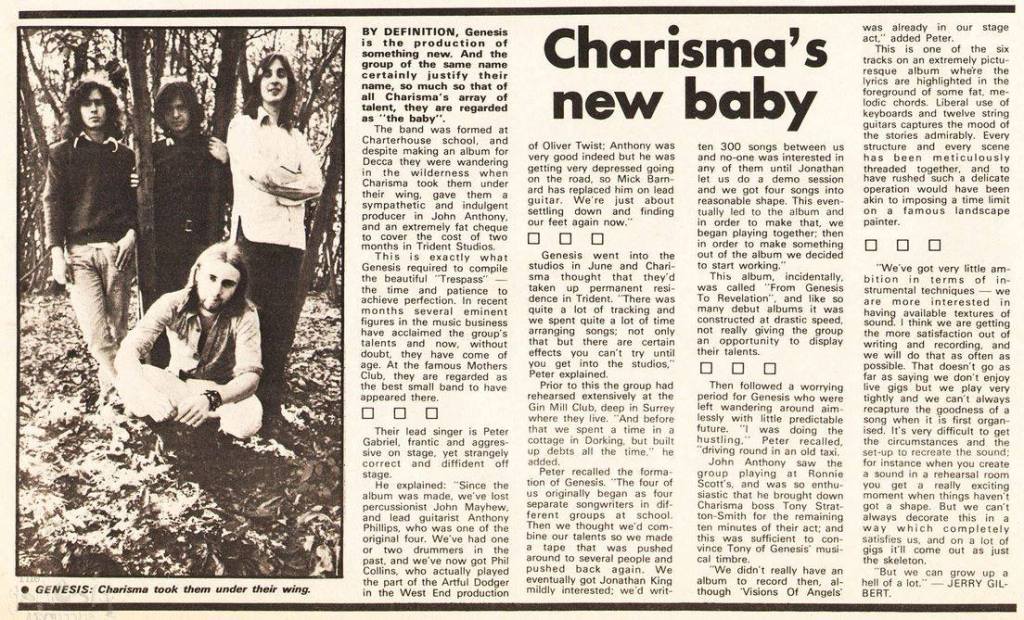
Stratton-Smith signed them to Charisma on a record and management deal, paying Genesis an initial sum of £10 a week. Genesis was initially set to open for The Who at Eliot College Dining Room, University of Kent, Canterbury on 8 May ’70, but The Who rescheduled to 16 May, when Genesis performed at the University of Surrey, Guildford, returning on 27 June to perform at the first Surrey Free Festival at the university along with Patto, May Blitz, Horse, Bridget St. John, CMU, Poppa Ben Hook, and Plinth. They stayed at the cottage in Wooton during this time, before recording the album “Trespass” at Trident Studios, London with Anthony as producer. By August 1970, Phillips had gone solo and Mike Bernard (guitar) had joined as well as Phil Collins (drums), who’d come over from Flaming Youth to replace Mayhew. Quiet Worlds guitarist Steve Hackett replaced Bernard in December 1970 and welcomed in the bands most progressive period.
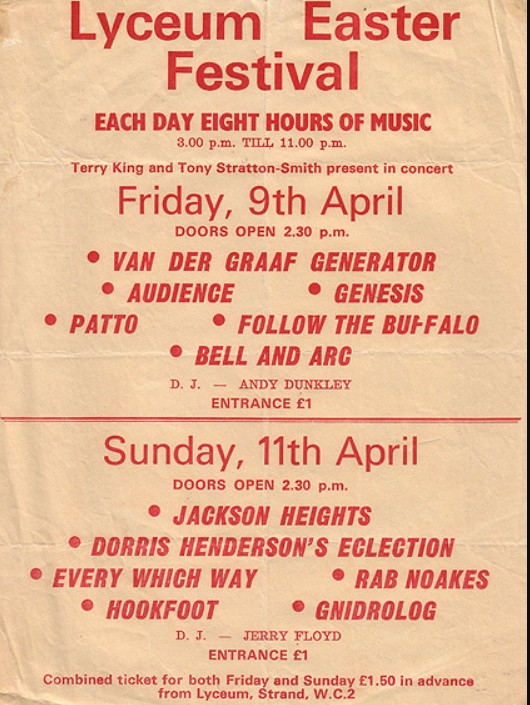
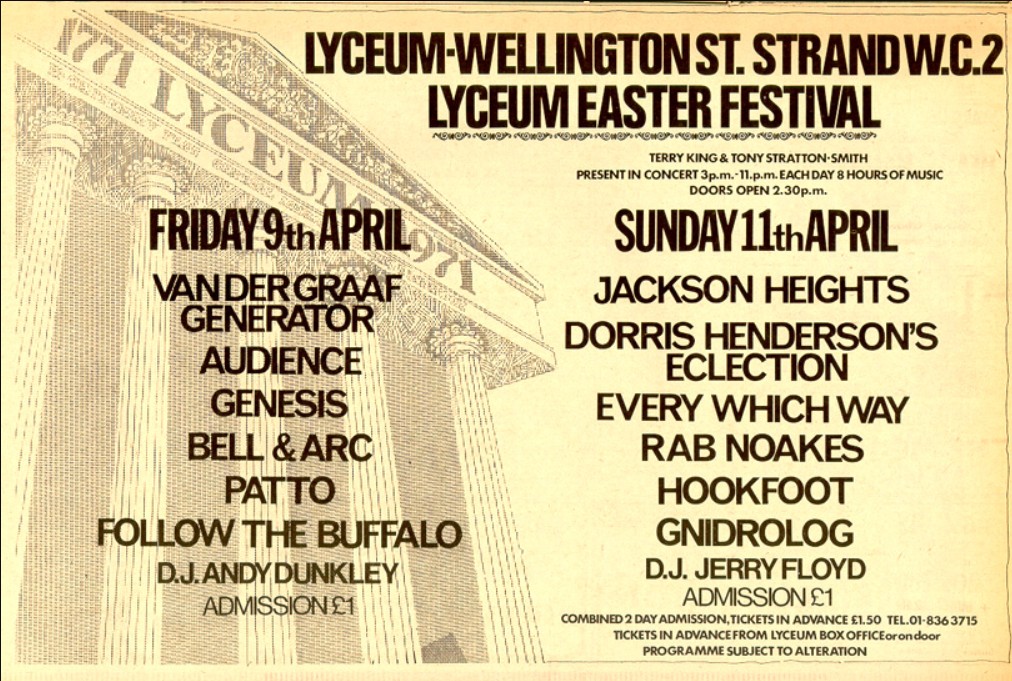
The support slots continued, including the Easter Festival at The Lyceum, London on 9 April ’71 with Van der Graaf Generator, Audience, Patto, Follow the Buffalo, and Bell & Arc. Six days later, on 15 April ’71, there was an appearance at the Civic Hall, Guildford supporting Van Der Graaf Generator again, along with Lindisfarne, and Graham Bell & Arc. “Nursery Crymes” – it is reported that, around September ’70, Rutherford’s father helped Genesis, with the newly recruited Collins, to rent The Maltings, Farnham where they rehearsed for six weeks and wrote what was to become their album “Nursery Crymes” – was released in November ’71, but the band had not cracked the UK yet, garnering more interest in mainland Europe.
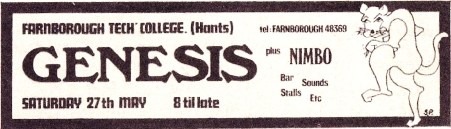
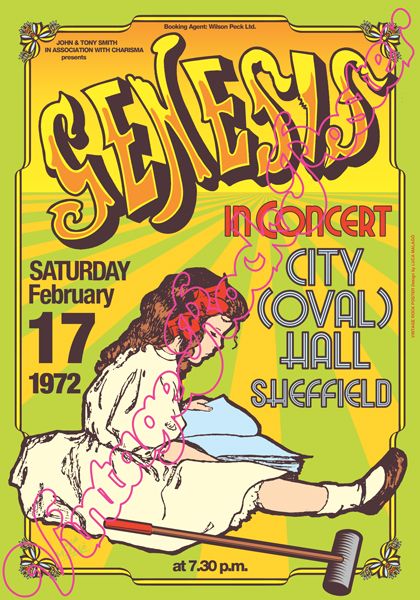
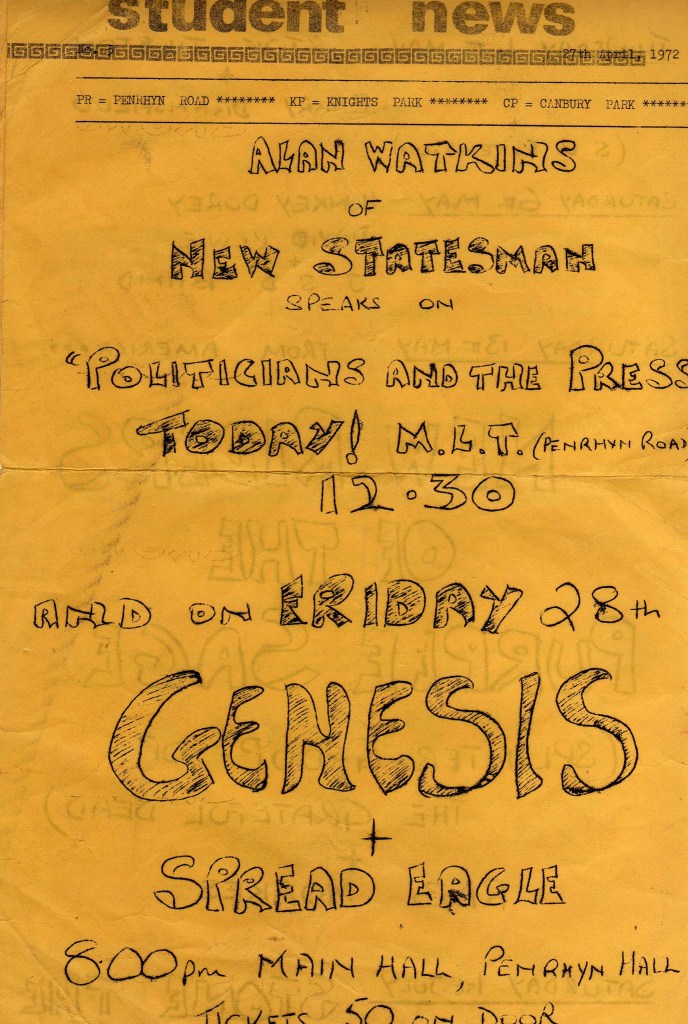
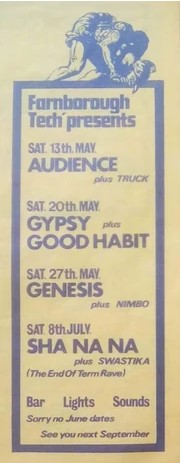
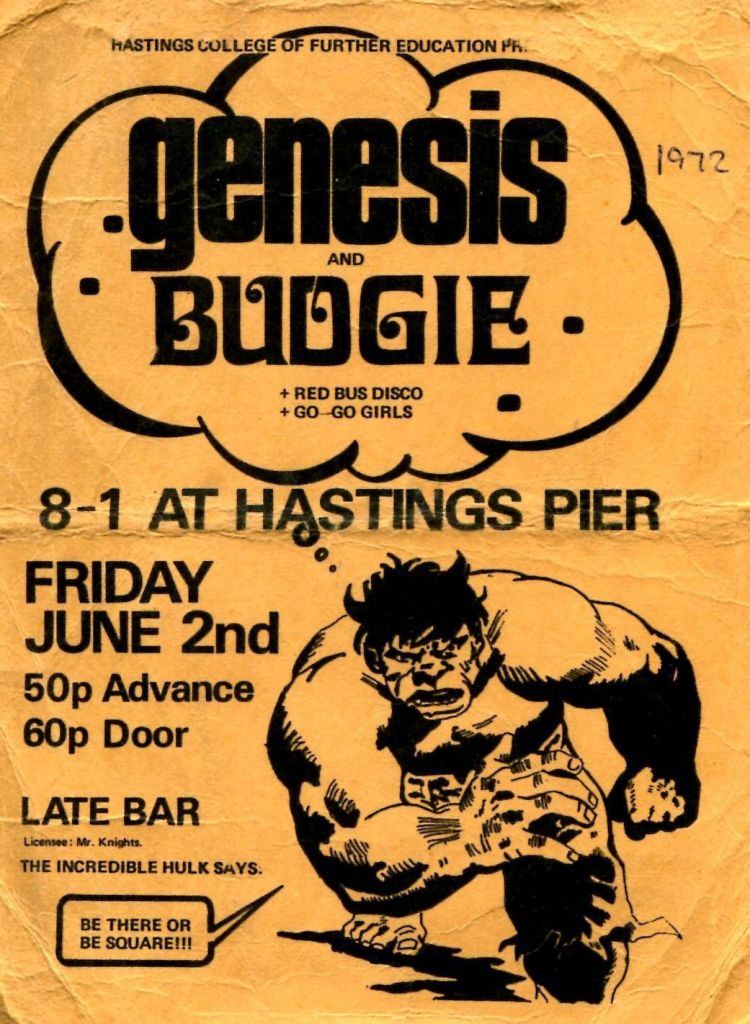
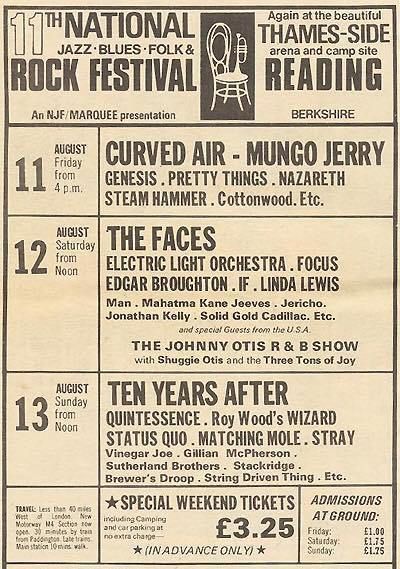
On 17 February ’72 Genesis played the City Hall, Sheffield and a week later, on 25 February ’72, they supported Moot the Hoople at the Locarno, Sunderland, then headed south to the Bracknell Sports Centre to support, along with Morgan, Arthur Brown’s Kingdom Come the next night. Then on 28 April ’72 the band performed at Kingston Polytechnic, with Spread Eagle in support. A month later the ex-student, Mike Rutherford’s band headlined, supported by power pop from Nimbo at Farnborough Tech on 27 May ’72 – Genesis had actually played the venue on two earlier occasions as support to the supporting band on the first, then as the support the following time (details to be uncovered). The Entertainment Committee at Hasting College of Further Education booked Genesis to headline at Hastings Pier on 2 June ’72, supported by Budgie. ’72 also saw the band on the roster for Day 1 of the Reading Festival, on 11 August. Later that year “Foxtrot” entered the UK charts, followed in ’73 by “Selling England by the Pound” and the band’s first UK Top 30 single: “I Know What I Like (In Your Wardrobe)”.

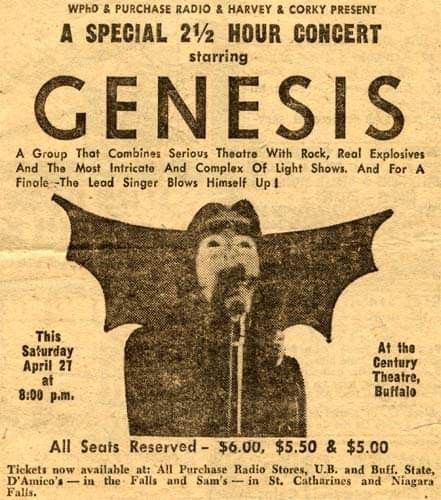
On 27 April ’74 the band performed at the Century Theatre, Buffalo at which it was promoted that “for the finale – The lead singer blows himself up!”. The band ‘retired’ to Headley Grange in ’74 to work on their next LP; and later that year “The Lamb Lies Down on Broadway” was released; but at the end of the transatlantic tour, that promoted the album, in August ’75, Gabriel left. Collins took over the lead vocalist role. “A Trick of the Tail” and “Wind & Wuthering” were released in 1976 followed by Hackett’s departure. The band was now just Banks, Rutherford, and Collins and this line-up’s first album was titled “…And Then There Were Three…”, which was released in ’78. This carried “Follow Me, Follow You” their first UK top ten and US top 30 single. Their success grew as the albums “Duke” (1980), “Abacab” (1981), “Genesis” (1983), and “Invisible Touch” (1986) were released.
Collins left Genesis in ’96. Stiltskin’s Ray Wilson joined for “Calling All Stations” in ’97, but lacklustre US sales led to a hiatus. Banks, Rutherford and Collins reunited for the ‘Turn It on Again’ tour in 2007. Genesis have not been active since that tour, but Banks, Rutherford and Collins; along with Gabriel and Hackett, did participate in interviews for the 2014 BBC documentary “Genesis: Together and Apart”.
Silver became a TV Producer. Cobham born Gabriel, a leaving the band in 1975, launched a solo career with the single “Solsbury Hill” as his opening volley. Banks also pursued a solo career with rock and classical release and film scores to his name. Phillips released “The Geese & the Ghost”, his first solo album in ’77; he also wrote and recorded with Andrew Latimer for Camel to help fulfill contractual obligations for Decca and continues to produce LPs, and TV and film scores. Rutherford is the one of only two continuous band members, along with Banks. Rutherford also released a couple of solo albums in the ’80s and in ’85 he formed Mike and the Mechanics. Stewart went travelling through Europe, working as he went and eventually settled on a Andalucian farm, which he works and became an author. Mayhew left this world on 26 March 2009 after moving to Australia in ’82 and working as a carpenter until his death in Glasgow, Scotland.
Gallery:





 Our Soundscene